
No products in the basket.



4G Routers, Teltonika, Teltonika 4G Routers
Teltonika RUT986 Global 4G Router
The Teltonika RUT986 is a global 4G LTE Cat 4 industrial router with RS232, RS485, GNSS, comprehensive I/O, and Micro SD storage, built for SCADA, energy, utilities, and industrial IoT deployments requiring serial connectivity alongside cellular. Powered by a Telit modem covering 18 LTE bands worldwide, it replaces regional hardware variants with a single globally-certified unit.
Key Features:
• Global 4G LTE Cat 4 via Telit modem – 150 Mbps down / 50 Mbps up, 3G/2G fallback
• 18 LTE bands: B1, B2, B3, B4, B5, B7, B8, B9, B12, B13, B14, B18, B19, B20, B25, B26, B28
• Dual physical SIM (Mini SIM 2FF) plus eSIM with Bootstrap provisioning (up to 7 eSIM profiles)
• RS232 (DB9) and RS485 full/half duplex serial ports, 300-115200 baud
• GNSS receiver: GPS, GLONASS, BeiDou, Galileo, QZSS – geofencing, NMEA, NTRIP client
• 4 digital/analog inputs and 3 outputs including SPST relay (40V, 4A) and analog 4-20 mA input
• 1x USB-A port, Micro SD slot (up to 2 TB) for local data logging
• Industrial protocols: Modbus, DNP3, OPC UA, BACnet, DLMS/COSEM
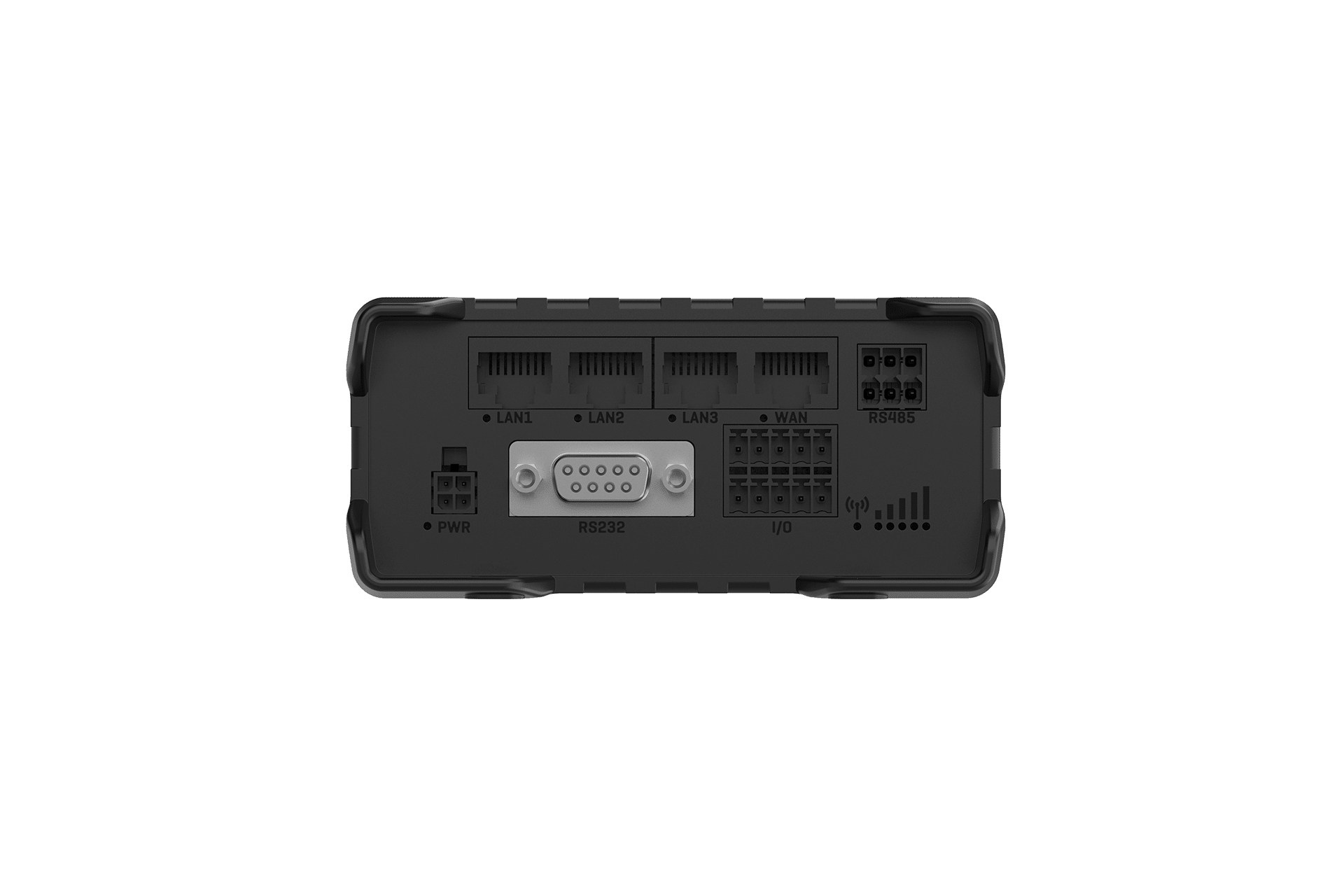
• 4x RJ45 (1x WAN, 3x LAN), 10/100 Mbps, passive PoE input via LAN1
• RutOS with VPN suite (OpenVPN, WireGuard, IPsec), VRF, RMS remote management
• -40 to +65 degrees C, IP30, aluminium enclosure, 110 x 50 x 100 mm, 294 g
£185.00 Excl VAT
Teltonika RUT986 – Industrial Global 4G Router with Serial and GNSS
The Teltonika RUT986 is a global 4G LTE Cat 4 industrial router built for SCADA, energy, utilities, building automation, and any deployment that requires serial connectivity alongside cellular. It combines a Telit modem covering 18 LTE bands worldwide with RS232 and RS485 serial ports, a multi-constellation GNSS receiver, comprehensive digital and analog I/O, Micro SD local storage, and the full suite of industrial communication protocols including Modbus, DNP3, OPC UA, and BACnet. For teams moving from the RUT956, the RUT986 is the direct global replacement – same 110 x 50 x 100 mm footprint, same DIN rail mounting, same cabling, with the addition of global bands and eSIM.
The RUT986 replaces regional hardware variants with a single globally-certified unit. The Telit modem covers Band 20 and Band 8 for UK and European networks, Bands 2, 4, 12, 13, and 25 for US carriers, Band 14 for FirstNet, and Band 28 for APT 700 deployments across Asia-Pacific. Dual physical SIM slots plus an integrated eSIM with Bootstrap provisioning support up to 7 eSIM profiles – useful for deployments across multiple carrier territories managed through Teltonika RMS.
Key Features
- Global 4G LTE Cat 4 via Telit modem – 150 Mbps download / 50 Mbps upload, with 3G and 2G fallback
- 18 LTE bands: B1, B2, B3, B4, B5, B7, B8, B9, B12, B13, B14, B18, B19, B20, B25, B26, B28 – covers UK/EU, US, FirstNet, APT 700 with a single SKU
- Dual physical SIM (Mini SIM 2FF) plus eSIM with Bootstrap provisioning – supports up to 7 eSIM profiles, auto-failover across SIM 1, SIM 2, and eSIM
- RS232 (DB9, RTS/CTS flow control) and RS485 full duplex and half duplex, 300-115200 baud – serial functions include Serial over IP, Modbus gateway, NTRIP client
- GNSS: GPS, GLONASS, BeiDou, Galileo, and QZSS – geofencing, NMEA 0183, NTRIP, TAVL and RMS server support
- 4 inputs: digital dry (0-3V), digital galvanically isolated (0-30V), analog 0-24V with 4-20 mA capability, digital non-isolated on power connector
- 3 outputs: digital open collector (30V, 250mA), SPST relay (40V, 4A), digital open collector on power connector
- USB-A port for external storage or additional modem; Micro SD slot up to 2 TB for local data logging
- Industrial protocols: Modbus TCP/RTU, DNP3, OPC UA (client and server), BACnet (MS/TP to IP), DLMS/COSEM for smart metering
- 4x RJ45 10/100 Mbps Ethernet, passive PoE input via LAN1, VRF support for SCADA traffic segmentation
- RutOS with OpenVPN, WireGuard, IPsec, full routing suite, Teltonika RMS compatible
- -40 to +65 degrees C, IP30, aluminium enclosure, CE, UKCA, FCC, ISED certified, 2-year warranty
What Is the RUT986 Used For?
Solar and Battery Energy Storage (BESS) Monitoring
Solar inverters, battery management systems, and energy meters commonly communicate over RS485 Modbus RTU. The RUT986 bridges this to Modbus TCP over cellular, forwarding real-time generation and state-of-charge data to a SCADA platform. The GNSS receiver provides precise time synchronisation for power quality logging, and Micro SD storage retains data locally if the cellular link drops.
EV Charging Infrastructure
EV charge point controllers typically use OCPP over Ethernet or RS232 for back-end connectivity. The RUT986 provides the cellular uplink with dual-SIM failover to keep payment processing and load management active. The digital relay output can signal charger status or fault conditions to a local alarm system, and GNSS enables asset tracking for mobile charging deployments.
Water and Wastewater Treatment
Water treatment sites use DNP3 and Modbus for PLC and RTU communications. The RUT986 supports both protocols natively, with galvanically isolated digital inputs for pump status and flow meter signals, and relay outputs for remote valve actuation. VRF in RutOS keeps SCADA traffic separate from management traffic on the same device.
Building Management Systems
BACnet MS/TP runs over RS485 in most commercial HVAC and building automation systems. The RUT986 operates as a BACnet router, bridging MS/TP devices on the RS485 port to BACnet/IP over the cellular WAN. This allows central BMS platforms to reach distributed building controllers over 4G without additional protocol conversion hardware on site.
Smart Metering and Utility AMR/AMI
DLMS/COSEM is the dominant smart meter communications protocol in European utility deployments. The RUT986 supports DLMS/COSEM client operation over RS232, RS485, and TCP, making it a direct fit for advanced metering infrastructure and automated meter reading applications. The analog 4-20 mA input handles pulse output meters that do not have a serial interface.
Remote Substation and SCADA Telemetry
Remote substations and field-mounted RTUs require reliable cellular backhaul with deterministic serial connectivity. The RUT986 provides both, with DNP3 support for standard SCADA protocols, dual-SIM failover, VPN tunnelling for secure communications, and the -40 to +65 degrees C operating range for unheated outdoor cabinets and kiosks.
Frequently Asked Questions
What serial interfaces does the RUT986 have?
The RUT986 has one RS232 port (DB9 socket with RTS/CTS flow control) and one RS485 port (6-pin industrial socket, full duplex 4-wire and half duplex 2-wire, 300-115200 baud). Serial functions available in RutOS include Console, Serial over IP, Modem emulation, Modbus gateway, and NTRIP client. There is also a USB-A port that accepts a USB-to-serial adapter if an additional serial connection is needed.
Does the RUT986 support DNP3 and OPC UA?
Yes. RutOS on the RUT986 includes DNP3 support for SCADA and utility applications, OPC UA client and server for Industry 4.0 interoperability, BACnet for building automation (bridging MS/TP over RS485 to BACnet/IP), and DLMS/COSEM for smart metering deployments. Modbus TCP and RTU are also supported as standard.
What is the GNSS capability on the RUT986?
The RUT986 includes a full multi-constellation GNSS receiver supporting GPS, GLONASS, BeiDou, Galileo, and QZSS. Coordinates are accessible via WebUI, SMS, TAVL, and RMS. The device supports NMEA 0183 output, NTRIP for differential correction, and configurable multi-zone geofencing. QZSS support improves positioning accuracy in Asia-Pacific deployments.
What is Teltonika RMS and does the RUT986 support it?
Teltonika RMS is a cloud platform for remote monitoring, configuration, and firmware management of Teltonika devices. The RUT986 is fully compatible. RMS also supports remote eSIM profile management, allowing carrier profiles to be pushed to the integrated eSIM without on-site access. Read our Teltonika RMS explainer for a full overview.
Does the RUT986 support eSIM and how does the Bootstrap profile work?
Yes – the RUT986 includes an integrated eSIM supporting up to 7 stored profiles. The eSIM comes pre-loaded with a 10 MB Bootstrap profile that provides limited connectivity for downloading a full operator profile on first setup, without needing a physical SIM present. This enables zero-touch deployment at scale. Read our eSIM router explainer for more on how eSIM works in practice.
What SIM card do I need for the RUT986?
For SCADA, remote monitoring, and VPN applications, a fixed IP SIM is the standard choice – it gives your router a consistent public IP address so you can establish inbound VPN tunnels or remote access sessions. For multi-site or international deployments, a roaming SIM covers multiple networks and countries from a single contract. We supply both alongside the RUT986 and can advise on the right option for your application.
Related Products and Further Reading
The RUT986 sits at the top of the Teltonika 4G router range for deployments requiring serial interfaces and industrial protocols. For branch office and commercial applications where Wi-Fi client capacity matters more than serial ports, the Teltonika RUT981 is the appropriate alternative. Most RUT986 installations in outdoor cabinets require a properly matched external antenna rather than the bundled magnetic-mount units – browse our 4G antenna range for panel, omni, and specialist options suited to utility enclosures. Pair with a fixed IP IoT SIM for VPN-based SCADA connectivity, or a roaming SIM for multi-country deployments. For guidance on securing the cellular link, see our VPN on cellular routers explainer.
| Cellular Connectivity | |
| Modem | Telit, LTE Cat 4 |
| Standards | 4G LTE, 3G UMTS/HSPA+, 2G GSM/GPRS/EDGE |
| 4G LTE Download / Upload | 150 Mbps / 50 Mbps |
| 3G Download / Upload | 42 Mbps / 5.76 Mbps |
| 2G Download / Upload | 236.8 Kbps / 236.8 Kbps |
| 3GPP Release | Release 10 |
| 4G LTE Bands (18) | B1, B2, B3, B4, B5, B7, B8, B9, B12, B13, B14, B18, B19, B20, B25, B26, B28 |
| 3G UMTS Bands | See datasheet |
| 2G GSM Bands | 850 / 900 / 1800 / 1900 MHz |
| SIM | 2x Mini SIM (2FF), 1.8 V / 3 V, external SIM holders |
| eSIM | Integrated eSIM with Bootstrap provisioning profile. Supports up to 7 stored eSIM profiles |
| SIM Failover | Automatic failover across SIM 1, SIM 2, and eSIM. Switch triggers: weak signal, data limit, SMS limit, roaming, no network, network denied, data connection fail, SIM idle protection |
| WAN Management | WAN failover, load balancing, MultiWAN |
| Wi-Fi | |
| Standards | IEEE 802.11b/g/n (Wi-Fi 4) |
| Frequency | 2.4 GHz |
| Modes | Access Point (AP), Station (STA) |
| Maximum Clients | Up to 100 simultaneous connections |
| Security | WPA2-PSK, WPA2-Enterprise (PEAP, EAP-TLS), WPA3-SAE, WPA3-EAP, OWE; AES-CCMP, TKIP; 802.11w Protected Management Frames |
| Advanced Wi-Fi | Wireless mesh (802.11s), fast roaming (802.11r), BSS transition management (802.11v), radio resource measurement (802.11k), Hotspot 2.0 |
| Antenna Connectors | 2x RP-SMA (female) |
| Ethernet | |
| WAN Port | 1x RJ45, 10/100 Mbps, IEEE 802.3 / 802.3u / 802.3az, auto MDI/MDIX |
| LAN Ports | 3x RJ45, 10/100 Mbps, IEEE 802.3 / 802.3u, auto MDI/MDIX |
| PoE Input | Passive PoE via LAN1, Mode B, 9-30 VDC. Not compatible with IEEE 802.3af/at/bt |
| Processor and Memory | |
| CPU | MediaTek MIPS 24KEc, 580 MHz |
| RAM | 128 MB DDR2 |
| Flash Storage | 32 MB NOR Flash |
| SD Card | Micro SD (internal), up to 2 TB. FAT32, NTFS, ext2/3/4. Applications: Samba share, storage expansion, DLNA, data logging |
| Software and Operating System | |
| OS | RutOS (based on OpenWrt) |
| Routing | Static routing, dynamic routing (BGP, OSPF v2, RIP v1/v2, EIGRP, NHRP), policy-based routing, VRF (virtual routing and forwarding) |
| VPN | OpenVPN, WireGuard, IPsec/IKEv2, L2TP, PPTP, SSTP, GRE, ZeroTier |
| Industrial Protocols | Modbus TCP/RTU (gateway), DNP3, OPC UA (client and server), BACnet (MS/TP to BACnet/IP bridging), DLMS/COSEM (client over RS232, RS485, TCP), MQTT, NMEA 0183, NTRIP |
| Network Protocols | TCP, UDP, IPv4, IPv6, ICMP, NTP, DNS, HTTP, HTTPS, SFTP, FTP, SMTP, SSL/TLS, ARP, VRRP, PPP, PPPoE, UPNP, SSH, DHCP, Telnet, SMPP, SNMP, MQTT, WOL, VXLAN |
| Firewall | Port forward, traffic rules, custom rules, TTL target customisation, port management |
| DHCP | Static and dynamic IP allocation, DHCP relay, DHCP server, static leases |
| DNS | DNS over HTTPS proxy, DDNS (77+ providers) |
| QoS | Traffic priority queuing by source/destination, service, protocol or port; WMM, 802.11e, Smart Queue Management (SQM) |
| Connection Monitoring | Ping Reboot, Wget Reboot, Periodic Reboot, LCP and ICMP link inspection |
| Remote Management | Teltonika RMS compatible (includes remote eSIM profile management) |
| Location / GNSS | |
| Constellations | GPS, GLONASS, BeiDou, Galileo, QZSS |
| Coordinates | Available via WebUI, SMS, TAVL, RMS |
| Standards | NMEA 0183 |
| Differential Correction | NTRIP client (Networked Transport of RTCM via Internet Protocol) |
| Server Software | TAVL, RMS |
| Geofencing | Configurable multiple geofence zones |
| GNSS Antenna Connector | 1x SMA (female) |
| Serial Interfaces | |
| RS232 | DB9 socket, RS232 with RTS/CTS flow control |
| RS485 | 6-pin industrial socket. Full duplex (4 wires) and half duplex (2 wires). 300-115200 baud rate |
| Serial Functions | Console, Serial over IP, Modem, Modbus gateway, NTRIP client |
| USB | 1x USB-A, USB 2.0. Applications: Samba share, USB-to-serial. Supports HDD, flash drive, additional modem, printer. Formats: FAT, FAT32, exFAT, NTFS (read-only), ext2/3/4 |
| Interfaces | |
| Ethernet | 4x RJ45 (1x WAN, 3x LAN), 10/100 Mbps |
| Cellular Antenna | 2x SMA (female) |
| Wi-Fi Antenna | 2x RP-SMA (female) |
| GNSS Antenna | 1x SMA (female) |
| Serial | 1x DB9 (RS232), 1x 6-pin industrial socket (RS485) |
| USB | 1x USB-A |
| SIM Slots | 2x external Mini SIM (2FF) holders + integrated eSIM |
| I/O Socket | 1x 10-pin industrial socket for inputs/outputs |
| Power Connector | 1x 4-pin industrial DC socket (DI/DO on power connector) |
| Status LEDs | 1x bi-colour connection status, 5x mobile signal strength, 4x Ethernet status, 1x power |
| Reset | Reboot / user default reset / factory reset button |
| Inputs and Outputs | |
| Digital Input 1 | Digital dry input, 0-3 V |
| Digital Input 2 | Digital galvanically isolated input, 0-30 V |
| Analog Input | 0-24 V with 4-20 mA capability |
| Digital Input 4 | Digital non-isolated input on 4-pin power connector (0-5 V low, 8-30 V high) |
| Digital Output 1 | Open collector output, 30 V, 250 mA (on 10-pin socket) |
| Relay Output | SPST relay output, 40 V, 4 A |
| Digital Output 3 | Open collector output on 4-pin power connector, 30 V, 300 mA |
| I/O Events | Email, RMS, SMS; configurable I/O conditions to initiate event |
| Power | |
| Input Connector | 4-pin industrial DC power socket |
| Input Voltage | 9-30 VDC |
| Protection | Reverse polarity protection; surge protection >31 VDC 10 µs max |
| PoE Input | Passive PoE, Mode B, 9-30 VDC via LAN1. Not IEEE 802.3af/at/bt |
| Power Consumption | Idle: <2 W / Maximum: <7 W |
| Included PSU | See datasheet (confirm with supplier - 9W or 18W depending on variant) |
| Physical | |
| Casing | Aluminium housing, plastic panels |
| Dimensions (W x H x D) | 110 x 50 x 100 mm |
| Weight | 294 g |
| Mounting | DIN rail, wall mount, flat surface (all require additional mounting kit) |
| Environmental | |
| Operating Temperature | -40 to +65 degrees C |
| Storage Temperature | See datasheet |
| Operating Humidity | 10% to 95% non-condensing |
| Ingress Protection | IP30 |
| Certifications and Compliance | |
| Radio / Safety | CE (RED 2014/53/EU), UKCA (Radio Equipment Regulations 2017), FCC (Part 15), ISED Canada (IC), EAC, UCRF, RCM, CB |
| In the Box | |
| Included Items | RUT986 router, PSU (see note), 2x mobile antennas (SMA male), 2x Wi-Fi antennas (RP-SMA male), GNSS antenna (adhesive, SMA male, 3 m cable), RS485 connector block, I/O connector block, Ethernet cable (1.5 m), SIM adapter kit, Quick Start Guide, packaging box |
| PSU Rating | Confirm with supplier - 9W and 18W variants listed in different sources |
| Order Code | See datasheet / confirm with supplier |
| Warranty and Support | |
| Manufacturer Warranty | 2 years |
| Technical Support | UK-based technical support - 0300 124 6181 |
| Remote Management | Teltonika RMS compatible |
| Firmware | RutOS - updates via WebUI or Teltonika RMS |
Based on 0 reviews
Be the first to review “Teltonika RUT986 Global 4G Router”
Related products
- 4G Router For Office, 4G Routers, CAT6 4G Router, Office 4G Router, Teltonika, Teltonika 4G Routers
Teltonika RUTXR1 Enterprise SFP / LTE Router
 4G Router For Office, 4G Routers, CAT6 4G Router, Office 4G Router, Teltonika, Teltonika 4G Routers
Teltonika RUTXR1 Enterprise SFP / LTE Router
- WiFi 5
Wave-2 802.11ac Dual Band WiFi. - 4G LTE Cat 6
Cellular speeds up to 300Mbps with Carrier Aggregation. - Dual SIM
With auto failover, backup WAN and other switching scenarios. - SFP
SFP port for long-range Fibre-optic communication. - Gigabit Ethernet
Five (5) Gigabit Ethernet ports. - RMS
Compatible with Teltonika Remote Management System (sold separately, see accessories tab for licences).
 SKU: TELTONIKA-RUTXR1-N
 - WiFi 5
- 4G Routers, CAT6 4G Router
Billion BiPAC 8206AZ CAT6 4G/LTE Embedded VDSL/ADSL2+ Triple WAN Failover/Fallback Dual Band 802.11AC WiFi VPN Firewall Router
4G Routers, CAT6 4G RouterBillion BiPAC 8206AZ CAT6 4G/LTE Embedded VDSL/ADSL2+ Triple WAN Failover/Fallback Dual Band 802.11AC WiFi VPN Firewall Router
Buy the Billion 8206AZ if you need a home office VDSL/ADSL router with embedded 4G LTE modem for back-up resilience. The Billion 8206AZ is a triple WAN – EWAN, LTE, and VDSL & ADSL2 firewall router.
With WiFi 802.11ac (5GHz) 802.11n (2.4GHz) and 4 Gigabit ethernet ports the 8206AZ has high speed capabilities for local networking requirements.
WE NO LONGER STOCK BILLION ROUTERS
SKU: BILLION-8206AZ-N - 4G CCTV, 4G Routers, Teltonika, Teltonika 4G Routers
Teltonika RUT956 Industrial 4G Router with RS232, RS485 and GNSS
4G CCTV, 4G Routers, Teltonika, Teltonika 4G RoutersTeltonika RUT956 Industrial 4G Router with RS232, RS485 and GNSS
The Teltonika RUT956 is a 4G LTE Cat 4 industrial router with dual SIM, RS232, RS485, GNSS, and a full suite of digital and analogue I/O. It combines cellular failover, serial device integration, and precise location tracking in a compact aluminium enclosure rated for -40 to +75 °C.
Key Features:
• 4G LTE Cat 4 – 150 Mbps down / 50 Mbps up, 3G and 2G fallback
• Dual Mini SIM (2FF) + integrated eSIM with configurable auto-failover
• RS232 (DB9) and RS485 serial interfaces for Modbus RTU, DNP3, DLMS/COSEM, and NTRIP
• GNSS: GPS, GLONASS, BeiDou, Galileo and QZSS with geofencing support
• 4 x digital/analogue I/O: dry input, isolated input, analogue 4-20 mA input, relay output
• 4 x RJ45 Ethernet (1 x WAN, 3 x LAN), 10/100 Mbps
• Wi-Fi 4 (802.11b/g/n) access point and station modes, up to 100 clients
• RutOS with OpenVPN, WireGuard, IPsec, Modbus TCP/RTU, MQTT, OPC UA, BACnet
• Teltonika RMS compatible – remote monitoring, FOTA, configuration management
• DIN rail, wall mount or flat surface mounting (kit required, sold separately)SKU: TELTONIKA-RUT956200100-N - 4G Router For Office, 4G Routers, CAT6 4G Router, DrayTek
DrayTek 2865Lac Vigor Dual-WAN Dual-Band ADSL+/VDSL2 WiFi 5 3G/4G LTE Cat 6 Broadband Router
4G Router For Office, 4G Routers, CAT6 4G Router, DrayTekDrayTek 2865Lac Vigor Dual-WAN Dual-Band ADSL+/VDSL2 WiFi 5 3G/4G LTE Cat 6 Broadband Router
Vigor 2865Lac LTE 4G Router & VDSL Router with Gigabit Ethernet and AC WiFi
The Draytek Vigor 2865Lac features the same specification as the standard Vigor 2865 product with the addition of built-in 4G (Cellular/LTE) connectivity, compatible with all UK networks.
SKU: DRAYTEK-2865Lac-N


There are no reviews yet.