
No products in the basket.



4G CCTV, 4G Routers, Teltonika, Teltonika 4G Routers
Teltonika RUT956 Industrial 4G Router with RS232, RS485 and GNSS
The Teltonika RUT956 is a 4G LTE Cat 4 industrial router with dual SIM, RS232, RS485, GNSS, and a full suite of digital and analogue I/O. It combines cellular failover, serial device integration, and precise location tracking in a compact aluminium enclosure rated for -40 to +75 °C.
Key Features:
• 4G LTE Cat 4 – 150 Mbps down / 50 Mbps up, 3G and 2G fallback
• Dual Mini SIM (2FF) + integrated eSIM with configurable auto-failover
• RS232 (DB9) and RS485 serial interfaces for Modbus RTU, DNP3, DLMS/COSEM, and NTRIP
• GNSS: GPS, GLONASS, BeiDou, Galileo and QZSS with geofencing support
• 4 x digital/analogue I/O: dry input, isolated input, analogue 4-20 mA input, relay output
• 4 x RJ45 Ethernet (1 x WAN, 3 x LAN), 10/100 Mbps
• Wi-Fi 4 (802.11b/g/n) access point and station modes, up to 100 clients
• RutOS with OpenVPN, WireGuard, IPsec, Modbus TCP/RTU, MQTT, OPC UA, BACnet
• Teltonika RMS compatible – remote monitoring, FOTA, configuration management
• DIN rail, wall mount or flat surface mounting (kit required, sold separately)

£215.00 Excl VAT
Teltonika RUT956 industrial 4G router with serial, GNSS and I/O
The Teltonika RUT956 is a 4G LTE Cat 4 industrial router built for deployments where cellular connectivity, serial device integration, and location tracking are all required in a single unit. It carries dual Mini SIM slots plus an integrated eSIM, RS232 and RS485 serial ports, a dedicated GNSS receiver covering GPS, GLONASS, BeiDou, Galileo and QZSS, and four configurable I/O lines including an analogue 4-20 mA input and an SPST relay output. The aluminium enclosure operates from -40 to +75 °C and mounts on DIN rail, wall or flat surface.
Running RutOS – Teltonika’s OpenWrt-based firmware – the RUT956 supports Modbus TCP and RTU, DNP3, DLMS/COSEM, OPC UA, BACnet, and MQTT alongside a full VPN suite. Failover across dual SIM, wired WAN, and Wi-Fi WAN is configurable in RutOS and, once set up, switches automatically based on signal strength, data limits, or connection loss. The router is fully compatible with Teltonika RMS for remote management, FOTA, and alerting across large deployments.
Key features
- 4G LTE Cat 4: up to 150 Mbps down / 50 Mbps up with 3G and 2G fallback on European LTE FDD bands B1, B3, B7, B8, B20 and B28.
- Dual SIM + eSIM: two external Mini SIM (2FF) holders plus an integrated eSIM; auto-switch configurable on weak signal, data limit, roaming, or network denial.
- RS232 and RS485: DB9 RS232 with RTS/CTS flow control and 6-pin RS485 (full and half duplex, 300-115200 baud) for serial device integration and Modbus RTU gateways.
- GNSS: GPS, GLONASS, BeiDou, Galileo and QZSS with NMEA 0183 output, NTRIP client, geofencing, and TAVL/RMS server support.
- Rich I/O: 1 x digital dry input, 1 x galvanically isolated digital input, 1 x analogue input (0-24 V with 4-20 mA), 1 x open collector output, 1 x SPST relay (40 V, 4 A), plus digital I/O on the power connector.
- 4 x Ethernet: 1 x WAN and 3 x LAN, all 10/100 Mbps RJ45, with the WAN port reconfigurable as LAN in RutOS.
- Wi-Fi 4: 802.11b/g/n access point and station modes, WPA3-SAE and WPA2-Enterprise security, up to 100 simultaneous clients.
- Industrial protocols: Modbus TCP/RTU client and server, DNP3, DLMS/COSEM, OPC UA, BACnet/IP, MQTT broker and publisher, Data to Server via HTTP(S) and Azure MQTT.
- VPN suite: OpenVPN, WireGuard, IPsec (IKEv1/IKEv2), GRE, L2TP, PPTP, ZeroTier, Stunnel, DMVPN, SSTP, Tinc.
- Passive PoE input: 9-30 V DC via LAN1 spare pairs (Mode B). Not compatible with IEEE 802.3af, 802.3at or 802.3bt – only use a matched passive PoE injector.
What is the RUT956 used for?
Remote substation and SCADA telemetry
Energy utilities connect the RUT956 to IEDs and RTUs via RS485 using Modbus RTU or DNP3 over serial, with data forwarded over cellular to a SCADA head end via Modbus TCP or DNP3 TCP. The isolated digital input and relay output allow event-driven alerting and remote switching. A fixed IP SIM removes carrier-grade NAT from the data path, enabling reliable inbound VPN tunnels for SCADA polling.
Smart metering and DLMS/COSEM data collection
The RUT956 supports DLMS/COSEM over both RS232/RS485 and TCP, making it a direct fit for smart metering concentrators connecting to electricity, gas and water meters. The analogue 4-20 mA input accepts signals from pressure transducers or flow meters on the same unit, reducing field hardware. GNSS timestamps data collection events for audit purposes.
ANPR and traffic monitoring
The RUT956 suits roadside ANPR deployments where cameras connect via Ethernet LAN, cellular backhaul is the only connectivity option, and GPS coordinates are required for incident logging. The SPST relay output triggers barriers or signals, and the isolated input can receive detector loop signals. GNSS geofencing in RutOS generates RMS alerts when a mobile installation moves outside a defined zone.
EV charge point management
EV charge points using OCPP over TCP route traffic through the RUT956 on cellular WAN. The router’s dual SIM failover – once configured in RutOS – keeps OCPP sessions active if the primary SIM loses connectivity. RS485 connects to energy meters for local load management, and the analogue input monitors supply voltage. See our explainer on 4G and 5G connectivity for EV charge points for more detail.
Vehicle and asset tracking
Fleets and mobile assets use the RUT956 for combined connectivity and GPS tracking via TAVL or RMS. GNSS coordinates are sent to a tracking server over MQTT or Data to Server on a configurable interval. The I/O juggler in RutOS triggers SMS or RMS alerts on ignition, door open, or geofence breach. The -40 °C cold start rating suits vehicles operating in northern Europe through winter.
Building management and industrial automation
The RUT956 supports BACnet over RS485 and TCP, and OPC UA client/server over TCP, covering a broad range of BMS and automation controllers. Digital I/O connects directly to dry-contact sensors, alarm outputs, and control relays without an additional I/O module. SNMP v3 integrates the router into network management platforms alongside other site infrastructure.
Pro tip
The RS485 port on the RUT956 runs full duplex on 4 wires or half duplex on 2 wires, configurable in RutOS. If you are connecting to a half-duplex Modbus RTU network with multiple slaves, set the port to half duplex and enable the Modbus gateway function. The serial Modbus gateway maps RTU slaves to Modbus TCP registers, so a SCADA system on the LAN or over VPN can poll the field devices directly without a separate converter. Baud rate, data bits, parity and stop bits all match to your device’s configuration in the RutOS serial settings page.
Building a resilient cellular connection
The RUT956 supports dual SIM failover, configurable in RutOS to switch on signal threshold, data limit, SMS limit, roaming, or connection failure. For critical deployments, use SIMs from two separate UK mobile networks to avoid single-operator outages. Ping reboot monitors connectivity at the application layer and triggers a modem restart if the target host becomes unreachable – this catches cases where the cellular bearer is active but routing has failed. Pair with a UPS on the DC input and monitor the deployment remotely via Teltonika RMS for FOTA updates and live signal alerts.
Frequently asked questions
What SIM cards does the RUT956 take?
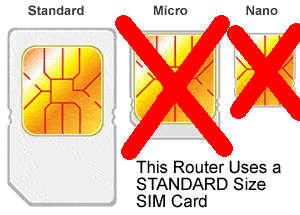
The RUT956 uses Mini SIM (2FF) format in both external SIM holders. If you are used to handling Nano or Micro SIM cards from recent consumer hardware, you will need the SIM adapter kit included in the box, or source a 2FF SIM directly. For deployments needing a static, reachable IP address, a fixed IP SIM is strongly recommended – standard SIM cards sit behind carrier-grade NAT, which prevents inbound VPN connections and SCADA polling.
Does the RUT956 support eSIM?
Yes. The RUT956230100 (UK PSU variant) includes an integrated eSIM. It supports bootstrap eSIM provisioning for remote profile download and removal, storing up to 7 profiles. The eSIM can be used alongside or instead of the physical SIM slots. Our IoT eSIM service is compatible – call us to confirm the right profile for your deployment.
What is the difference between the RS232 and RS485 ports on the RUT956?
Both ports are independent. RS232 uses a DB9 connector with RTS/CTS hardware flow control, suited to point-to-point connections with a single device such as a GNSS receiver, legacy modem, or barcode scanner. RS485 uses a 6-pin industrial socket and supports multi-drop bus wiring with up to 32 devices (full or half duplex), making it the right choice for Modbus RTU networks, DLMS/COSEM meter buses, and DNP3 serial networks. Both can run simultaneously in RutOS.
Is the passive PoE input compatible with my 802.3af PoE switch?
No. The RUT956’s passive PoE input operates at 9-30 V DC on the spare pairs (Mode B) and is not compatible with IEEE 802.3af, 802.3at or 802.3bt standards. Standard PoE switches and injectors operate at 48 V and will damage the router. You must use a matched passive PoE injector operating within 9-30 V DC. See our guide to PoE on cellular routers before connecting.
Does the RUT956 support Teltonika RMS?
Yes, the RUT956 is fully supported by Teltonika RMS. From RMS you can monitor signal strength, manage configuration profiles, trigger FOTA firmware updates, set up alerts, and access the RutOS web interface remotely without a VPN. RMS requires credits per device per month. We stock Teltonika RMS credits for purchase alongside the router.
What mounting options does the RUT956 support?
The RUT956 supports DIN rail, wall mount, and flat surface mounting. None of the mounting kits are included in the standard box – they are sold separately. The standard package includes the router, a 9 W UK PSU, two mobile SMA antennas, two Wi-Fi RP-SMA antennas, a GNSS adhesive SMA antenna, a connectors set, a 1.5 m Ethernet cable, and a SIM adapter kit.
Related products and further reading
If you need dual SIM but no serial ports, the Teltonika 4G router range includes options at lower price points. For serial connectivity without GNSS or analogue I/O, look at the RUT906. If your deployment requires 5G throughput alongside serial interfaces, the RUTM series is the step up. We also stock a range of 4G antennas compatible with the RUT956’s SMA connectors, and fixed IP SIM cards suitable for SCADA, ANPR, and EV charge point use cases.
| Cellular connectivity | |
| Cellular standard | 4G LTE Cat 4 / 3G / 2G |
| Max download | 150 Mbps (4G LTE Cat 4) |
| Max upload | 50 Mbps (4G LTE Cat 4) |
| 3G max download | 21 Mbps |
| 3G max upload | 5.76 Mbps |
| 2G max speed | 236.8 kbps DL / 236.8 kbps UL |
| 3GPP release | Release 11 |
| LTE FDD bands (23**** variant) | B1, B3, B7, B8, B20, B28A |
| LTE TDD bands (23**** variant) | B38, B40, B41 |
| 3G bands (23**** variant) | B1, B8 |
| 2G bands (23**** variant) | B3, B8 |
| SIM slots | 2 x Mini SIM (2FF), external holders, 1.8 V / 3 V |
| eSIM | Yes - integrated eSIM (23**** variant); bootstrap provisioning, up to 7 profiles |
| SIM switching | Configurable auto-switch: weak signal, data limit, SMS limit, roaming, no network, network denied, connection fail, SIM idle protection |
| Mobile antenna ports | 2 x SMA female (MAIN and AUX) |
| Mobile features | Band lock, operator block/allow list, multiple PDN, SIM PIN management, auto APN, bridge, passthrough |
| Wi-Fi | |
| Wi-Fi standard | 802.11b/g/n (Wi-Fi 4) |
| Wi-Fi modes | Access Point (AP), Station (STA) |
| Wi-Fi security | WPA3-SAE, WPA3-EAP, WPA2-Enterprise (PEAP), WPA2-PSK, OWE, AES-CCMP, TKIP; 802.11w PMF |
| Max Wi-Fi clients | 100 |
| Wi-Fi features | Wireless mesh (802.11s), fast roaming (802.11r), BSS transition (802.11v), radio resource measurement (802.11k), MAC filter, QR code generator, TravelMate |
| Wi-Fi antenna port | 2 x RP-SMA female |
| Ethernet | |
| WAN ports | 1 x RJ45, 10/100 Mbps, IEEE 802.3 / 802.3u / 802.3az, auto MDI/MDIX (configurable as LAN) |
| LAN ports | 3 x RJ45, 10/100 Mbps, IEEE 802.3 / 802.3u, auto MDI/MDIX |
| Total RJ45 ports | 4 |
| Processor and memory | |
| CPU | Mediatek, 580 MHz, MIPS 24KEc |
| RAM | 128 MB DDR2 |
| Flash storage | 16 MB SPI Flash |
| Software and OS | |
| Operating system | RutOS (OpenWrt-based Linux) |
| Routing | Static, BGP, OSPF v2, RIP v1/v2, EIGRP, NHRP, policy-based routing |
| Network backup / failover | Mobile, Wi-Fi WAN, wired, VRRP - configurable in RutOS WebUI |
| Load balancing | Yes |
| VLAN | Port and tag-based |
| QoS / SQM | Yes - traffic priority by source/destination, service, protocol or port |
| DDNS | 77 providers supported |
| DNS over HTTPS | Yes |
| Connection monitoring | Ping reboot, Wget reboot, periodic reboot, LCP and ICMP |
| Hotspot | Captive portal, internal/external RADIUS, SMS auth, Hotspot 2.0 |
| VPN | OpenVPN (27 encryption methods), IPsec (IKEv1/IKEv2, 14 methods), WireGuard, GRE, L2TP (v3, over IPsec), PPTP, ZeroTier, Stunnel, DMVPN (Phase 2 and 3), SSTP, Tinc |
| Industrial protocols | Modbus TCP/RTU client and server, DNP3 (TCP, RS232, RS485), DLMS/COSEM (TCP, RS232, RS485), OPC UA client/server (TCP), BACnet (RS485, TCP), MQTT broker and publisher, Data to Server (HTTP(S), MQTT, Azure MQTT) |
| IoT platforms | Azure IoT Hub (with DPS zero-touch provisioning), AWS IoT Core, ThingWorx, Cumulocity / Cloud of Things |
| Management | WebUI (HTTP/HTTPS), SSH (v1, v2), CLI, SNMP (v1, v2, v3 with trap), TR-069, RMS, FOTA, JSON-RPC, SMS management, Call management |
| Security | Pre-shared key, X.509 / TACACS+ / RADIUS auth, IP and login attempt blocking, DDoS prevention, port scan prevention, VLAN, mobile quota control, web filter, certificate manager (CA, Let's Encrypt, SCEP), 802.1x |
| Package Manager | Yes - install additional RutOS software packages |
| SDK | Yes - OpenWrt build environment, Lua, C, C++ supported |
| Interfaces | |
| Serial RS232 | 1 x DB9 socket, RS232 with RTS/CTS flow control |
| Serial RS485 | 1 x 6-pin industrial socket, full duplex (4-wire) and half duplex (2-wire), 300-115200 baud |
| Serial functions | Console, serial over IP, modem, Modbus gateway, NTRIP client |
| USB | 1 x USB 2.0 Type-A (Samba share, USB-to-serial, external storage, additional modem) |
| USB storage formats | FAT, FAT32, exFAT, NTFS (read-only), ext2, ext3, ext4 |
| SD card | Micro SD (internal) - availability depends on production batch; up to 2 TB; FAT32, NTFS, ext2/3/4 |
| Digital inputs | 1 x dry input (0-3 V logic low), 1 x galvanically isolated input (0-30 V), 1 x digital non-isolated input on power connector (0-5 V low / 8-30 V high) |
| Analogue input | 1 x 0-24 V with 4-20 mA capability |
| Digital outputs | 1 x open collector (30 V, 250 mA), 1 x SPST relay (40 V, 4 A), 1 x open collector on power connector (30 V, 300 mA) |
| I/O connector | 1 x 10-pin industrial socket (inputs/outputs), 1 x 4-pin power connector (power, ground, digital I/O) |
| I/O events | Email, RMS, SMS; I/O juggler for condition-based event triggers |
| GNSS | GPS, GLONASS, BeiDou, Galileo, QZSS; NMEA 0183; NTRIP client; geofencing; TAVL/RMS server |
| GNSS antenna port | 1 x SMA female |
| Power | |
| Power connector | 4-pin industrial DC power socket |
| Input voltage | 9-30 V DC; reverse polarity protection; surge protection 31 V DC 10 µs max |
| Passive PoE input | Mode B (spare pairs via LAN1), 9-30 V DC. Not compatible with IEEE 802.3af, 802.3at or 802.3bt |
| Power consumption | < 2 W idle / < 7 W max |
| Power socket pinout | Pin 1: Power (red), Pin 2: Ground (black), Pin 3: Input (green), Pin 4: Output (white) |
| Physical | |
| Dimensions (W x H x D) | 110 x 50 x 100 mm |
| Weight | 287 g |
| Housing | Aluminium housing, plastic panels |
| Status LEDs | 1 x bi-colour connection status, 5 x mobile signal strength, 4 x ETH status, 1 x power |
| Reset button | Reboot / user default reset / factory reset |
| Mounting | DIN rail, wall mount, flat surface (all require additional mounting kit, sold separately) |
| Environmental | |
| Operating temperature | -40 °C to +75 °C |
| Operating humidity | 10% to 90% non-condensing |
| IP rating | IP30 |
| Hazardous environments | Class I, Division 2, Groups A, B, C, D; Class I, Zone 2, Group IIC (UL/CSA) |
| Certifications | |
| Regulatory | CE, UKCA, FCC, IC, PTCRB, RCM, Anatel, Giteki, IMDA, ANRT, ICASA, CITC, NCC, ETA-WPC, MTCTE, EAC |
| Safety | CB (IEC 62368-1), UL/CSA 62368-1, C22.2 No. 62368-1, UL 121201 (C1D2) |
| Other | E-mark, ECE R118, RoHS, REACH |
| Operator approved | AT&T, Verizon, T-Mobile |
| In the box | |
| RUT956230100 (UK PSU) | RUT956 router, 9 W UK PSU, 2 x mobile magnetic SMA antennas, 2 x Wi-Fi magnetic RP-SMA antennas, 1 x GNSS adhesive SMA antenna, connectors set, 1.5 m Ethernet cable, SIM adapter kit, quick start guide |
| Warranty and support | |
| Warranty | 2-year manufacturer warranty |
| Technical support | UK-based technical support - 0300 124 6181 |
| Documentation | RUT956 datasheet (PDF) | RUT956 flyer (PDF) |
Based on 0 reviews
Be the first to review “Teltonika RUT956 Industrial 4G Router with RS232, RS485 and GNSS”
You may also like…
- 2x2 MiMo 5G Antennas, 4G Antennas, 5G Antennas, Omni-Directional 5G Antennas, Panorama Antennas, UR32L Antennas
Panorama DMM-6-60-2SP 2×2 MiMo 4G / 5G Antenna 5dBi Peak Gain
 2x2 MiMo 5G Antennas, 4G Antennas, 5G Antennas, Omni-Directional 5G Antennas, Panorama Antennas, UR32L Antennas
Panorama DMM-6-60-2SP 2×2 MiMo 4G / 5G Antenna 5dBi Peak Gain
Panorama DMM-6-60-2SP is a high gain, omni-directional 5G MiMo antenna (2×2 MIMO) terminated with 2m long cable with 2 x SMA Male antenna connectors – ideal for direct connection to the majority of our 4G and 5G routers.
This antenna can be desk mounted, window mounted (supplied with rubber suckers) or wall mounted. The DMM-6-60-2SP 5G Antenna provides 5dBi Peak Gain and the configuration means the antennas are cross polarized to provide peak data throughput and performance for all 4G and 5G mobile broadband Internet connections.
This item is terminated with SMA Male Connectors.
SKU: DMM-6-60-2SP-N - 4G CCTV, Teltonika, Teltonika 4G Routers
Teltonika RUT951 Industrial 4G Router with eSIM
Teltonika RUT951 4G LTE Industrial Router
- This device features dual SIM 4G cellular connectivity combined with Wi-Fi and 4 Ethernet interfaces to meet the needs of the most varied IoT solutions.
- Automatic WAN failover to an available backup connection ensures network continuity and eliminates downtime.
- Powered by RutOS that offers customization options for professional use, automation features, and top-level security for your solution.
- Compatible with the Teltonika Networks Remote Management System (Teltonika RMS) enables secure remote management to save time and expenses.
- Standard Teltonika order code: RUT951030200
CHECK OUT THE NEW RUT901 – CLICK HERE
SKU: TELTONIKA-RUT951030200-ESIM-N - 2x2 MiMo 5G Antennas, 4G Antennas, 5G Antennas, Fullband 4G Antennas, Fullband Antennas, Omni-Directional 4G Antennas, Omni-Directional 5G Antennas
Fullband® MIMORAD Outdoor 4G/5G MIMO Antenna 6dBi Peak Gain with 2 x 5m cables with SMA Male Connectors
2x2 MiMo 5G Antennas, 4G Antennas, 5G Antennas, Fullband 4G Antennas, Fullband Antennas, Omni-Directional 4G Antennas, Omni-Directional 5G AntennasFullband® MIMORAD Outdoor 4G/5G MIMO Antenna 6dBi Peak Gain with 2 x 5m cables with SMA Male Connectors
Fullband MIMORAD is an omni Directional, high performance wide band 2×2 MIMO antenna that has twin connector cables to connect to the MAIN and AUX ports of 4G and 5G routers.
Ref : FULLBAND-MIMORAD-200MM-N
PLEASE NOTE AS OF 1ST APRIL 2026 MIMORAD ANTENNAS HAVE A NEW FORM FACTOR, HEIGHT REDUCES FROM 350MM TO 200MM. PERFORMANCE REMAINS IDENTICAL WITH THE ONLY DIFFERENCE BEING THE REDUCTION IN THE HOUSING.
See PCN notifcation here: PCN_Fullband_MIMORAD_Housing_Change_April_2026
SKU: FULLBAND-MIMORAD-N


Related products
- 4G Routers, CAT6 4G Router, Manufacturers, Teltonika, Teltonika 4G Routers
Teltonika RUTX11 4G LTE CAT6 Industrial Router
4G Routers, CAT6 4G Router, Manufacturers, Teltonika, Teltonika 4G RoutersTeltonika RUTX11 4G LTE CAT6 Industrial Router
The Teltonika RUTX11 is a robust 4G LTE router designed for industrial and enterprise applications. Offering high-speed cellular connectivity, dual-SIM functionality, and versatile networking options, it’s ideal for IoT, M2M, and remote monitoring solutions. Its rugged design ensures reliable performance in challenging environments.
Key Features:
- Advanced 4G LTE connectivity (Cat 6)
- Dual-SIM for network redundancy
- Five Gigabit Ethernet ports
- Industrial-grade design with wide temperature range
- Multiple VPN options for secure communications
- Works with Teltonika RMS (Remote Management System)
 SKU: TELTONIKA-RUTX11-N
 - 4G Routers, IoT 4G Gateway, IoT Gateways, Teltonika, Teltonika 4G Routers, Teltonika IoT Gateways
Teltonika TRB140 Industrial Rugged 4G/LTE CAT4 Gateway
4G Routers, IoT 4G Gateway, IoT Gateways, Teltonika, Teltonika 4G Routers, Teltonika IoT GatewaysTeltonika TRB140 Industrial Rugged 4G/LTE CAT4 Gateway
The Teltonika TRB140 is a compact industrial 4G LTE gateway with a Gigabit Ethernet port and CAT4 LTE Modem. This is ideal for applications where a sole device needs internet connectivity. The Teltonika TRB140 is an industrial unit with robust construction with a wide range of software features such as SMS control, Firewall, Open VPN, IPSec, RMS and FOTA support.
SKU: TELTONIKA-TRB140-N


There are no reviews yet.