
No products in the basket.
Teltonika, Teltonika 4G Routers, Teltonika eSIM Routers
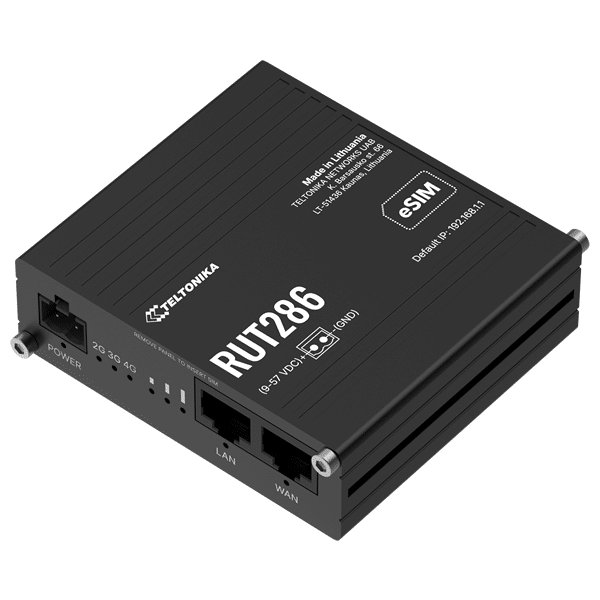
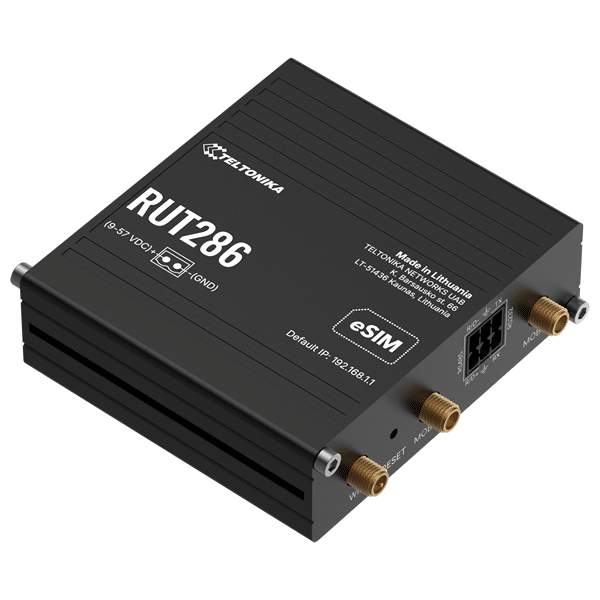
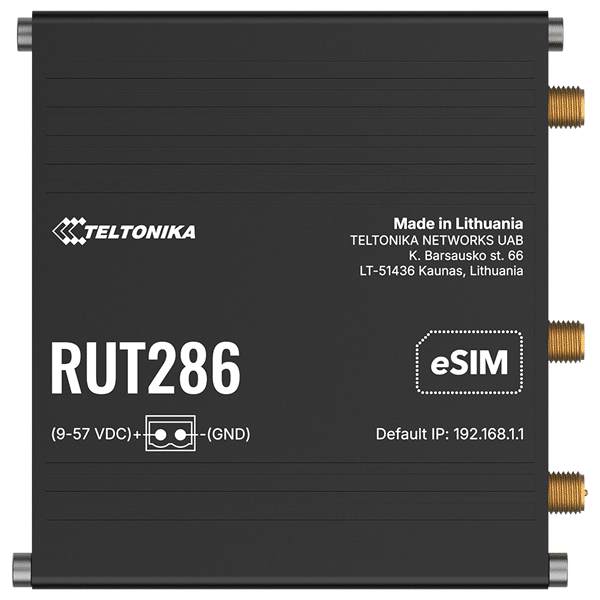
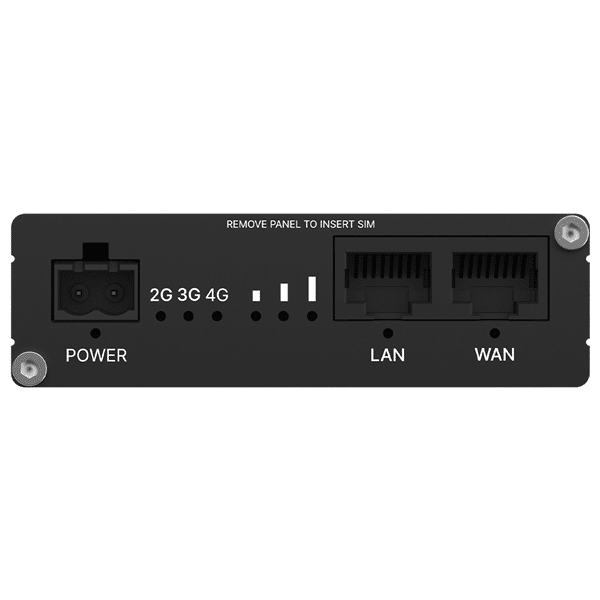
Teltonika RUT286 Global LTE Cat 4 Router
Availability:
Available on back-order
The Teltonika RUT286 (RUT286AAAAA0) is an industrial global LTE Cat 4 router with integrated eSIM, dual Mini SIM slots, RS232 and RS485 serial interfaces, and support for 4G bands across Europe, the Americas, Asia-Pacific, and Africa. Powered by a Telit modem and running RutOS, it combines Modbus TCP/RTU, DNP3, DLMS/COSEM, OPC UA, and BACnet with flexible 9-57 V DC or PoE power input in a compact anodised aluminium enclosure.
Key Features:
• Global LTE Cat 4 via Telit modem – 150 Mbps down / 50 Mbps up, with 3G/2G fallback
• Integrated eSIM (consumer type, up to 7 profiles) plus 2 x Mini SIM (2FF) slots
• RS232 and RS485 on a single 6-pin terminal block with Modbus RTU/TCP, DNP3, DLMS, OPC UA, BACnet
• 9-57 V DC industrial power input plus active 802.3af PoE and passive PoE (16-57 V DC) on LAN port
• 802.11b/g/n Wi-Fi with Access Point and Station modes, up to 50 simultaneous clients
• 1 x WAN + 1 x LAN, 10/100 Mbps Ethernet (WAN configurable as LAN)
• Micro SD slot supporting up to 2 TB (FAT32, NTFS, ext2/3/4)
• Full RutOS VPN suite: OpenVPN, IPsec, WireGuard, ZeroTier, GRE, DMVPN, L2TP, Stunnel, SSTP, Tinc
• Teltonika RMS remote management and FOTA support
• Operating temperature -40 to +65 °C, IP30, anodised aluminium housing, 132 g

Teltonika RUT286 global LTE Cat 4 router with eSIM, RS232/RS485 and dual PoE input
The Teltonika RUT286 (RUT286AAAAA0) is an industrial LTE Cat 4 router built for global deployments where serial equipment integration, flexible power input, and broad band coverage matter. Its Telit modem covers LTE FDD bands B1, B2, B3, B4, B5, B7, B8, B9, B12, B13, B14, B18, B19, B20, B25, B26, and B28, plus seven UMTS bands and four GSM bands, making it compatible with networks across Europe, the Americas, Asia-Pacific, and Africa. It ships as the A***** hardware variant without a PSU, so order code RUT286AAAAA0 is the standard package.
What sets the RUT286 apart in the RUT range is the combination of RS232 and RS485 on a single 6-pin terminal block, a triple SIM architecture (two Mini SIM slots plus integrated eSIM), and a power input range that stretches to 57 V DC. Active 802.3af PoE input on the LAN port and passive PoE Mode A/B through the same port mean the router can be powered over Ethernet without a separate supply run, which simplifies installations in panels, kiosks, and enclosures where separate cabling is impractical. RutOS provides the full industrial protocol stack: Modbus TCP and RTU, DNP3, DLMS/COSEM, OPC UA, and BACnet, alongside the complete VPN suite.
Key features
- Global LTE Cat 4 via Telit modem: 150 Mbps down, 50 Mbps up, 18 LTE FDD bands, 7 UMTS bands, 4 GSM bands, 3GPP Release 10.
- Triple SIM architecture: 2 x Mini SIM (2FF) in a double-stacked tray plus integrated consumer eSIM supporting up to 7 downloadable profiles. Auto-switch on weak signal, data limit, SMS limit, roaming, no network, network denied, or data connection fail.
- RS232 and RS485 serial: Both interfaces on a single 6-pin terminal block. Supports Modbus RTU (RS232 and RS485), DNP3 RTU (RS232 and RS485), DLMS/COSEM (RS232 and RS485), serial over IP, and NTRIP client.
- Flexible PoE and DC power: 9-57 V DC on 2-pin industrial connector; active 802.3af PoE input on LAN port; passive PoE Mode A/B 16-57 V DC on LAN port. Reverse polarity protection, surge protection to 58 V DC.
- Industrial protocol stack: Modbus TCP/RTU client and server, OPC UA client/server (TCP), DNP3 station/outstation (RTU and TCP), DLMS/COSEM client (RTU and TCP), BACnet router (RTU RS485, TCP), Modbus MQTT Gateway.
- Full RutOS VPN suite: OpenVPN (27 encryption methods), IPsec (IKEv1/IKEv2, 14 methods), WireGuard, ZeroTier, GRE, DMVPN (Phase 2 and 3), L2TP, Stunnel, SSTP, Tinc, EoIP, OpenConnect.
- Micro SD card slot: Internal slot, up to 2 TB, supports FAT32, NTFS, ext2, ext3, ext4. Usable for Samba share and local data logging.
- Wi-Fi 4 (802.11b/g/n): Access Point and Station modes, up to 50 simultaneous clients, WPA3-SAE, WPA3-EAP, WPA2-PSK, WPA2-Enterprise, 802.11r fast roaming, 802.11s mesh.
- Compact aluminium enclosure: 83 x 25 x 83 mm, 132 g, IP30, -40 to +65 °C operating range. DIN rail, wall mount, and flat surface mounting kits available separately.
- Teltonika RMS compatible: Full remote management, configuration, alerts, FOTA, and RMS Connect access. Integrates with Azure IoT Hub, AWS IoT Core, ThingWorx, and Cumulocity.
What is the RUT286 used for?
Smart metering and utility telemetry
Water, gas, and electricity meters using DLMS/COSEM or Modbus RTU over RS485 connect directly to the RUT286 serial port without a protocol converter. The global band support means the same hardware can be deployed across UK, European, and international utility networks. A fixed IP SIM allows the head-end system to initiate connections to each meter point without requiring port forwarding through carrier-grade NAT.
Remote substation and DNP3 SCADA
DNP3 outstation mode over RS485 makes the RUT286 a direct serial gateway for IEC 61968-compliant SCADA systems monitoring remote substations and distribution equipment. The 57 V DC input tolerance accommodates substation battery bus voltages, and the passive PoE option simplifies power delivery at sites where a single Ethernet cable can reach the cabinet from a managed switch. SIM auto-switch, once configured in RutOS, provides automatic failover between two physical SIM cards on network loss or signal degradation.
Industrial automation and OPC UA edge connectivity
OPC UA server mode on the RUT286 allows PLCs and SCADA clients to subscribe to router parameters, mobile signal quality, and interface status over TCP. Combined with Modbus TCP client polling of downstream devices, the router acts as a lightweight protocol bridge for factory automation and process control applications. The Modbus MQTT Gateway adds a path to cloud IoT platforms without custom middleware.
Remote kiosk, retail, and payment terminal backhaul
The 9-57 V DC input range and 802.3af PoE input make the RUT286 easy to install in kiosk and payment terminal enclosures that typically carry 12 V, 24 V, or 48 V bus rails. The integrated eSIM removes the need to pre-provision a physical SIM before deployment in multi-country rollouts. Once configured, SIM profile selection can be managed remotely via RMS without physical access to the unit.
Construction site and temporary infrastructure
Construction sites, event venues, and temporary facilities often power equipment from 24 V or 48 V DC distribution, which the RUT286 handles natively. The RS485 port covers site sensors, access control panels, and environmental monitors using Modbus RTU. Wi-Fi provides local connectivity for site office equipment, with the cellular WAN providing the backhaul independently of fixed broadband.
Pro tip
The RUT286 supports both active 802.3af PoE and passive PoE on the same LAN port, but these are not interchangeable. Active 802.3af PoE input requires a compliant 802.3af power sourcing equipment (PSE) on the switch side. Passive PoE on the RUT286 operates at 16-57 V DC and uses Mode A/B on all four pairs. Do not connect a 48 V 802.3af switch port to the RUT286 LAN and expect passive PoE to function correctly. Check your injector or switch output type before connecting. For panel installations, a dedicated 24 V passive PoE injector matched to the panel supply voltage is the most reliable approach. See our Teltonika RMS explainer for guidance on remote management once the unit is powered and online.
Frequently asked questions
Does the RUT286 support dual SIM failover?
Yes. The RUT286 has two Mini SIM (2FF) slots plus an integrated eSIM, giving three SIM inputs in total. SIM switching must be configured in the RutOS WebUI. Auto-switch triggers include weak signal, data limit reached, SMS limit, roaming, no network, network denied, and data connection failure. For inbound connections and remote management, a fixed IP SIM removes the carrier-grade NAT constraint that affects standard mobile data connections.
What serial interfaces does the RUT286 have?
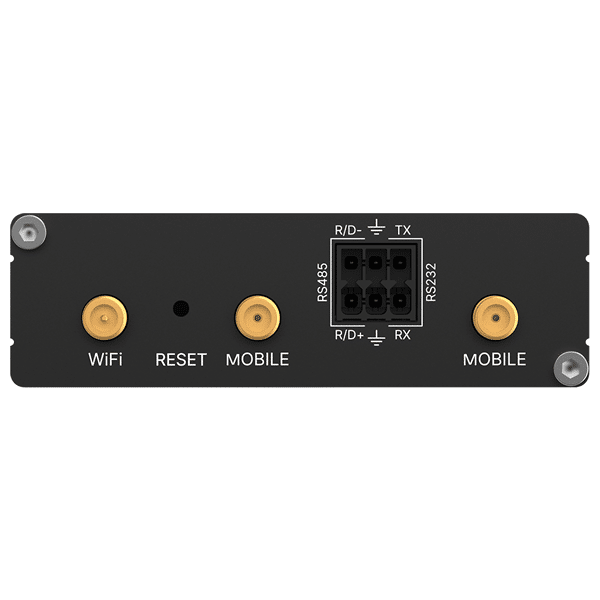
The RUT286 has both RS232 and RS485 on a single 6-pin terminal block on the rear panel. RS485 is half-duplex 2-wire. RS232 is without hardware flow control signals. Both interfaces support Modbus RTU, DNP3 RTU, and DLMS/COSEM. Serial over IP and NTRIP client are also available via RutOS. The 6-pin connector pinout is: D+ (RS485), GND, TX (RS232) on pins 1-3 and D- (RS485), GND, RX (RS232) on pins 4-6.
How does PoE input work on the RUT286?
The RUT286 accepts two types of PoE input on its LAN port. Active 802.3af PoE input works with any standard 802.3af compliant PSE switch or injector. Passive PoE input accepts 16-57 V DC using Mode A/B across all four pairs. These are separate input modes: do not mix a 48 V 802.3af injector with a passive PoE configuration. The 2-pin DC power connector accepts 9-57 V DC and can be used instead of or alongside PoE. Read our VPN on cellular routers guide if you need to configure secure tunnels once the unit is installed.
What is the eSIM on the RUT286 and does it include a data plan?
The RUT286 includes a consumer-type integrated eSIM supporting up to 7 downloadable profiles via standard eSIM provisioning. The eSIM does not include a data plan. An active eSIM data plan must be obtained separately from a compatible operator. The bootstrap eSIM profile is pre-installed at the factory for initial provisioning. For more on eSIM router deployments, see our eSIM routers explainer.
What SIM card format does the RUT286 use?
The two physical SIM slots use Mini SIM (2FF) format in a double-stacked tray. This is the older, larger SIM format. The tray is on the front panel, accessible by removing the panel as indicated on the housing. Check the SIM format before ordering as most current phones and IoT SIM suppliers default to Nano (4FF) or Micro (3FF), both of which require an adapter. A SIM adapter kit is included in the standard package.
What is Teltonika RMS and is the RUT286 compatible?
Teltonika RMS (Remote Management System) is a cloud platform for monitoring, configuring, and managing RutOS devices remotely. The RUT286 is fully RMS compatible. Via RMS you can check connection status, signal strength, and interface state; push configuration updates; trigger FOTA firmware updates; and use RMS Connect to establish remote CLI or WebUI access without a public IP. See our Teltonika RMS explainer for full details on credits, features, and setup.
Related products and further reading
For serial-equipped deployments needing dual-SIM, GNSS, and four Ethernet ports, see the Teltonika 4G routers range including the RUT956. For eSIM-specific guidance, our eSIM routers explainer covers provisioning, bootstrap profiles, and operator compatibility. Pair the RUT286 with an external antenna from our 4G antennas range for enclosure installations where stub antennas underperform. Fixed IP SIM cards are strongly recommended for any deployment requiring inbound VPN tunnels or direct SCADA polling over cellular.
| Cellular Connectivity | |
|---|---|
| Mobile module | Telit 4G LTE Cat 4 |
| Max download speed | 150 Mbps |
| Max upload speed | 50 Mbps |
| 3G max speed | 21 Mbps down / 5.76 Mbps up |
| 2G max speed | 236.8 kbps down / 236.8 kbps up |
| 3GPP release | Release 10 |
| LTE FDD bands (global variant) | B1, B2, B3, B4, B5, B7, B8, B9, B12, B13, B14, B18, B19, B20, B25, B26, B28 |
| 3G (UMTS/HSPA) bands | B1, B2, B4, B5, B6, B8, B19 |
| 2G (GSM/GPRS/EDGE) bands | B2, B3, B5, B8 |
| SIM slots | 2 x Mini SIM (2FF), double-stacked tray, 1.8 V / 3 V |
| eSIM | Consumer type eSIM; up to 7 downloadable profiles; profile download and removal via standard eSIM provisioning; does not include a data plan |
| SIM auto-switch triggers | Weak signal, data limit, SMS limit, roaming, no network, network denied, data connection fail |
| Band management | Band lock, used band status display |
| Additional mobile features | Auto APN, operator block/allow list (by country or operator), multiple PDN, SIM PIN management, SIM idle protection, bridge, passthrough, USSD |
| Mobile antenna ports | 2 x SMA female (MAIN and AUX, rear panel) |
| Wi-Fi | |
|---|---|
| Standard | 802.11b/g/n (Wi-Fi 4) |
| Modes | Access Point (AP), Station (STA), Mesh (802.11s), Multi-AP |
| Security | WPA3-SAE, WPA3-EAP, WPA2-PSK, WPA2-Enterprise (PEAP), WPA-EAP, WPA-PSK, OWE; AES-CCMP, TKIP; 802.11w Protected Management Frames (PMF); EAP-TLS with PKCS#12 certificates |
| Max simultaneous clients | 50 |
| Additional features | Wireless mesh (802.11s), fast roaming (802.11r), BSS transition management (802.11v), radio resource measurement (802.11k), SSID stealth mode, MAC access control, wireless QR code generator, TravelMate |
| Wi-Fi antenna port | 1 x RP-SMA female (rear panel) |
| Ethernet | |
|---|---|
| WAN port | 1 x RJ45, 10/100 Mbps, IEEE 802.3 / 802.3u / 802.3az, auto MDI/MDIX; configurable as LAN |
| LAN port | 1 x RJ45, 10/100 Mbps, IEEE 802.3 / 802.3u / 802.3az, auto MDI/MDIX |
| Processor and Memory | |
|---|---|
| CPU | Mediatek, 580 MHz, MIPS 24KEc |
| RAM | 128 MB DDR2 |
| Flash storage | 32 MB NOR Flash |
| Software and OS | |
|---|---|
| Operating system | RutOS (OpenWrt-based Linux) |
| Routing | Static, BGP, OSPF v2, RIP v1/v2, EIGRP, NHRP, policy-based routing |
| Network backup / failover | Wi-Fi WAN, mobile, VRRP, wired |
| Load balancing | Yes |
| VLAN | Port and tag-based |
| QoS / SQM | Traffic priority queuing by source/destination, service, protocol or port; WMM, 802.11e |
| DDNS | 77 providers supported |
| DNS over HTTPS | Yes |
| Connection monitoring | Ping reboot, wget reboot, periodic reboot, LCP and ICMP |
| Hotspot | Captive portal, internal/external RADIUS, RADIUS MAC authentication, SMS authorisation, SSO, Hotspot 2.0 |
| VPN | OpenVPN (27 encryption methods), IPsec (XFRM, IKEv1, IKEv2, 14 methods), WireGuard, ZeroTier, GRE, PPTP, L2TP (v3, over IPsec), Stunnel, DMVPN (Phase 2 and 3), SSTP, Tinc, EoIP, OpenConnect |
| Industrial protocols | Modbus TCP/RTU (client and server), OPC UA (client and server, TCP), DNP3 (station and outstation, RTU and TCP), DLMS/COSEM (client, RTU and TCP), BACnet (router, RTU RS485 and TCP), Modbus MQTT Gateway |
| Management | WebUI (HTTP/HTTPS), CLI, SSH (v1, v2), SNMP (v1, v2, v3 with trap and brute force protection), TR-069, RMS, FOTA, JSON-RPC, SMS management, call management |
| IoT platforms | Azure IoT Hub (with Device Provisioning Service), AWS IoT Core (with Jobs), ThingWorx, Cumulocity / Cloud of Things |
| Security | Pre-shared key, X.509 certificates, TACACS+, RADIUS, IP and login attempt blocking, time-based login blocking; DDoS prevention, SYN flood protection, port scan prevention; 802.1x; DMZ, NAT, NAT-T, NAT64; Certificate Manager (CA, server, client, Let's Encrypt, SCEP); mobile quota control, web filter |
| Development | SDK provided; Busybox shell, Lua, C, C++ supported; Package Manager for additional software; GPL customisation available |
| Interfaces | |
|---|---|
| Serial | RS232 (without flow control) and RS485 (half-duplex 2-wire) on 1 x 6-pin terminal block. Serial functions: console, serial over IP, modem, Modbus gateway, NTRIP client |
| RS485 connector pinout | Pin 1: D+ (RS485); Pin 2: GND; Pin 3: TX (RS232); Pin 4: D- (RS485); Pin 5: GND; Pin 6: RX (RS232) |
| SD card | Micro SD (internal), up to 2 TB; FAT32, NTFS, ext2, ext3, ext4; Samba share |
| Status LEDs | 3 x connection type, 3 x connection strength, 2 x LAN status, 1 x power |
| Reset button | Reboot / user default reset / factory reset |
| Power | |
|---|---|
| DC power connector | 2-pin industrial DC power socket |
| DC input voltage | 9-57 V DC, reverse polarity protection, surge protection 58 V DC 10 us min |
| Active PoE input | IEEE 802.3af on LAN port |
| Passive PoE input | Mode A/B, pins 1,2,4,5 (+) / 3,6,7,8 (-) through LAN port; 16-57 V DC. Not compatible with 802.3at or 802.3bt |
| Power consumption (idle) | < 2 W |
| Power consumption (max) | < 6.5 W |
| Physical | |
|---|---|
| Dimensions (W x H x D) | 83 x 25 x 83 mm |
| Weight | 132 g |
| Housing | Anodised aluminium housing and panels |
| Antenna connectors | 2 x SMA female (mobile MAIN and AUX, rear panel); 1 x RP-SMA female (Wi-Fi, rear panel) |
| Mounting | DIN rail, wall mount, flat surface (all require additional mounting kit, not included) |
| Environmental | |
|---|---|
| Operating temperature | -40 °C to +65 °C |
| Operating humidity | 10% to 90% non-condensing |
| IP rating | IP30 |
| Certifications | |
|---|---|
| Regulatory approvals | CE, UKCA, CB, RCM, FCC, IC, WEEE, EAC, UCRF |
| In the Box | |
|---|---|
| Standard package (RUT286AAAAA0) | RUT286 router, quick start guide, 2-pin terminal block, 2x3-pin connector, hex key, SIM adapter kit. No PSU included. |
| Warranty and Support | |
|---|---|
| Warranty | 2-year manufacturer warranty |
| Support | UK-based technical support via The Router Store; Teltonika RMS for remote management |
Based on 0 reviews
Be the first to review “Teltonika RUT286 Global LTE Cat 4 Router”
Related products
- 4G Routers, Teltonika, Teltonika 4G Routers
Teltonika RUT200 4G LTE Industrial Cellular Router
The Teltonika RUT200 (RUT200013000) is a compact 4G LTE Cat 4 industrial cellular router with a single Mini SIM, 802.11b/g/n Wi-Fi, and two 10/100 Mbps Ethernet ports in a 125 g aluminium housing. It runs RutOS on a Mediatek 580 MHz processor with a full VPN stack, industrial protocol support, digital I/O, and Teltonika RMS compatibility, operating from -40 to +75 °C.
Key Features:
• 4G LTE Cat 4 – 150 Mbps down / 50 Mbps up; automatic fallback to 3G and 2G
• Single Mini SIM (2FF) with auto APN, band lock, and operator block/allow list
• Wi-Fi 4 (802.11b/g/n) – access point and station modes, up to 50 simultaneous clients
• 1 x WAN + 1 x LAN (10/100 Mbps); WAN port configurable as second LAN via RutOS
• 1 x digital input and 1 x digital output on 4-pin power connector
• Passive PoE input via LAN1 – Mode B, 9-30 V DC (not compatible with 802.3af/at/bt)
• VPN: OpenVPN, IPsec, WireGuard, ZeroTier, GRE, L2TP, DMVPN, SSTP, Tinc
• Modbus TCP, OPC UA, DNP3, MQTT broker/publisher, Azure IoT Hub, AWS IoT Core
• Teltonika RMS compatible – remote management, FOTA, alerts, and VPN tunnels
• CE, UKCA, E-mark certified; IP30; 83 x 25 x 74 mm; 125 gSKU: TELTONIKA-RUT200-N - 4G CCTV, Teltonika, Teltonika 4G Routers
Teltonika RUT951 Industrial 4G Router
Teltonika RUT951 4G LTE Industrial Router
- This device features dual SIM 4G cellular connectivity combined with Wi-Fi and 4 Ethernet interfaces to meet the needs of the most varied IoT solutions.
- Automatic WAN failover to an available backup connection ensures network continuity and eliminates downtime.
- Powered by RutOS that offers customization options for professional use, automation features, and top-level security for your solution.
- Compatible with the Teltonika Networks Remote Management System (Teltonika RMS) enables secure remote management to save time and expenses.
- Standard Teltonika order code: RUT951030200
CHECK OUT THE NEW RUT901 – CLICK HERE
SKU: TELTONIKA-RUT951-ESIM-N - 4G Routers, CAT6 4G Router, Teltonika, Teltonika 4G Routers
Teltonika RUTX12 Dual LTE Cat 6 Industrial Cellular Router
 4G Routers, CAT6 4G Router, Teltonika, Teltonika 4G Routers
Teltonika RUTX12 Dual LTE Cat 6 Industrial Cellular Router
The Teltonika RUTX12 is a powerful dual LTE Cat 6 industrial router designed for mission-critical applications. It offers uninterrupted connectivity with dual LTE modems, providing speeds up to 600 Mbps with load balancing. The robust router features advanced security, remote management, and a durable aluminum housing suitable for harsh environments.Top 6 Key Features:
- Dual LTE Cat 6 Modems for simultaneous high-speed internet up to 600 Mbps
- enables load balancing, hot swap failover or bonded 4G using Bondix service.
- 5 Gigabit Ethernet ports for wired connections up to 1000 Mbps
- Wave-2 802.11ac Dual Band WiFi with speeds up to 867 Mbps
- Advanced security features like VPN, IPsec, PPTP, L2TP, and GNSS tracking
- Remote Management System (RMS) for seamless monitoring and configuration
- Robust aluminium housing with IP30 rating for harsh industrial environments
 SKU: TELTONIKA-RUTX12-N
 - Dual LTE Cat 6 Modems for simultaneous high-speed internet up to 600 Mbps


There are no reviews yet.