
No products in the basket.
4G Routers, CAT6 4G Router, Teltonika, Teltonika 4G Routers
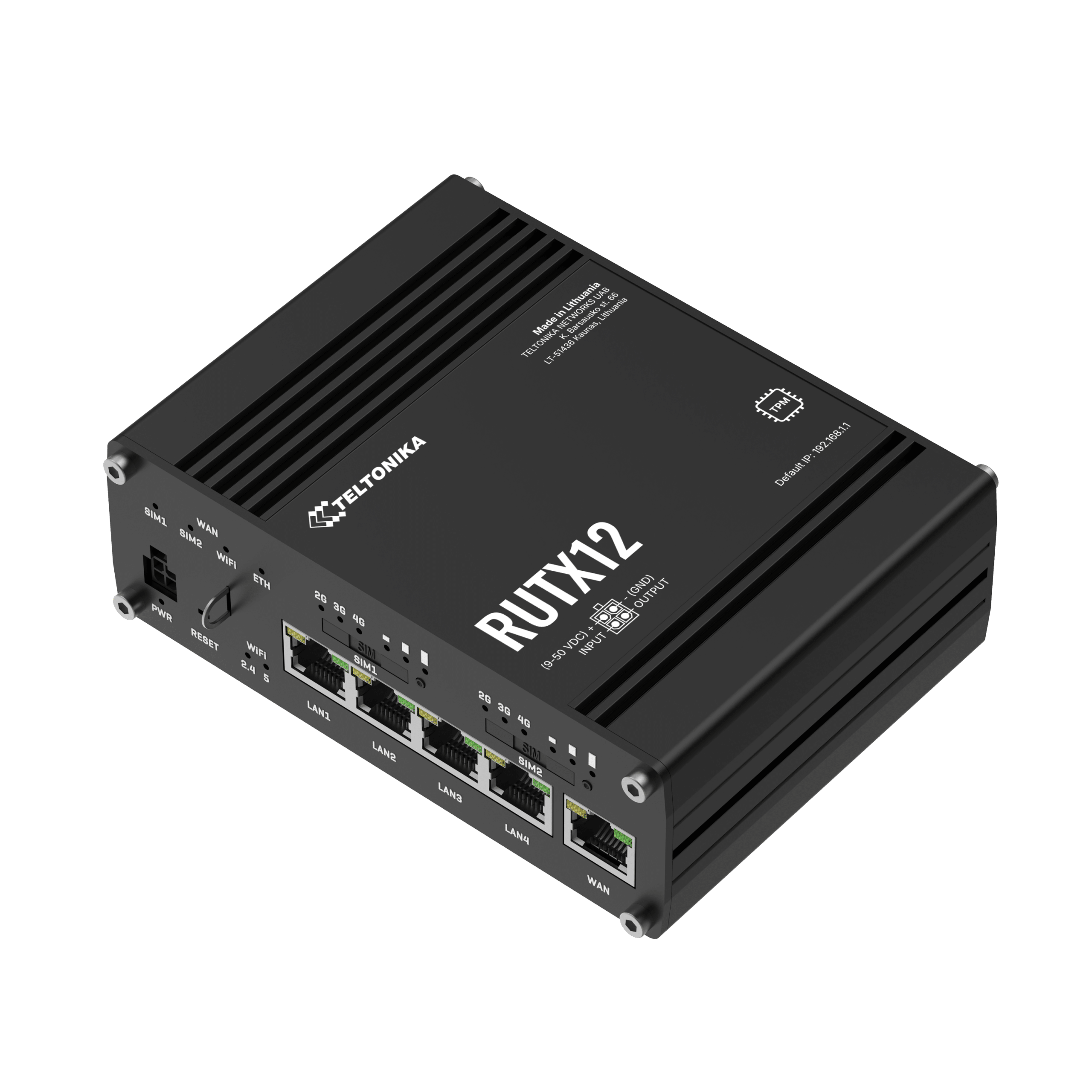
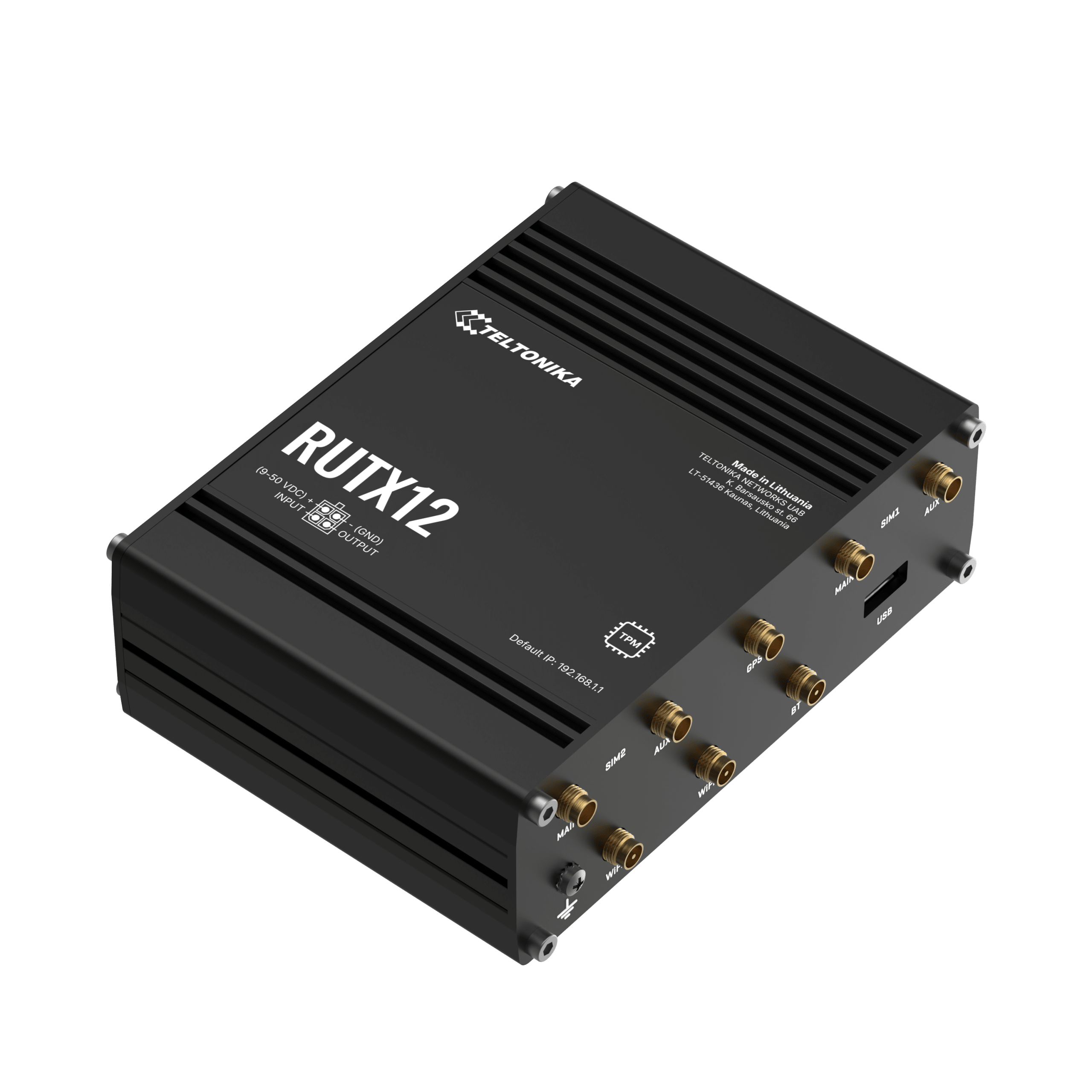
Teltonika RUTX12 Dual LTE Cat 6 Industrial Cellular Router
The Teltonika RUTX12 is a powerful dual LTE Cat 6 industrial router designed for mission-critical applications. It offers uninterrupted connectivity with dual LTE modems, providing speeds up to 600 Mbps with load balancing. The robust router features advanced security, remote management, and a durable aluminum housing suitable for harsh environments.Top 6 Key Features:
- Dual LTE Cat 6 Modems for simultaneous high-speed internet up to 600 Mbps
- enables load balancing, hot swap failover or bonded 4G using Bondix service.
- 5 Gigabit Ethernet ports for wired connections up to 1000 Mbps
- Wave-2 802.11ac Dual Band WiFi with speeds up to 867 Mbps
- Advanced security features like VPN, IPsec, PPTP, L2TP, and GNSS tracking
- Remote Management System (RMS) for seamless monitoring and configuration
- Robust aluminium housing with IP30 rating for harsh industrial environments

£375.00 Excl VAT
Teltonika RUTX12
The Teltonika RUTX12 is a dual-modem LTE Cat 6 industrial cellular router with two completely independent cellular modems running simultaneously. Each modem delivers up to 300 Mbps download. With load balancing active, combined cellular throughput reaches up to 600 Mbps. This is the primary distinction from a standard dual-SIM router: the RUTX12 runs two separate physical LTE modems, both live at the same time, not a single modem switching between two SIM slots.
Beyond the dual-modem cellular core, the RUTX12 includes built-in GNSS (GPS, GLONASS, BeiDou, Galileo, QZSS), Bluetooth 4.0 LE, Wave-2 dual-band Wi-Fi 5, five Gigabit Ethernet ports, and RutOS with OpenVPN, WireGuard, IPsec, Modbus TCP, OPC UA, DNP3, MQTT, and Teltonika RMS remote management. Both modems support Bondix bonded 4G for aggregated cellular bandwidth over a single IP.
Key features
- Dual independent LTE Cat 6 modems: up to 300 Mbps download per modem; both run simultaneously, not as a failover pair.
- Combined throughput up to 600 Mbps: load balancing distributes live traffic across both cellular connections at the same time.
- Hot-swap failover: if one modem loses its connection, all traffic shifts to the other immediately without manual intervention.
- Bondix bonded 4G support: aggregate bandwidth from two separate carrier connections into a single higher-throughput WAN link.
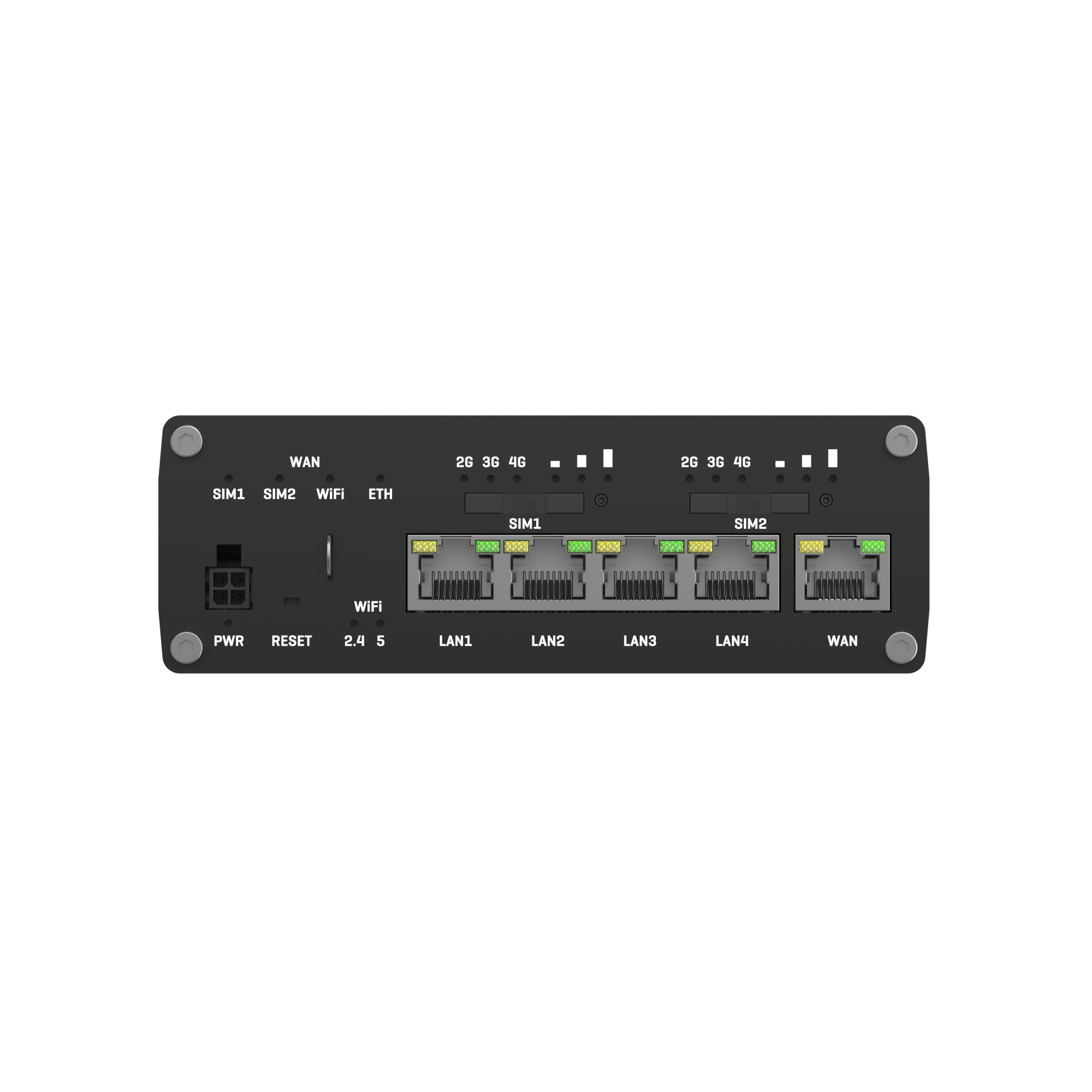
- Dual Mini SIM (2FF): one SIM slot per modem; eSIM available on 23**** order codes, supporting up to seven profiles.
- Wave-2 dual-band Wi-Fi 5 (802.11ac): MU-MIMO, up to 867 Mbps, supports up to 150 simultaneous clients, fast roaming (802.11r).
- 5 x Gigabit Ethernet: 1 x WAN configurable as LAN, 4 x LAN, 10/100/1000 Mbps on all ports.
- Built-in GNSS: GPS, GLONASS, BeiDou, Galileo, QZSS with NMEA 0183 output, configurable geofencing, and NTRIP protocol support.
- Bluetooth 4.0 LE: short-range BLE communication, proximity sensing, and asset tracking alongside the cellular backhaul.
- RutOS full protocol stack: 13 VPN protocols, Modbus TCP, OPC UA, DNP3, MQTT broker, TR-069, SNMP v3, Azure IoT Hub, AWS IoT Core.
- Full aluminium housing: -40 to +75 °C, IP30, DIN rail mountable (kit sold separately), grounding screw included.
What is the RUTX12 used for?
High-uptime SCADA and DNP3 telemetry
Remote substations, water treatment sites, and energy metering installations use the RUTX12 where a dropped cellular link cannot interrupt DNP3 polling or Modbus TCP data exchange. With two live modems on separate mobile network operators, a single carrier outage does not affect connectivity. Each modem has its own SIM idle protection to prevent inactive SIM cards from being deactivated by the carrier.
Bonded 4G for high-bandwidth remote sites
Where a single LTE connection cannot deliver sufficient bandwidth, the RUTX12 supports Bondix bonded cellular service, combining two separate carrier connections into a single higher-throughput WAN link. This suits live video uplinks, large-file transfer from remote construction or broadcast sites, and high-volume M2M data feeds where per-carrier throughput is a constraint.
Enterprise WAN with active dual-modem load balancing
The RUTX12 handles multi-WAN edge deployments where both cellular connections need to carry live traffic simultaneously. Five Gigabit Ethernet ports, VLAN support, dynamic routing via BGP, OSPF v2, and EIGRP, plus load balancing across wired WAN and both modems, support complex network topologies at remote or branch sites without fixed-line infrastructure.
Fleet management and vehicle tracking
The integrated multi-constellation GNSS module delivers real-time position data alongside dual-modem LTE connectivity for vehicle tracking, fleet management, and logistics applications. NMEA 0183 output feeds TAVL and RMS platforms directly. Configurable geofence zones trigger SMS or RMS alerts on entry and exit events, with no external GPS hardware required.
Smart city and public Wi-Fi with dual-modem backhaul
The RUTX12’s captive portal hotspot, 150-client Wi-Fi 5 radio, and dual-modem cellular backhaul suit temporary event Wi-Fi, public access points, and smart city edge nodes where bandwidth and resilience both matter. The hotspot supports external and internal RADIUS, SMS OTP, MAC authentication, and walled garden, all configurable from the RutOS WebUI.
Critical infrastructure with mobile network operator diversity
Energy and utility installations that cannot tolerate a single-operator failure put each RUTX12 SIM on a different MNO. If one operator has a regional outage, the second modem continues Modbus TCP or OPC UA data exchange without intervention. Teltonika RMS provides per-modem signal monitoring and alert delivery across the whole estate from a single management view.
Pro tip
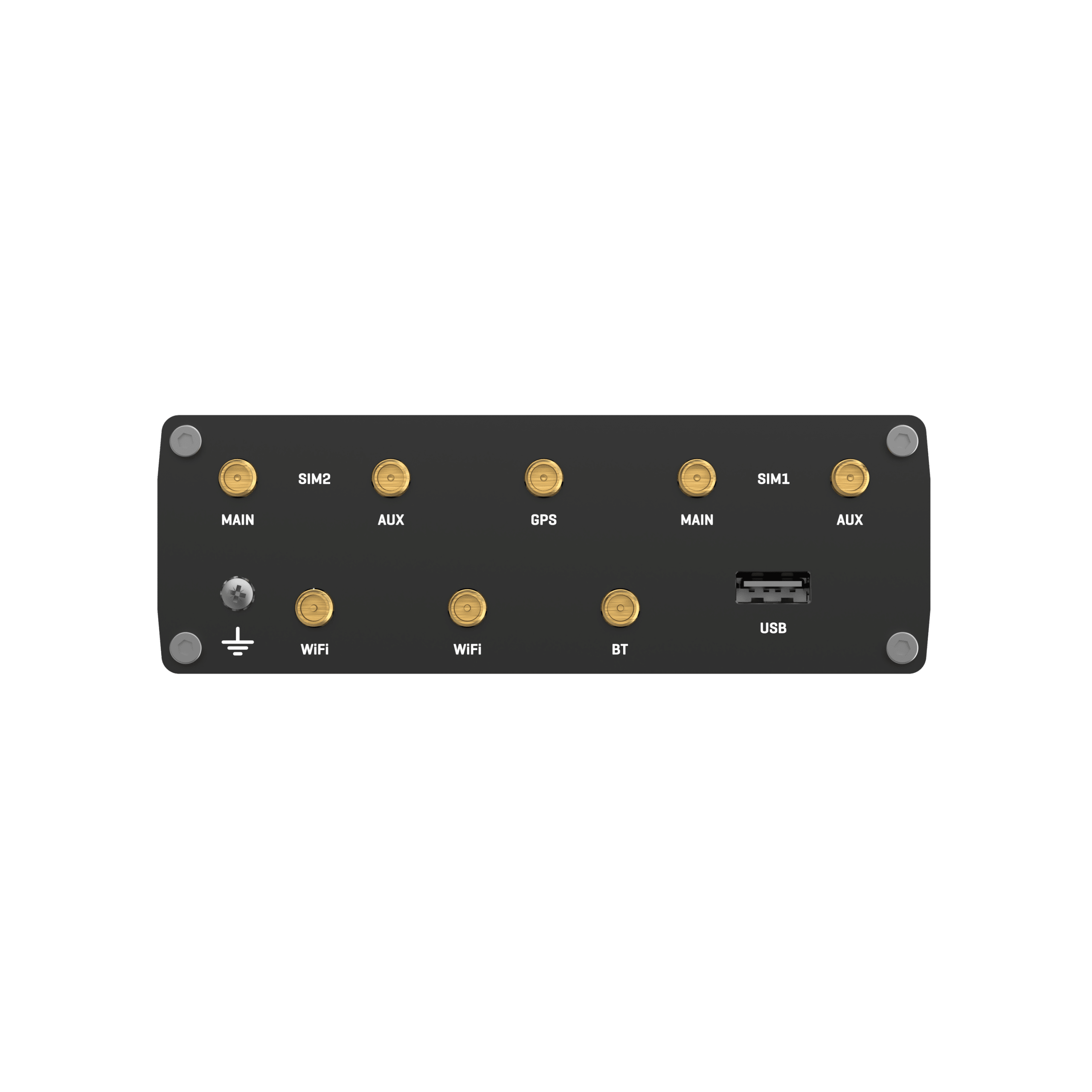
The RUTX12 has four SMA mobile antenna ports on the rear panel: MAIN and AUX for SIM1, and MAIN and AUX for SIM2. For best dual-modem performance, connect antennas to all four ports. Always fit an antenna to both MAIN ports before powering up. Running either modem without an antenna on its MAIN port risks modem damage from reflected power. In space-constrained enclosures where routing four cables is difficult, fit the supplied stubs to the AUX ports rather than leaving them open.
Building a resilient cellular connection
The RUTX12 runs two independent LTE modems, so the first step in building resilience is placing each SIM on a different mobile network operator. A single MNO outage then cannot affect both modems at once. Add a UPS on the 9-50 V DC power input to protect against mains failure, and use a fixed IP SIM on at least one slot to allow stable inbound VPN and remote management sessions without carrier-grade NAT interference. Enable Teltonika RMS monitoring to receive real-time signal and connectivity alerts across both modems from a single dashboard.
Frequently asked questions
What is the difference between the RUTX12 and a standard dual-SIM router?
Most dual-SIM routers have one cellular modem and two SIM slots. One SIM is active at a time; the other waits for a failover trigger, then the modem renegotiates a connection on the second SIM. The RUTX12 has two entirely separate LTE Cat 6 modems, one assigned per SIM slot. Both modems run simultaneously. This means the RUTX12 can load-balance traffic across two live connections at the same time, not just switch between them. Combined download throughput with both modems active reaches up to 600 Mbps.
Does the RUTX12 support eSIM?
eSIM is available on RUTX12 23**** order codes only. The 2***** EMEA variants do not include eSIM. Where supported, the eSIM holds up to seven profiles and supports over-the-air profile download and removal, but it does not include data plans. For an overview of eSIM in industrial routers, see our eSIM routers explainer. Confirm which order code is being stocked with Dan before publishing.
What SIM cards does the RUTX12 take?
Both SIM holders take Mini SIM (2FF) cards. A SIM adapter kit is included in the box for Micro or Nano SIMs. For remote management and inbound VPN connections, we recommend a fixed IP SIM on at least one slot. A fixed IP SIM gives the router a stable, publicly routable address, removing the carrier-grade NAT barrier that prevents inbound SSH or VPN sessions on standard data SIMs. If you need SIM recommendations, call us.
What VPN protocols does the RUTX12 support?
RutOS on the RUTX12 supports OpenVPN (27 encryption methods, client and server simultaneously), IPsec (IKEv1/v2, 14 methods), WireGuard, GRE, L2TP v3, PPTP, Stunnel, DMVPN (Phase 2, Phase 3, and Dual Hub), SSTP, ZeroTier, Tinc, and Tailscale. Multiple VPN instances run simultaneously across both modems. See our VPN on cellular routers guide for a protocol comparison.
What industrial protocols does the RUTX12 support?
RutOS includes Modbus TCP client and server with custom register mapping, OPC UA client and server over TCP, DNP3 station and outstation over TCP, DLMS/COSEM client, and MQTT broker and publisher. Data to Server forwards telemetry to HTTP(S), MQTT, or Azure MQTT endpoints, with direct integrations for Azure IoT Hub (including Device Provisioning Service and zero-touch provisioning), AWS IoT Core, ThingWorx, and Cumulocity built in.
Does the RUTX12 come with a mounting bracket?
No. The RUTX12 supports DIN rail, wall mount, and flat-surface mounting, but all options require a separate mounting kit not included in the standard package. The standard package contains the router, 24 W PSU, four mobile SMA antennas, two Wi-Fi magnetic SMA antennas, a GNSS adhesive SMA antenna, a Bluetooth magnetic SMA antenna, a 1.5 m Ethernet cable, a SIM adapter kit, and a quick start guide. Confirm mounting kit availability and SKU with Dan.
Related products and further reading
For external antenna installations with the RUTX12 in cabinets or on vehicle rooflines, browse our 4G antenna range. For deployments where a single modem with dual-SIM failover is sufficient, see the full Teltonika 4G router range. Manage the RUTX12 alongside your wider Teltonika estate through Teltonika RMS.
| Cellular Connectivity | |
|---|---|
| Mobile modules | 2 x 4G LTE Cat 6 (two independent modems) |
| Max download speed | 300 Mbps per modem (up to 600 Mbps combined with load balancing) |
| Max upload speed | 50 Mbps per modem |
| 3G | Up to 42 Mbps DL / 5.76 Mbps UL (HSPA+) |
| 3GPP release | Release 12 |
| LTE FDD bands (EMEA) | B1, B3, B5, B7, B8, B20, B28, B32 (B32 Rx only / 2CA secondary) |
| LTE TDD bands (EMEA) | B38, B40, B41 |
| 3G bands (EMEA) | B1, B3, B5, B8 |
| LTE FDD bands (North America) | B2, B4, B5, B7, B12, B13, B14, B25, B26, B29, B30, B66, B71 |
| LTE TDD bands (North America) | B41, B48 |
| SIM slots | 2 x Mini SIM (2FF), external holders, 1.8 V / 3 V |
| eSIM | Consumer eSIM, up to 7 profiles, profile download and removal (23**** and 43**** order codes only) |
| SIM switch | Auto-switch on: weak signal, data limit, SMS limit, roaming, no network, network denied, connection fail, SIM idle protection |
| Mobile antenna ports | 4 x SMA female (MAIN + AUX per modem, on rear panel) |
| Features | Auto APN, band lock, operator block/allow list, multiple PDN, SIM PIN management, SIM idle protection, bridge, passthrough, carrier aggregation (CA) |
| Wi-Fi | |
| Standard | 802.11b/g/n/ac Wave 2 (Wi-Fi 5), dual-band, MU-MIMO |
| Max Wi-Fi speed | Up to 867 Mbps |
| Modes | Access Point (AP), Station (STA) |
| Security | WPA3-SAE, WPA3-EAP, WPA2-PSK, WPA2-Enterprise (PEAP, EAP-TLS with PKCS#12), WPA-PSK, WPA-EAP, OWE, AES-CCMP, TKIP, 802.11w Protected Management Frames |
| Max simultaneous clients | 150 |
| Wi-Fi antenna ports | 2 x RP-SMA female |
| Features | Wireless mesh (802.11s), fast roaming (802.11r), BSS transition management (802.11v), radio resource measurement (802.11k), SSID stealth, MAC access control (allowlist/blocklist), QR code generator, TravelMate hotspot forward |
| Ethernet | |
| WAN port | 1 x RJ45, 10/100/1000 Mbps, IEEE 802.3 / 802.3u / 802.3az, auto MDI/MDIX (configurable as LAN) |
| LAN ports | 4 x RJ45, 10/100/1000 Mbps, IEEE 802.3 / 802.3u / 802.3az, auto MDI/MDIX |
| Processor and Memory | |
| CPU | Quad-core ARM Cortex-A7, 717 MHz |
| RAM | 256 MB DDR3 |
| Flash storage | 256 MB SPI Flash |
| Software and Operating System | |
| Operating system | RutOS (OpenWrt-based Linux) |
| Routing | Static, BGP, OSPF v2, RIP v1/v2, EIGRP, NHRP, policy-based routing, VRF (initial support) |
| Network backup / failover | Wi-Fi WAN, mobile, VRRP, wired |
| Load balancing | Yes — across multiple WAN sources simultaneously |
| VLAN | Port and tag-based, up to 128 |
| QoS / SQM | Yes — traffic priority queuing by source/destination, service, protocol or port; WMM, 802.11e |
| DDNS | 77 service providers supported |
| DNS over HTTPS | Yes |
| VPN | OpenVPN (27 encryption methods, client and server simultaneously), IPsec (XFRM, IKEv1/v2, 14 methods), WireGuard (client and server), GRE, L2TP v3 (over IPsec), PPTP, Stunnel, DMVPN (Phase 2 and 3, Dual Hub), SSTP, ZeroTier, Tinc, Tailscale |
| Industrial protocols | Modbus TCP (client and server, custom registers), OPC UA (client and server, TCP), DNP3 (station and outstation, TCP), DLMS/COSEM (client, TCP), MQTT broker and publisher |
| Data to Server | HTTP(S), MQTT, Azure MQTT; custom Lua scripting support |
| IoT platforms | Azure IoT Hub (Device Provisioning Service, zero-touch provisioning), AWS IoT Core (Jobs support), ThingWorx, Cumulocity / Cloud of Things |
| Hotspot | Captive portal, internal/external RADIUS, RADIUS MAC authentication, SMS OTP authorisation, SSO, walled garden, user groups, 9 default customisable themes |
| Management | WebUI (HTTP/HTTPS), CLI, SSH (v1/v2), SNMP (v1/v2/v3 with trap and brute force protection), TR-069, RMS, FOTA, JSON-RPC over HTTP/HTTPS, SMS management, Call management |
| Security | Pre-shared key, X.509 certificates, TACACS+, internal and external RADIUS, IP and login attempt blocking, time-based login blocking, firewall (DMZ, NAT, NAT-T, NAT64), DDoS prevention (SYN flood, SSH, HTTP/HTTPS), port scan prevention, 802.1x port-based access control, web filter (block/allow lists), Certificate Manager (CA, server, client, Let's Encrypt, SCEP), TPM 2.0 (order-code dependent) |
| Network protocols | TCP, UDP, IPv4, IPv6, ICMP, NTP, DNS, HTTP, HTTPS, SFTP, FTP, SMTP, SSL/TLS, ARP, VRRP, PPP, PPPoE, UPnP, SSH, DHCP, Telnet, SMPP, SNMP, MQTT, WoL, VXLAN |
| Interfaces | |
| Digital input | 1 x, on 4-pin power connector, 0-6 V = logic low, 8-30 V = logic high |
| Digital output | 1 x, open collector, max 30 V / 300 mA, on 4-pin power connector |
| I/O events | Email, RMS, SMS; I/O juggler for conditional event rules |
| USB | 1 x USB 2.0 Type-A; Samba share, USB-to-serial, external HDD / flash drive / modem / printer; FAT, FAT32, exFAT, NTFS (read-only), ext2/3/4 |
| GNSS | GPS, GLONASS, BeiDou, Galileo, QZSS; NMEA 0183; geofencing (configurable zones); NTRIP protocol; TAVL and RMS server support |
| GNSS antenna port | 1 x SMA female |
| Bluetooth | 4.0 LE (BLE) |
| Bluetooth antenna port | 1 x RP-SMA female |
| Status LEDs | 4 x connection status, 6 x connection strength, 10 x Ethernet port status, 4 x WAN type, 1 x power, 2 x Wi-Fi band (2.4 GHz / 5 GHz) |
| Reset button | Reboot / user default reset / factory reset |
| Grounding | 1 x grounding screw |
| Power | |
| Connector | 4-pin industrial DC power socket |
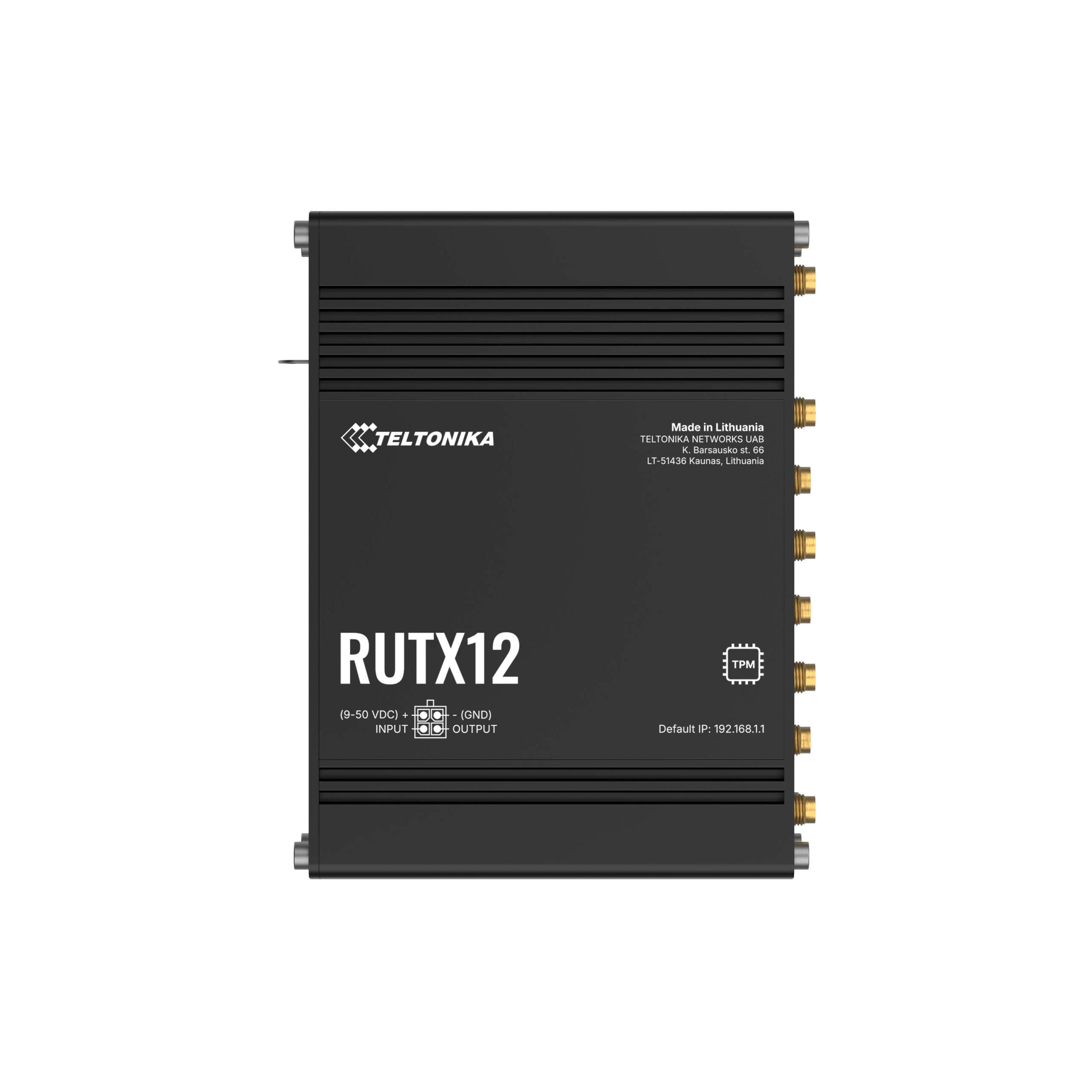
| Input voltage | 9-50 V DC, reverse polarity protection, surge/transient protection |
| Passive PoE input | Via LAN1 port, Mode B, 9-50 V DC. Not compatible with IEEE 802.3af, 802.3at or 802.3bt |
| Power consumption (idle) | Less than 4 W |
| Power consumption (max) | Less than 22 W |
| Power connector pinout | Power (red wire), Ground (black wire), Input (green wire), Output (white wire) |
| Physical | |
| Dimensions (W x H x D) | 132 x 44.2 x 95.1 mm (housing only, without connectors) |
| Weight | 540 g |
| Housing | Full aluminium |
| Mounting | DIN rail, wall mount, flat surface — all require additional mounting kit (sold separately) |
| SIM holders | 2 x external, front panel, Mini SIM (2FF) |
| Antenna connectors | 4 x SMA female (mobile), 2 x RP-SMA female (Wi-Fi), 1 x RP-SMA female (Bluetooth), 1 x SMA female (GNSS) |
| Environmental | |
| Operating temperature | -40 to +75 °C |
| Operating humidity | 10% to 90% non-condensing |
| Ingress protection | IP30 |
| Certifications | |
| Regulatory | CE, UKCA, EAC, UCRF, CITC, ANRT, ICASA, NOM, Anatel, RCM, SIRIM, NTC, NBTC, CB, E-mark, ETA-WPC, KC |
| In the Box | |
| Standard package contents | RUTX12 router, 24 W PSU, 4 x mobile SMA stub antennas, 2 x Wi-Fi magnetic SMA antennas, GNSS adhesive SMA antenna, Bluetooth magnetic SMA antenna, Ethernet cable 1.5 m, SIM adapter kit, Quick start guide |
| Note | PSU type varies by order code. Mounting kit not included — sold separately. |
| Warranty and Support | |
| Warranty | 2 years manufacturer warranty [VERIFY WITH DAN / TELTONIKA WIKI] |
| Remote management | Teltonika RMS — fleet management, FOTA, alerts, configuration push |
| Support | UK-based technical support from The Router Store |
| Firmware updates | Via WebUI, or remotely via Teltonika RMS (FOTA) |
Based on 0 reviews
Be the first to review “Teltonika RUTX12 Dual LTE Cat 6 Industrial Cellular Router”
Related products
- 4G CCTV, 4G Routers, Office 4G Router, Teltonika, Teltonika 4G Routers
Teltonika RUTX14 4G LTE CAT 12 Industrial Router
 4G CCTV, 4G Routers, Office 4G Router, Teltonika, Teltonika 4G Routers
Teltonika RUTX14 4G LTE CAT 12 Industrial Router
Teltonika RUTX14 4G LTE Industrial Router – CAT12 4G LTE IoT/M2M Router
- 4G LTE CAT12, Download up to 600 Mbps. Upload up to 150 Mbps
- 5 x Gigabit Ethernet ports
- Wave-2 802.11ac Dual-Band Wi-Fi and Bluetooth LE
- Dual SIM (SIM Failover)
- Equipped with advanced security features like multiple VPN’s, firewall & cyber attack prevention
- Compatible with Teltonika Remote Management System
 SKU: TELTONIKA-RUTX14-N
 - 4G CCTV, 4G Routers, Teltonika, Teltonika 4G Routers
Teltonika RUT956 Industrial 4G Router with RS232, RS485 and GNSS
4G CCTV, 4G Routers, Teltonika, Teltonika 4G RoutersTeltonika RUT956 Industrial 4G Router with RS232, RS485 and GNSS
The Teltonika RUT956 is a 4G LTE Cat 4 industrial router with dual SIM, RS232, RS485, GNSS, and a full suite of digital and analogue I/O. It combines cellular failover, serial device integration, and precise location tracking in a compact aluminium enclosure rated for -40 to +75 °C.
Key Features:
• 4G LTE Cat 4 – 150 Mbps down / 50 Mbps up, 3G and 2G fallback
• Dual Mini SIM (2FF) + integrated eSIM with configurable auto-failover
• RS232 (DB9) and RS485 serial interfaces for Modbus RTU, DNP3, DLMS/COSEM, and NTRIP
• GNSS: GPS, GLONASS, BeiDou, Galileo and QZSS with geofencing support
• 4 x digital/analogue I/O: dry input, isolated input, analogue 4-20 mA input, relay output
• 4 x RJ45 Ethernet (1 x WAN, 3 x LAN), 10/100 Mbps
• Wi-Fi 4 (802.11b/g/n) access point and station modes, up to 100 clients
• RutOS with OpenVPN, WireGuard, IPsec, Modbus TCP/RTU, MQTT, OPC UA, BACnet
• Teltonika RMS compatible – remote monitoring, FOTA, configuration management
• DIN rail, wall mount or flat surface mounting (kit required, sold separately)SKU: TELTONIKA-RUT956200100-N - 4G CCTV, 4G Routers, Manufacturers, Proroute, Proroute 4G Routers, Proroute Routers
Proroute H820 WRT 4G Router with 4 x LAN, 1 x WAN and WiFi – Industrial Grade M2M LTE 4G Router
4G CCTV, 4G Routers, Manufacturers, Proroute, Proroute 4G Routers, Proroute RoutersProroute H820 WRT 4G Router with 4 x LAN, 1 x WAN and WiFi – Industrial Grade M2M LTE 4G Router
The Proroute H820 embedded industrial 4G LTE router includes keep alive features such as Ping Reboot to ensure that the router will provide a reliable 4G LTE connection.
Ref : H820 4G Router
SKU: PRORT-H820-4G-CAT4-N


There are no reviews yet.