
-
×


Subtotal: £135.00
Available on back-order
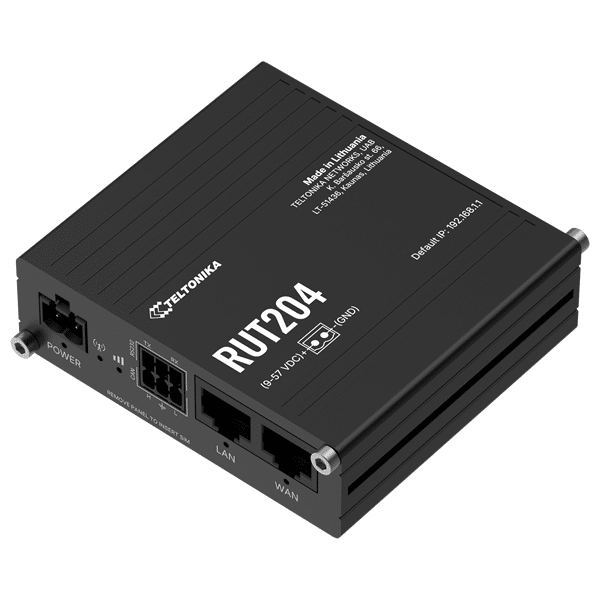
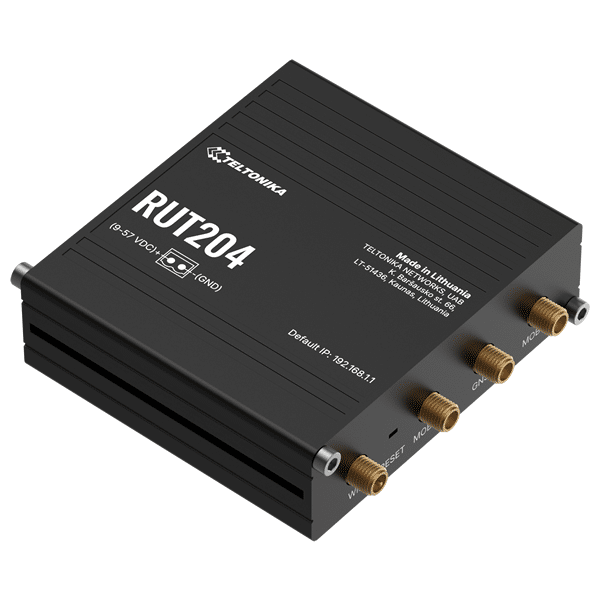
The Teltonika RUT204 is a compact 4G LTE Cat 4 router with a native CAN Bus interface, built for vehicle telematics, industrial machine monitoring, and mobile IoT deployments. It combines dual SIM failover, integrated GNSS, RS232 serial, active PoE input, and a wide 9-57 VDC power range in an anodised aluminium enclosure rated to -40 to +75°C.
Key Features:
• 4G LTE Cat 4 – 150 Mbps download / 50 Mbps upload with 3G and 2G fallback
• Native CAN Bus interface via 6-pin terminal block – CAN frame forwarding over IP; CANopen and J1939 client support on firmware roadmap
• Dual internal SIM slots (Mini SIM 2FF, double stacked tray) with automatic failover
• GNSS: GPS, GLONASS, BeiDou, Galileo and QZSS with geofencing and NMEA 0183
• RS232 serial interface (TX/RX) on 6-pin terminal block
• Active PoE input 802.3af Class 0 on LAN port; passive PoE input 16-57 VDC
• Wide-range 9-57 VDC DC power input with reverse polarity and surge protection
• Internal Micro SD slot up to 2 TB for local data logging
• Wi-Fi 4 (802.11b/g/n) – access point and station modes, up to 50 clients
• RutOS with OpenVPN, WireGuard, IPsec, Modbus, MQTT, DNP3 and RMS support
£127.50 Excl VAT
Available on back-order
The Teltonika RUT204 is a 4G LTE Cat 4 industrial router with an integrated CAN Bus interface, built for fleet telematics, vehicle diagnostics, and industrial machine connectivity. Unlike standard cellular routers that require an external CAN-to-IP converter, the RUT204 handles CAN frame forwarding over IP directly – reducing hardware count and installation complexity in mobile and fixed plant environments.
Alongside the CAN interface, the RUT204 carries RS232, integrated GNSS (GPS, GLONASS, BeiDou, Galileo, QZSS), dual internal SIM slots, active PoE input, and a wide 9-57 VDC power range. It runs RutOS, the same Linux-based operating system used across the Teltonika Teltonika 4G router range, giving access to OpenVPN, WireGuard, IPsec, Modbus TCP, MQTT, DNP3, and full Teltonika RMS remote management. Power consumption is under 3.5 W at maximum load – well suited to battery and solar-backed installations.
The RUT204 connects directly to a vehicle’s CAN bus via the 6-pin terminal block. CAN frames are forwarded over the cellular connection to a fleet management platform without an external converter. The integrated GNSS provides real-time position data alongside CAN payload data. The 9-57 VDC power range covers 12 V and 24 V vehicle electrical systems, and the -40 to +75°C operating range handles cab and underbonnet environments.
Machines using CAN-based control systems – packaging equipment, agricultural machinery, construction plant – can be monitored remotely over 4G without modifying existing CAN wiring. The RS232 interface handles legacy serial equipment on the same installation. Local data is buffered to the internal SD card during connectivity gaps and pushed to the server when the link recovers.
Smart meters and grid edge devices using DLMS/COSEM or DNP3 can be connected via RS232 or Ethernet. GNSS positioning identifies the asset location within the RMS dashboard. The wide voltage input suits solar charge controller outputs and battery-backed distribution boards without a separate DC converter. Power consumption below 3.5 W minimises draw on limited energy budgets.
Traffic management controllers, bus and tram telemetry, and roadside asset monitoring all benefit from the combined CAN, GNSS, and 4G capability in a single compact unit. The dual SIM failover maintains connectivity if a primary network operator loses coverage at a specific location. Geofencing triggers in RutOS can send alerts via SMS or RMS when a mobile asset leaves a defined zone.
The sub-3.5 W maximum consumption and 9-57 VDC input make the RUT204 practical for solar-backed remote monitoring enclosures where power budget is constrained. Modbus TCP/RTU and MQTT connect sensors and PLCs. Data to Server pushes readings to Azure IoT Hub or AWS IoT Core over the cellular link. For inbound remote access, a fixed IP SIM removes the carrier-grade NAT constraint and allows direct VPN connection to the device.
The RUT204 includes integrated CAN hardware on the 6-pin terminal block (pins 4 and 6 for CAN H and CAN L; pin 2 and 5 for ground). The current live firmware feature is CAN Gateway, which forwards CAN frames over IP networks – allowing a back-end system to receive raw CAN data from the vehicle or machine over the cellular link. CANopen Client and SAE J1939 Client are listed on Teltonika’s firmware roadmap and are not yet live in the current release. Check the Teltonika RutOS release notes for current status before specifying the RUT204 if J1939 parsing is a requirement.
The RUT204 uses Mini SIM (2FF) format in two internal slots accessed by removing the front panel. The double stacked tray fits both SIMs in a compact footprint. The hardware specification sheet (datasheet v1.00, 2026-04-29) does not list eSIM capability – confirm with Teltonika or the routerstore.com team before ordering if eSIM is required for your deployment. Standard dynamic IP SIMs and fixed IP SIMs work on this device.
Yes. The RUT204 supports Teltonika RMS for remote configuration, monitoring, firmware updates, and access. RMS includes zero-touch provisioning, so units can be pre-configured before dispatch and brought online without an engineer on site. RMS operates on a credit model – RMS credits are available from routerstore.com.
The RUT204 supports two PoE input modes on the LAN port. Active PoE input is 802.3af Class 0, accepting up to 12.94 W from a standard 802.3af PoE switch or injector. Passive PoE input is over spare pairs at 16-57 VDC – useful where a non-standard passive injector is already in place. The primary 2-pin DC power connector accepts 9-57 VDC. All three power paths are separate options, not simultaneous inputs.
Yes. RutOS on the RUT204 includes OpenVPN (client and server, 27 encryption methods), WireGuard (client and server), IPsec with IKEv1 and IKEv2, GRE, L2TP over IPsec, DMVPN Phase 2 and 3, ZeroTier, Tinc, and OpenConnect. For inbound connections without port forwarding, a fixed IP SIM paired with an appropriate VPN configuration is the standard approach. Standard SIM cards sit behind carrier-grade NAT and cannot accept inbound connections directly.
Yes. The RUT204 includes a dedicated GNSS receiver supporting GPS, GLONASS, BeiDou, Galileo and QZSS. Position data is available via the WebUI, SMS, NMEA 0183 stream, TAVL server, and Teltonika RMS. Multiple geofence zones can be configured in RutOS with alerts sent via SMS or RMS when a device enters or leaves a zone. The GNSS antenna connector is a dedicated SMA female on the rear panel, separate from the mobile antenna ports.
If you need dual SIM hardware failover without a CAN Bus requirement, the Teltonika RUT series includes models such as the RUT901 and RUT956. For RS232 and RS485 serial without CAN, the RUT956 covers both serial standards alongside 4G and GNSS. For remote management of the RUT204 fleet, Teltonika RMS credits are available directly from routerstore.com. For SIM connectivity, the routerstore.com SIM connectivity range includes fixed IP SIMs for VPN and remote access deployments and IoT data SIMs for machine-to-machine traffic. For 4G antenna upgrades beyond the included stub antennas, see the 4G antennas category – external antennas on short low-loss cable runs consistently outperform stub antennas inside metal enclosures.
| Cellular Connectivity | |
| Cellular standard | 4G LTE Cat 4 |
| Max download | 150 Mbps (4G LTE) |
| Max upload | 50 Mbps (4G LTE) |
| 3G | Up to 21 Mbps download / 5.76 Mbps upload |
| 2G | Up to 236.8 kbps download / 236.8 kbps upload |
| 3GPP release | Release 9 |
| LTE FDD bands | B1, B3, B5, B7, B8, B20, B28 (Europe / Australia / Asia-Pacific variant) |
| LTE TDD bands | B38, B40, B41 |
| 3G bands | B1, B5, B8 |
| 2G bands | B3, B8 |
| SIM slots | 2 x internal (double stacked tray); automatic failover on weak signal, data limit, roaming, no network, connection failure |
| SIM format | Mini SIM (2FF), 1.8 V / 3 V |
| SIM features | Auto APN, band lock, operator block/allow list, SIM idle protection, SIM PIN management, multiple PDN, SMS management |
| Mobile antenna ports | 2 x SMA female (MAIN and AUX, rear panel) |
| Wi-Fi | |
| Wi-Fi standard | 802.11b/g/n (Wi-Fi 4) |
| Wi-Fi modes | Access Point (AP), Station (STA) |
| Wi-Fi security | WPA3-SAE, WPA3-EAP, WPA2-PSK, WPA2-Enterprise (PEAP, EAP-TLS), OWE, AES-CCMP, TKIP, 802.11w PMF |
| Max Wi-Fi clients | 50 |
| Wi-Fi features | Fast roaming (802.11r), BSS transition (802.11v), radio resource measurement (802.11k), MAC filter, QR code generator, Hotspot 2.0 |
| Wi-Fi antenna port | 1 x RP-SMA female (rear panel) |
| Ethernet | |
| WAN port | 1 x RJ45, 10/100 Mbps, IEEE 802.3 / 802.3u / 802.3az, auto MDI/MDIX (configurable as LAN) |
| LAN port | 1 x RJ45, 10/100 Mbps, IEEE 802.3 / 802.3u / 802.3az, auto MDI/MDIX |
| Processor and Memory | |
| CPU | Mediatek, 575/580 MHz, MIPS 24KEc |
| RAM | 128 MB DDR2 |
| Flash storage | 32 MB NOR Flash |
| SD card | Internal Micro SD slot; up to 2 TB; FAT32, NTFS, ext2, ext3, ext4; Samba share support |
| Software and Operating System | |
| Operating system | RutOS (OpenWrt based Linux) |
| Routing | Static, BGP, OSPF v2, RIP v1/v2, EIGRP, NHRP, policy-based routing |
| Network features | DHCP, VLAN (port and tag-based), QoS/SQM, DDNS (77 providers), DNS over HTTPS, load balancing, VoIP passthrough (H.323, SIP-ALG), Hotspot, Hotspot 2.0 |
| Network backup | Wi-Fi WAN, mobile, VRRP, wired - each configurable as automatic failover |
| VPN | OpenVPN (client and server, 27 encryption methods), WireGuard (client and server), IPsec (XFRM, IKEv1, IKEv2, 14 encryption methods), GRE, PPTP, L2TP (v3, over IPsec), Stunnel, DMVPN (Phase 2 and 3), SSTP, ZeroTier, Tinc, EoIP, OpenConnect |
| Industrial protocols | Modbus TCP/RTU (client and server), OPC UA (client and server, TCP), DNP3 (TCP master and outstation, RTU), DLMS/COSEM (client, TCP and RTU), BACnet RTU (router mode), CAN Gateway (CAN frames over IP), MQTT (broker and publisher), Data to Server (HTTP/S, MQTT, Azure MQTT) |
| Security | Pre-shared key, X.509 certificates, TACACS+, RADIUS, IP/login blocking, time-based login blocking, DMZ, NAT, NAT64, DDoS prevention, port scan prevention, 802.1x, mobile quota control, web filter, certificate manager (CA, Let's Encrypt, SCEP) |
| Management | WebUI (HTTP/HTTPS), CLI, SSH (v1, v2), SNMP (v1/v2/v3 with trap), TR-069, JSON-RPC, FOTA, SMS management, RMS |
| Cloud platforms | Teltonika RMS, Azure IoT Hub (with DPS zero-touch provisioning), AWS IoT Core (with Jobs), ThingWorx, Cumulocity / Cloud of Things |
| Interfaces | |
| Serial | RS232 (TX and RX) via 6-pin terminal block; functions: Serial over IP, Modbus RTU gateway, NTRIP client, console, modem |
| CAN Bus | Integrated CAN interface via 6-pin terminal block; CAN Gateway (CAN frames over IP) - live; CANopen Client and SAE J1939 Client - firmware roadmap (planned) |
| GNSS | GPS, GLONASS, BeiDou, Galileo, QZSS; NMEA 0183; NTRIP (RTCM over Internet); geofencing (multiple zones); TAVL server; RMS position reporting; dedicated SMA antenna port |
| SD card | Internal Micro SD (remove front panel to access); up to 2 TB |
| Status LEDs | 1 x RGB connection type (red = 2G, yellow = 3G, green = 4G); 1 x RGB signal strength; 2 x ETH status; 1 x power |
| Reset button | Reboot / user default reset / factory reset |
| Power | |
| Power connector | 2-pin industrial DC power socket |
| Input voltage | 9-57 VDC; reverse polarity protection 100 V max; surge protection min 64.4 V / max 71.2 V breakdown voltage |
| Active PoE input | 802.3af Class 0 (12.94 W) on LAN port |
| Passive PoE input | Over spare pairs 4,5(+) / 7,8(-) on LAN port; 16-57 VDC |
| Power consumption | Idle: <2 W; Max: <3.5 W |
| Physical | |
| Dimensions (W x H x D) | 83 x 25 x 83 mm |
| Weight | 140 g |
| Housing | Anodised aluminium housing and panels |
| Antenna connectors | 2 x SMA female (mobile MAIN and AUX, rear); 1 x RP-SMA female (Wi-Fi, rear); 1 x SMA female (GNSS, rear) |
| Mounting | DIN rail, wall mount, flat surface (all require additional mounting kit, sold separately) |
| IP rating | IP30 |
| Environmental | |
| Operating temperature | -40 to +75 °C |
| Operating humidity | 10% to 90% non-condensing |
| Ingress protection | IP30 |
| Certifications and Compliance | |
| Regulatory | CE, UKCA, CB, RCM, EAC, UCRF, RoHS |
| In the Box | |
| Standard package (RUT2040AAAA0) | RUT204 router, quick start guide, 2-pin terminal block, 2 x 3-pin connector, hex key, Ethernet cable 1.5 m, SIM adapter kit. Note: no PSU included - power via DC connector or PoE. |
| Mounting kit | Not included. DIN rail and wall mount kits sold separately. |
| Warranty and Support | |
| Warranty | 2-year manufacturer warranty |
| Support | UK-based technical support - call 0300 124 6181 |

The DrayTek Vigor 2620Ln is a low cost router/firewall with an integrated LTE/4G modem. Supporting speeds of up to 150Mbps downstream and 50Mbps Upstream, the DrayTek Vigor 2620Ln provides high speed mobile broadband with versatile connectivity.
With Dual-SIM cellular (3G/4G/LTE) modem, VDSL2 / ADSL2+ modem (Phone Line Broadband) and Ethernet (RJ45) the Vigor 2620Ln offers users a highly adaptable router with non-stop connectivity. Ideal for mobile internet connectivity with the built-in 4G, the Vigor 2620Ln offers users the benefits of DrayTek firewall, with optional web content filtering, shared by multiple users on wireless or wired connections to the unit.
No Longer Stocked

Buy the Billion 8206AZ if you need a home office VDSL/ADSL router with embedded 4G LTE modem for back-up resilience. The Billion 8206AZ is a triple WAN – EWAN, LTE, and VDSL & ADSL2 firewall router.
With WiFi 802.11ac (5GHz) 802.11n (2.4GHz) and 4 Gigabit ethernet ports the 8206AZ has high speed capabilities for local networking requirements.
WE NO LONGER STOCK BILLION ROUTERS

The Teltonika RUTX12 is a powerful dual LTE Cat 6 industrial router designed for mission-critical applications. It offers uninterrupted connectivity with dual LTE modems, providing speeds up to 600 Mbps with load balancing. The robust router features advanced security, remote management, and a durable aluminum housing suitable for harsh environments.Top 6 Key Features:

Teltonika RUT950 4G router with Ethernet, WiFi and Dual SIM card slots for 4G SIM failover.
We offer the best prices for the RUT950 in the UK and hold large stocks for next working day delivery.


There are no reviews yet.