
-
×


Subtotal: £185.00
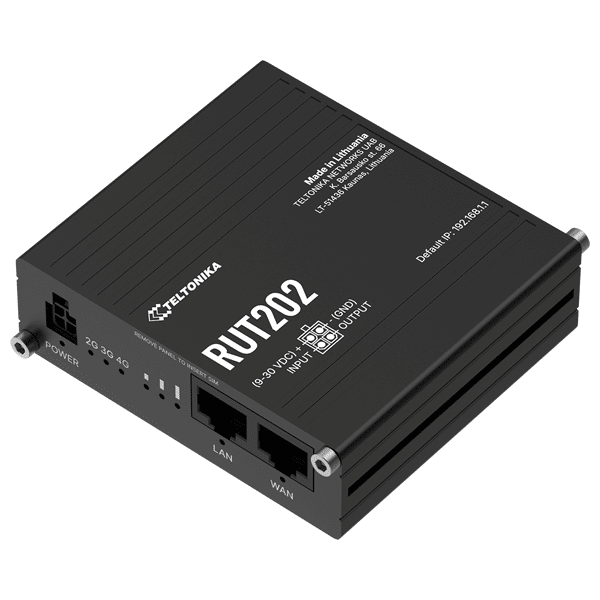
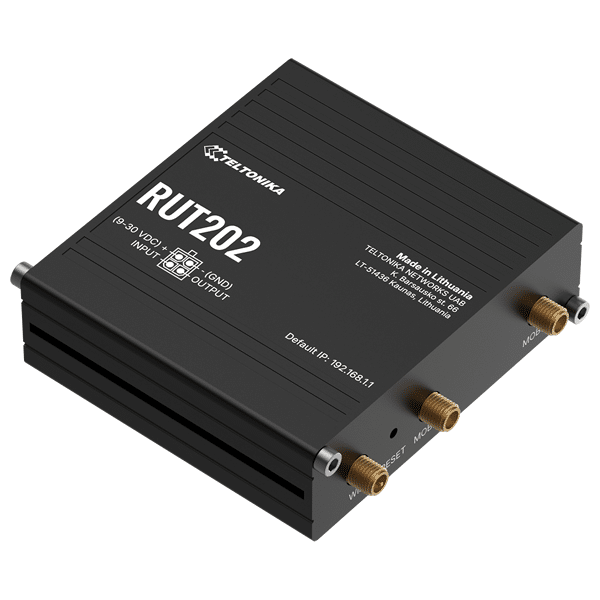
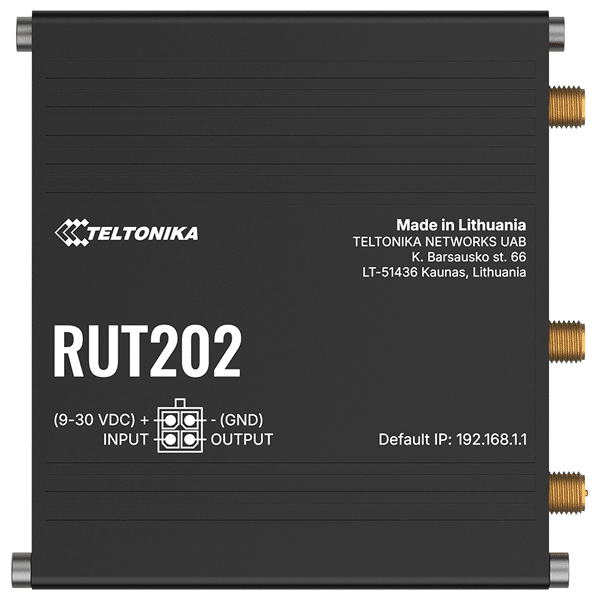
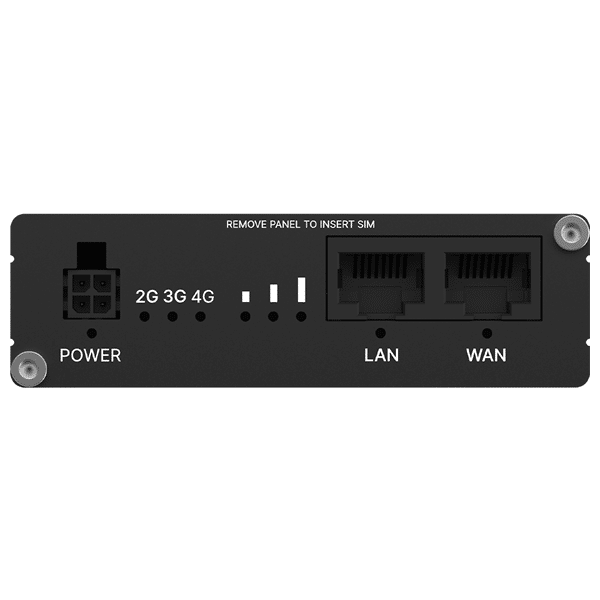
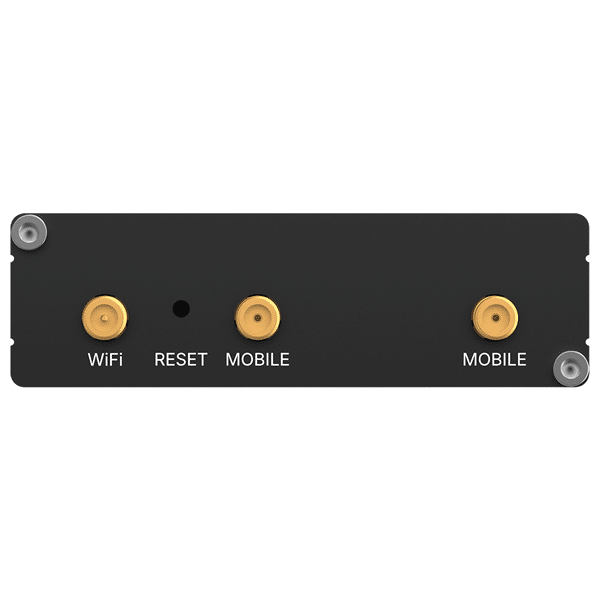
The Teltonika RUT202 is a compact dual SIM 4G LTE Cat 4 industrial router built for embedded and space-constrained installations. It carries two internal Mini SIM slots with automatic failover, digital I/O on the power connector, passive PoE input, and the full RutOS software stack in an anodised aluminium enclosure measuring just 83 x 25 x 74 mm.
Key Features:
• 4G LTE Cat 4 – 150 Mbps download / 50 Mbps upload with 3G and 2G fallback
• Dual internal SIM slots (Mini SIM 2FF, double stacked tray) with automatic failover on weak signal, data limit, roaming, no network, or connection failure
• Digital input and digital output on 4-pin power connector – 0-6 V logic low, 8-30 V logic high; open collector output max 30 V / 300 mA
• Passive PoE input via LAN1 spare pairs, 9-30 VDC – Mode B, not compatible with 802.3af/at/bt
• Wi-Fi 4 (802.11b/g/n) – access point and station modes, WPA3-SAE, up to 50 clients
• 9-30 VDC wide-range DC input via 4-pin industrial power connector; reverse polarity and surge protection
• RutOS with OpenVPN, WireGuard, IPsec, Modbus TCP, OPC UA, MQTT, DNP3 and RMS support
• Anodised aluminium housing; IP30; -40 to +75°C operating range
• DIN rail, wall mount and flat surface mounting (kit sold separately)
• Teltonika RMS compatible – zero-touch provisioning and remote management
£90.00 Excl VAT
The Teltonika RUT202 is a compact 4G LTE Cat 4 industrial router with dual internal SIM slots, built for embedded installations where space is constrained and continuous connectivity is a requirement. At 83 x 25 x 74 mm and 130 g, the RUT202 fits inside panels, roadside cabinets, retail point-of-sale enclosures, and DIN rail assemblies where a larger device would not. The internal double stacked SIM tray protects both SIM cards from vibration and tampering – a practical advantage over external SIM holders in mobile and outdoor environments.
The RUT202 runs RutOS – the same OpenWrt-based Linux operating system across the full Teltonika range. It includes digital input and output on the 4-pin power connector, passive PoE input on the LAN port, Wi-Fi 4, and the complete RutOS protocol stack: OpenVPN, WireGuard, IPsec, Modbus TCP, OPC UA, DNP3, DLMS/COSEM, MQTT, and Teltonika RMS. The RUT202 does not carry serial ports, GNSS, or CAN – for RS232/RS485 serial connectivity see the RUT901 or RUT906; for GNSS see the RUT956.
The RUT202’s 25 mm height fits a single DIN rail slot. Dual SIM provides carrier redundancy in a footprint smaller than most single-SIM alternatives. The internal SIM tray removes the risk of SIM cards working loose in vibrating enclosures – a genuine reliability issue with external SIM holders on machinery and transport installations. Power comes from the existing panel DC supply via the 4-pin connector, or via passive PoE on the LAN port from a 9-30 V injector.
Retail branches, kiosks, and enterprise sites use the RUT202 as a cellular failover device alongside a primary fixed-line connection. When the broadband link drops, RutOS switches to 4G automatically via the mobile WAN. The dual SIM allows two separate network operators – if the primary SIM loses signal or hits its data limit, the router switches to the second SIM without manual intervention. For inbound management access from head office, a fixed IP SIM on one or both slots removes the carrier NAT constraint.
Parking meters, EV charge point controllers, public Wi-Fi kiosks, and roadside monitoring units all benefit from the compact form factor and dual SIM redundancy. The E-mark certification covers vehicle and roadside applications under ECE R10. Passive PoE input lets the RUT202 take power from an existing PoE circuit in a roadside cabinet without a separate DC supply. The Wi-Fi access point function serves local devices – a connected kiosk display or a technician’s laptop during maintenance.
Smart meters and remote monitoring units using DLMS/COSEM or DNP3 connect to the RUT202 over Ethernet. Modbus TCP sends data from connected sensors and controllers to a central platform via MQTT or the Data to Server function. The digital input monitors an alarm dry contact or door switch; the digital output drives a relay or indicator. RutOS delivers the connection event via email or RMS alert. The 9-30 VDC input suits existing DC distribution in utility substations and metering cabinets.
PLCs and HMIs with Ethernet ports connect directly to the RUT202’s LAN port. Modbus TCP client and server, OPC UA, and BACnet give the device a direct interface to industrial automation protocols without additional gateway hardware. Dual SIM failover keeps the PLC-to-SCADA link active if the primary operator loses coverage at the site. For applications requiring RS232 or RS485 serial alongside dual SIM, step up to the RUT901 or RUT906.
The RUT200 is a single SIM device. The RUT202 adds a second internal SIM slot with automatic failover – making it the smallest dual SIM router in the Teltonika range. Both share the same physical enclosure dimensions and the same RutOS feature set. The RUT202 also adds a third connection type status LED and three signal strength LEDs versus the simpler LED arrangement on the RUT200. If dual SIM failover is a requirement, the RUT202 is the correct choice. If a single SIM is sufficient and cost is the priority, the RUT200 is the alternative.
The RUT202 uses Mini SIM (2FF) format in both slots. The SIMs sit in a double stacked internal tray accessed by removing the front panel – the label on the front reads “REMOVE PANEL TO INSERT SIM”. A SIM adapter kit is included in the box to convert Micro or Nano SIMs to 2FF. The internal placement protects SIM cards from physical damage and tampering. Standard dynamic IP SIMs and fixed IP SIMs are compatible.
No. The passive PoE input on the RUT202 LAN port uses Mode B (spare pairs), 9-30 VDC only. It is not compatible with IEEE 802.3af, 802.3at, or 802.3bt injectors or switches, which operate at 48 V. Connecting a standard PoE switch or injector will damage the router. Use a matched passive PoE injector supplying 9-30 VDC. Alternatively, power the RUT202 via the primary 4-pin DC connector.
Yes. The RUT202 supports Teltonika RMS for remote configuration, monitoring, firmware updates (FOTA), and terminal access. RMS zero-touch provisioning allows devices to be pre-configured before dispatch and brought online remotely. RMS operates on a credit model – RMS credits are available from routerstore.com. For inbound VPN connections as an alternative to RMS, a fixed IP SIM is required on standard carrier networks.
Yes. RutOS includes OpenVPN (client and server, 27 encryption methods), WireGuard, IPsec with IKEv1 and IKEv2, GRE, L2TP over IPsec, DMVPN Phase 2 and 3, ZeroTier, Tinc, SSTP, EoIP, and OpenConnect. For a full overview of VPN on cellular routers – including the difference between RMS-proxied access and a direct VPN tunnel – see the routerstore.com explainer. For direct inbound VPN connections, a fixed IP SIM removes the carrier NAT barrier that blocks inbound connections on standard SIM cards.
The UK order code RUT202AADAA0 includes the RUT202 router, a 9 W UK PSU, 2 x mobile SMA stub antennas, 1 x Wi-Fi RP-SMA stub antenna, an Ethernet cable (1.5 m), a SIM adapter kit (for converting Micro or Nano SIMs to 2FF), a hex key, and a quick start guide. A mounting kit for DIN rail or wall mount is not included and is sold separately. For enclosure installations, external antennas on short low-loss cable runs will outperform the included stub antennas mounted inside a metal cabinet.
For dual SIM with RS232 and RS485 serial ports, the Teltonika RUT901 and RUT906 are the natural step up. For a single SIM compact router in the same enclosure, see the Teltonika RUT200. For higher-throughput dual SIM with Gigabit Ethernet and Wi-Fi 6, the RUTX11 is the next tier. For SIM connectivity alongside the RUT202, the routerstore.com SIM range includes fixed IP SIMs for remote access and VPN, and roaming SIMs for cross-border deployments. For antenna upgrades beyond the included stub antennas, the 4G antenna range includes magnetic mount, panel, and DIN rail options compatible with the RUT202’s SMA and RP-SMA connectors. Teltonika RMS credits are available directly from routerstore.com.
| Cellular Connectivity | |
| Cellular standard | 4G LTE Cat 4 |
| Max download | 150 Mbps (4G LTE) |
| Max upload | 50 Mbps (4G LTE) |
| 3G | Up to 21 Mbps download / 5.76 Mbps upload |
| 2G | Up to 236.8 kbps download / 236.8 kbps upload |
| 3GPP release | Release 9 |
| LTE FDD bands | B1, B3, B5, B7, B8, B20, B28 (EMEA / Thailand / Australia / New Zealand variant) |
| LTE TDD bands | B38, B40, B41 |
| 3G bands | B1, B8 |
| 2G bands | B3, B8 |
| SIM slots | 2 x internal (double stacked tray); automatic failover on weak signal, data limit, SMS limit, roaming, no network, network denied, connection failure |
| SIM format | Mini SIM (2FF), 1.8 V / 3 V |
| SIM features | Auto APN, band lock, operator block/allow list, multiple PDN, SIM idle protection, SIM PIN management, bridge, passthrough |
| Mobile antenna ports | 2 x SMA female (MAIN and AUX, rear panel) |
| Wi-Fi | |
| Wi-Fi standard | 802.11b/g/n (Wi-Fi 4) |
| Wi-Fi modes | Access Point (AP), Station (STA) |
| Wi-Fi security | WPA3-SAE, WPA3-EAP, WPA2-PSK, WPA2-Enterprise (PEAP, EAP-TLS with PKCS#12), OWE, AES-CCMP, TKIP, 802.11w PMF |
| Max Wi-Fi clients | 50 |
| Wi-Fi features | Fast roaming (802.11r), BSS transition (802.11v), radio resource measurement (802.11k), MAC filter, QR code generator, TravelMate, Hotspot 2.0 |
| Wi-Fi antenna port | 1 x RP-SMA female (rear panel) |
| Ethernet | |
| WAN port | 1 x RJ45, 10/100 Mbps, IEEE 802.3 / 802.3u / 802.3az, auto MDI/MDIX (configurable as LAN) |
| LAN port | 1 x RJ45, 10/100 Mbps, IEEE 802.3 / 802.3u, auto MDI/MDIX |
| Processor and Memory | |
| CPU | Mediatek, 580 MHz, MIPS 24KEc |
| RAM | 128 MB DDR2 |
| Flash storage | 32 MB SPI Flash |
| Software and Operating System | |
| Operating system | RutOS (OpenWrt based Linux) |
| Routing | Static, BGP, OSPF v2, RIP v1/v2, EIGRP, NHRP, policy-based routing |
| Network features | DHCP, VLAN (port and tag-based), QoS/SQM, DDNS (77 providers), DNS over HTTPS, load balancing, VoIP passthrough (H.323, SIP-ALG), Hotspot, Hotspot 2.0, SSHFS |
| Network backup | Wi-Fi WAN, mobile, VRRP, wired - each configurable as automatic failover |
| VPN | OpenVPN (client and server, 27 encryption methods), WireGuard (client and server), IPsec (XFRM, IKEv1, IKEv2, 14 encryption methods), GRE, PPTP, L2TP (v3, over IPsec), Stunnel, DMVPN (Phase 2 and 3), SSTP, ZeroTier, Tinc, EoIP, OpenConnect |
| Industrial protocols | Modbus TCP (client and server, custom registers), OPC UA (client and server, TCP), BACnet (TCP, router mode, BBMD support), DNP3 (station and outstation, TCP), DLMS/COSEM (client, TCP), MQTT (broker and publisher), Data to Server (HTTP/S, MQTT, Azure MQTT) |
| Security | Pre-shared key, X.509 certificates, TACACS, RADIUS, IP/login blocking, time-based login blocking, DMZ, NAT, NAT64, DDoS prevention, port scan prevention, 802.1x, VLAN, mobile quota control, web filter, certificate manager (CA, Let's Encrypt, SCEP) |
| Management | WebUI (HTTP/HTTPS), CLI, SSH (v1, v2), SNMP (v1/v2/v3 with trap), TR-069, JSON-RPC, FOTA, SMS management, call actions, RMS |
| Cloud platforms | Teltonika RMS, Azure IoT Hub (with DPS zero-touch provisioning), AWS IoT Core (with Jobs), ThingWorx, Cumulocity / Cloud of Things |
| Interfaces | |
| Digital input | 1 x; 0-6 V = logic low, 8-30 V = logic high; on 4-pin power connector (green wire) |
| Digital output | 1 x; open collector; max 30 V / 300 mA; on 4-pin power connector (white wire) |
| I/O events | Email, RMS, SMS; I/O juggler for conditional event triggers |
| Serial interfaces | None |
| GNSS | None |
| Status LEDs | 3 x connection type status (2G/3G/4G), 3 x signal strength, 2 x LAN status, 1 x power |
| Reset button | Reboot / user default reset / factory reset |
| Power | |
| Power connector | 4-pin industrial DC power socket (pin order: Power/red, Ground/black, Input/green, Output/white) |
| Input voltage | 9-30 VDC; reverse polarity protection; surge protection 31 VDC 10us max |
| Passive PoE input | Mode B over spare pairs on LAN1 port; 9-30 VDC; not compatible with 802.3af, 802.3at or 802.3bt |
| Power consumption | <6.5 W max |
| Physical | |
| Dimensions (W x H x D) | 83 x 25 x 74 mm (verify: flyer states 83 x 25 x 83 mm - confirm against unit before publishing) |
| Weight | 130 g |
| Housing | Anodised aluminium housing and panels |
| Antenna connectors | 2 x SMA female (mobile MAIN and AUX, rear); 1 x RP-SMA female (Wi-Fi, rear) |
| Mounting | DIN rail, wall mount, flat surface (all require additional mounting kit, sold separately) |
| IP rating | IP30 |
| Environmental | |
| Operating temperature | -40 to +75 °C |
| Operating humidity | 10% to 90% non-condensing |
| Ingress protection | IP30 |
| Certifications and Compliance | |
| Regulatory | CE, UKCA, RCM, CB, WEEE |
| Vehicle | E-mark (ECE R10) |
| In the Box | |
| UK order code RUT202AADAA0 | RUT202 router, 9 W UK PSU, 2 x mobile SMA stub antennas, 1 x Wi-Fi RP-SMA stub antenna, Ethernet cable 1.5 m, SIM adapter kit, hex key, quick start guide |
| Mounting kit | Not included. DIN rail and wall mount kits sold separately. |
| Warranty and Support | |
| Warranty | 2-year manufacturer warranty |
| Support | UK-based technical support - call 0300 124 6181 |

The Teltonika RUTX12 is a powerful dual LTE Cat 6 industrial router designed for mission-critical applications. It offers uninterrupted connectivity with dual LTE modems, providing speeds up to 600 Mbps with load balancing. The robust router features advanced security, remote management, and a durable aluminum housing suitable for harsh environments.Top 6 Key Features:


Buy the Billion 8206AZ if you need a home office VDSL/ADSL router with embedded 4G LTE modem for back-up resilience. The Billion 8206AZ is a triple WAN – EWAN, LTE, and VDSL & ADSL2 firewall router.
With WiFi 802.11ac (5GHz) 802.11n (2.4GHz) and 4 Gigabit ethernet ports the 8206AZ has high speed capabilities for local networking requirements.
WE NO LONGER STOCK BILLION ROUTERS


There are no reviews yet.