
No products in the basket.
Accessories, Teltonika, Teltonika Accessories
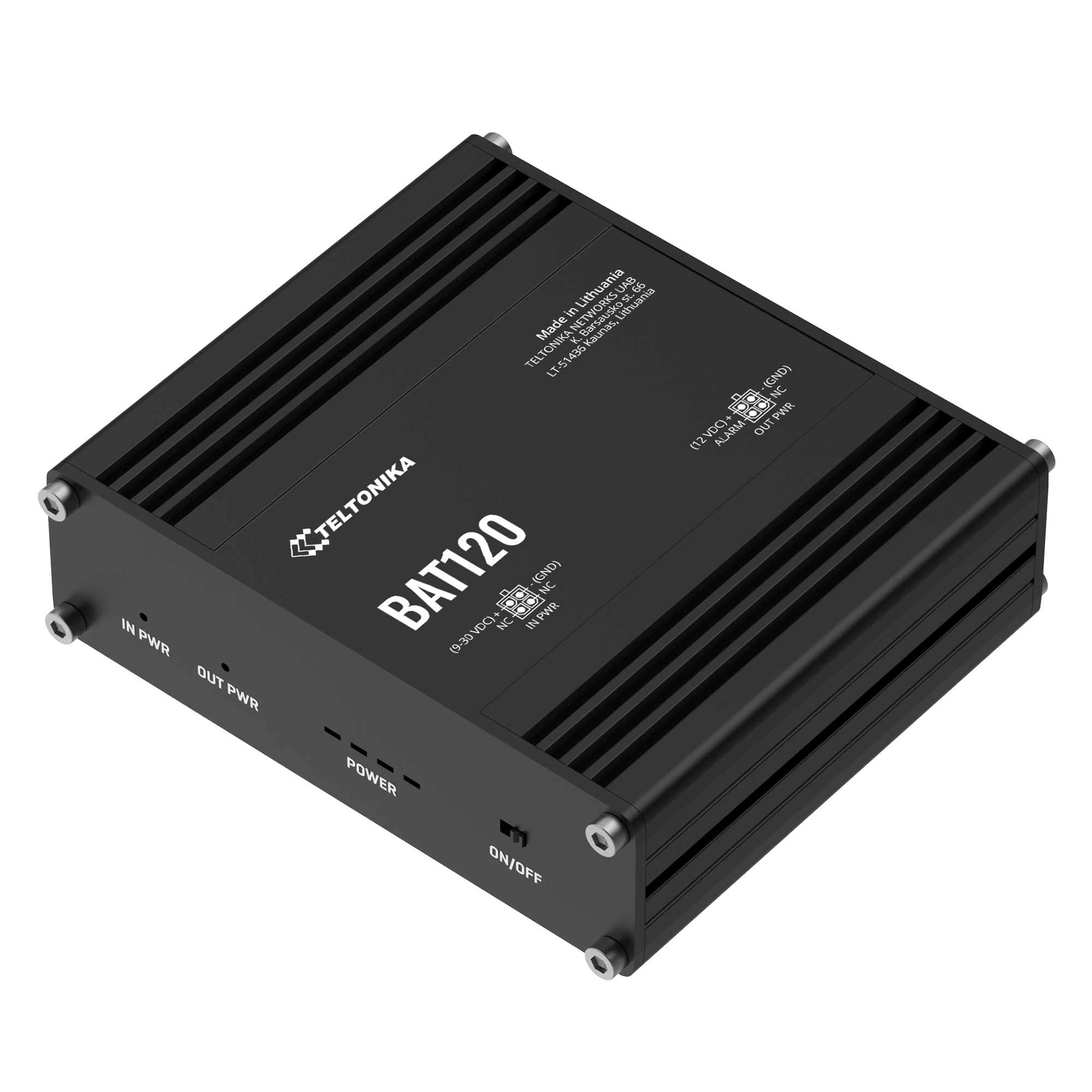
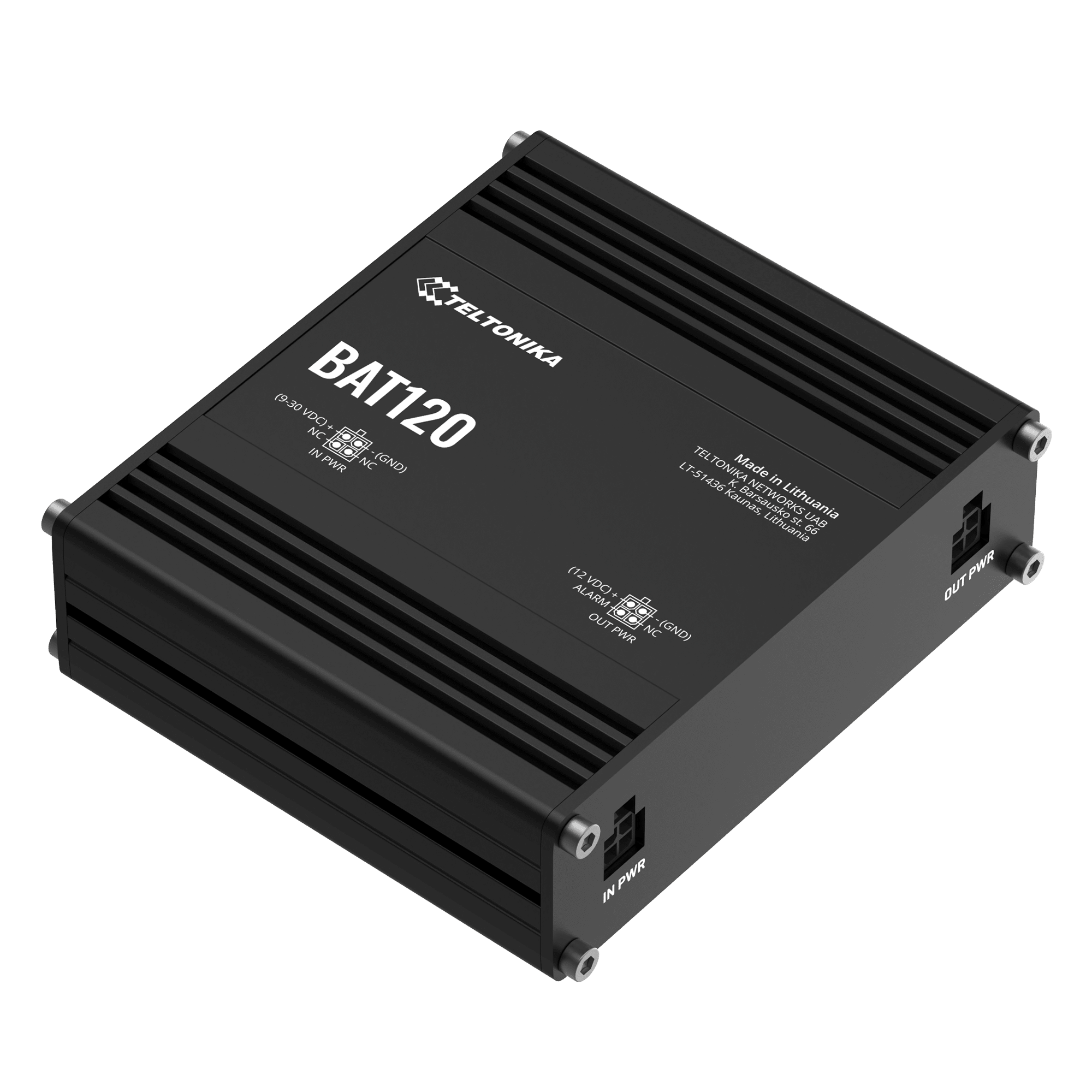
Teltonika BAT120 UPS Battery Backup for Teltonika Routers
The Teltonika BAT120 is a compact industrial UPS that keeps any compatible Teltonika device running for up to 6 hours when mains power fails. It connects inline between your existing PSU and router using the standard 4-pin DC connector, with no software configuration required.
Key Features:
• Up to 6 hours battery backup from two 18650 Li-Ion cells (2600 mAh, 17 Wh)
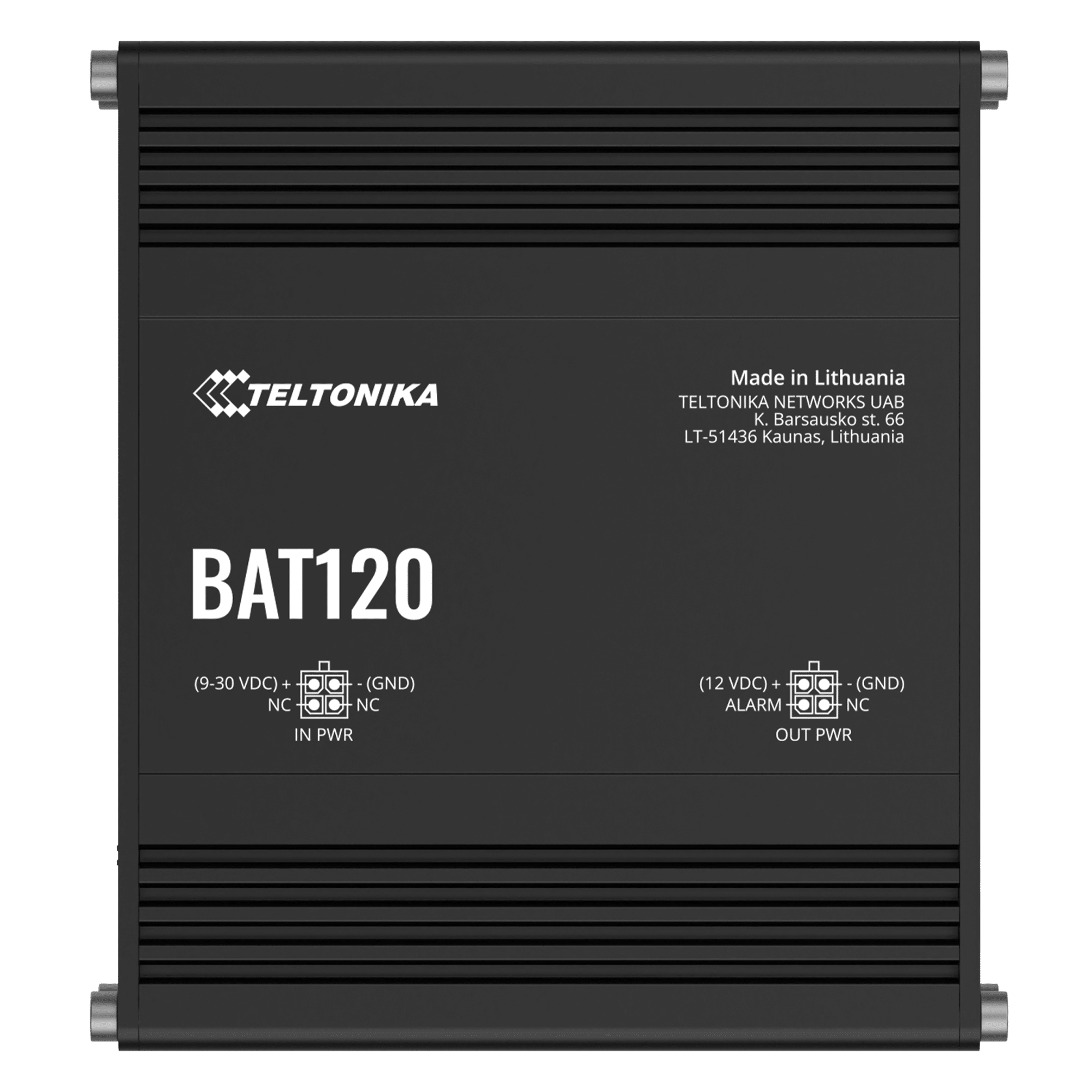
• Input: 9-30 V DC passthrough; output: 12 V DC in battery mode
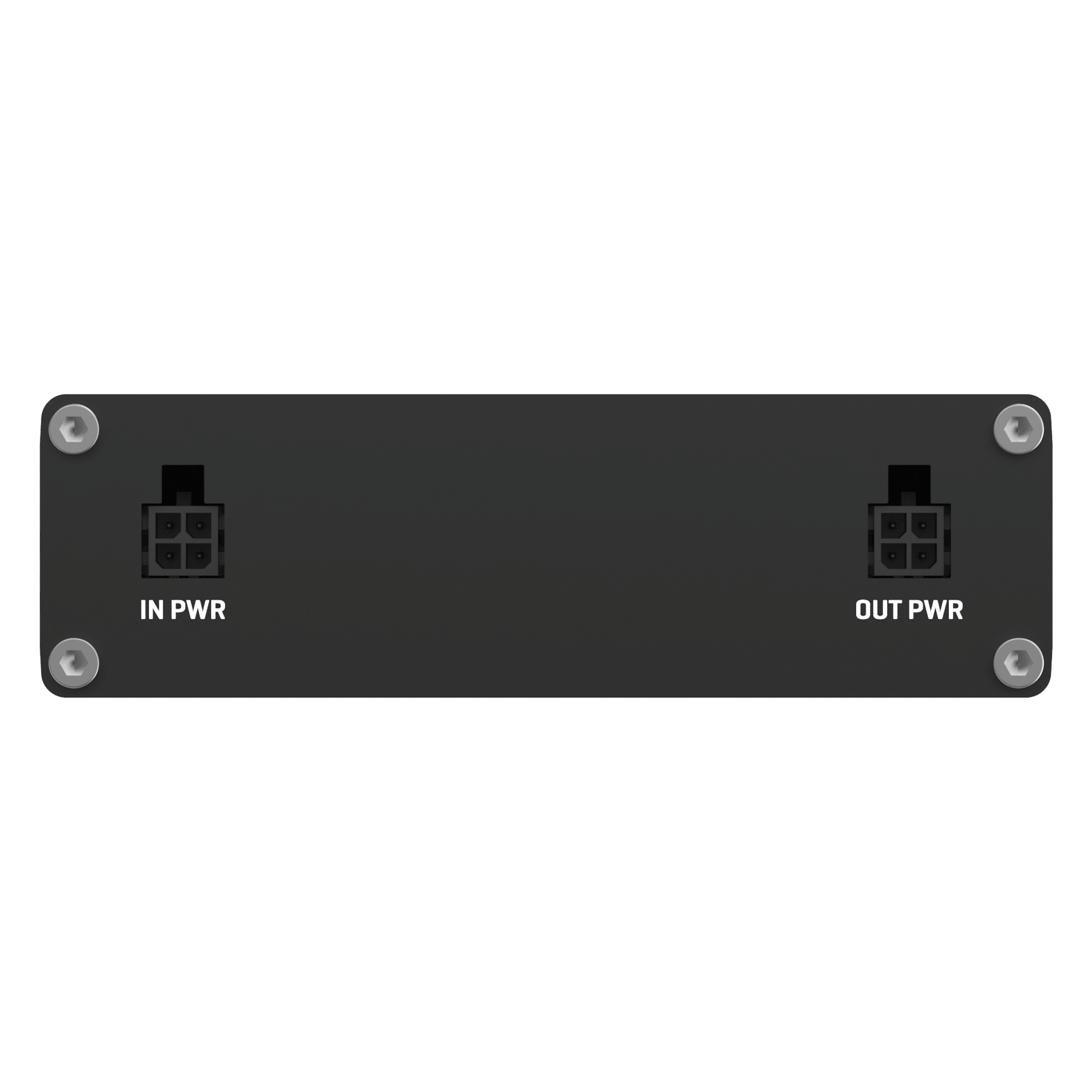
• 4-pin industrial DC connector in and out – compatible with the standard Teltonika power connector
• Max output 22 W / 1.8 A in battery mode
• Alarm output: 1x active HIGH signal (max 12 V, 2.5 mA) for external alerts or SMS via the router
• Reverse polarity and overvoltage input protection; 3 A overcurrent output protection
• Aluminium housing; DIN rail, wall mount, or flat surface (mounting kit sold separately)
• 100 x 30 x 85 mm, 315 g; operating temperature 0 to 45 °C
• CE/RED, UKCA, EAC certified
• Not compatible with PoE-enabled variants (e.g. RUT951 PoE+, TSW100)

£73.00 Excl VAT
Teltonika BAT120 – Inline UPS for Industrial 4G and 5G Routers
The Teltonika BAT120 is a compact industrial UPS that keeps any compatible Teltonika device running for up to 6 hours when mains power fails. It sits inline between your existing PSU and the router, using the standard 4-pin DC power connector found across the Teltonika RUT, RUTX, RUTM, RUTC and TRB ranges. No additional software configuration is needed. When mains power is present, the BAT120 passes it through and charges the internal cells simultaneously. When power is lost, it switches to battery output at 12 V DC instantly.
The BAT120 is powered by two 18650 Li-Ion cells with a total capacity of 2600 mAh (17 Wh), delivering up to 22 W / 1.8 A in battery mode. An alarm output sends an active HIGH signal when battery backup is active, which RutOS-based routers can use to trigger an SMS notification or RMS alert. Input protection includes reverse polarity and overvoltage protection. Output protection is 3 A overcurrent. The aluminium housing accepts DIN rail, wall mount, or flat surface mounting via an optional kit.
Key Features
- Up to 6 hours battery backup from 2 x 18650 Li-Ion cells, 2600 mAh, 17 Wh
- Input 9-30 V DC passthrough; 12 V DC output in battery mode, max 22 W / 1.8 A
- 4-pin industrial DC connector in and out – matches the standard Teltonika power connector
- Instant failover between mains passthrough and battery output
- Alarm output: 1 x active HIGH (max 12 V, 2.5 mA) – trigger SMS alerts or RMS events via the router
- Input protection: reverse polarity, overvoltage; output: 3 A overcurrent
- Compact aluminium housing: 100 x 30 x 85 mm, 315 g
- DIN rail, wall mount, or flat surface (mounting kit sold separately)
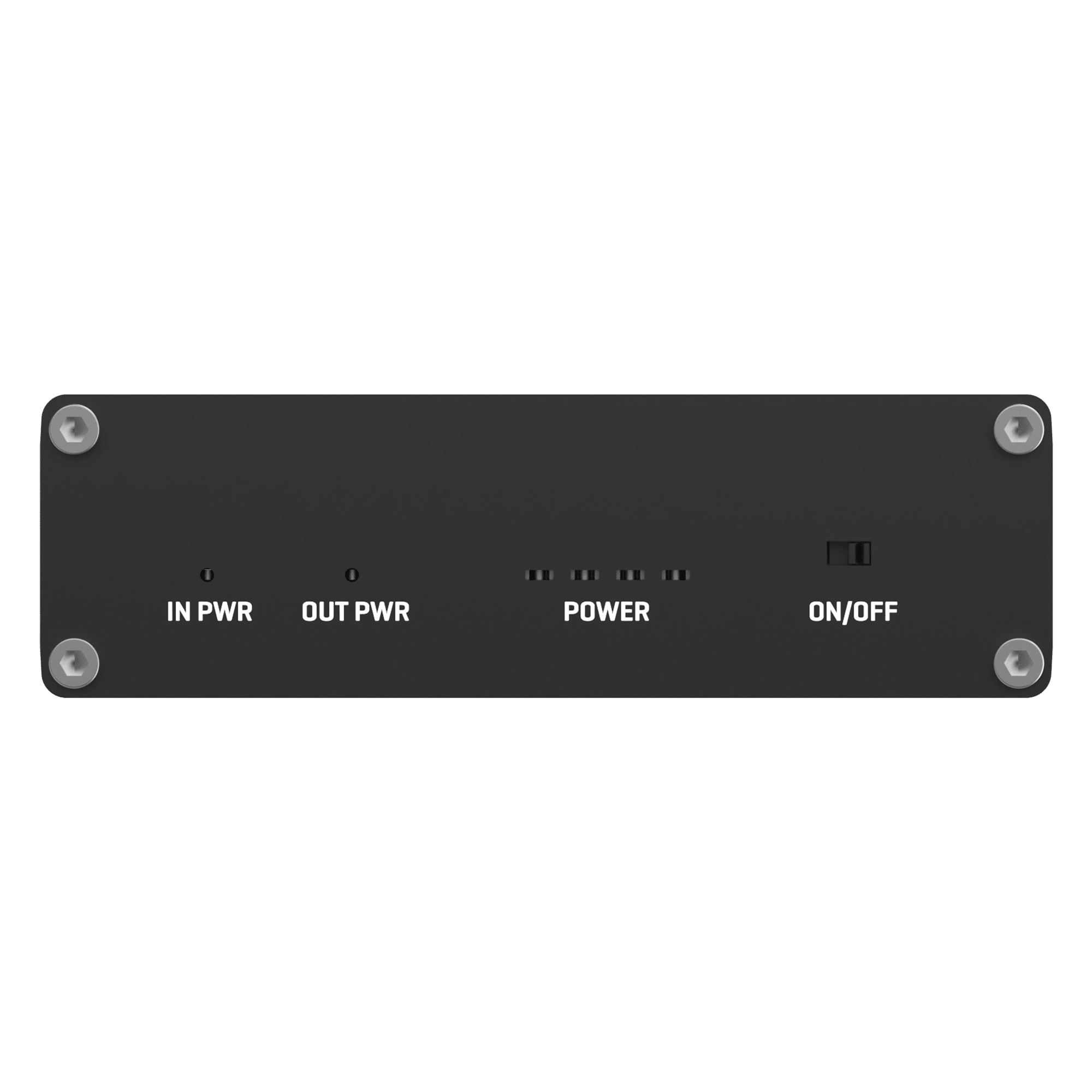
- LED status indicators: 1 x IN PWR, 1 x OUT PWR, 4 x power status LEDs
- CE/RED, UKCA, EAC certified; operating temperature 0 to 45 °C
Download the Teltonika BAT120 Datasheet
Where the BAT120 is Used
CCTV and Remote Surveillance
4G CCTV deployments at unmanned sites – construction sites, car parks, and retail parks – lose their cellular backhaul the moment mains power is cut. The BAT120 keeps the connected router online for up to 6 hours, maintaining the live feed and alarm notifications during a power outage or deliberate power tampering.
Remote Monitoring and SCADA
Substations, pump stations, and environmental monitoring points often lose power during the same events the monitoring system is intended to detect. Pairing a BAT120 with a Teltonika RUT956 or RUT986 ensures Modbus, DNP3, or MQTT data continues to reach the control centre during a power failure.
EV Charge Point Connectivity
EV charge point management systems rely on continuous cellular connectivity for OCPP communication, transaction processing, and fault reporting. Mains interruptions at a charge point can leave the unit in an unknown state. The BAT120 provides enough runtime to complete an active session and close gracefully.
Retail and Kiosk Applications
POS terminals, ticket machines, and digital signage depend on an always-on router connection. The BAT120 covers short power interruptions without requiring a full rack-mounted UPS, keeping the router online until mains supply is restored.
Industrial IoT and M2M
Factory automation, BMS controllers, and serial device gateways using a TRB142 or TRB143 continue to report data during planned maintenance shutdowns where site power is briefly cut, preventing false alarms and data gaps.
Smart City and Public Infrastructure
Street lighting controllers, traffic sensors, and environmental monitors running on Teltonika gateways benefit from short-duration backup during network maintenance windows and utility supply interruptions.
Building a Resilient 4G/5G Connection
Battery backup addresses power failure. However, a truly resilient cellular connection requires additional layers. The following three-layer approach covers the most common failure scenarios for industrial and critical IoT deployments.
Layer 1 – Battery Backup (BAT120)
The BAT120 protects against mains power failure. Without it, a power outage takes the router offline immediately. With it, the router continues operating on battery for up to 6 hours. This covers the vast majority of short-duration outages – brief grid faults, planned supply interruptions, and tamper events at remote sites. The alarm output allows RutOS to send an SMS or RMS alert when the BAT120 switches to battery, giving you advance warning that the site has lost mains power.
Layer 2 – Roaming or Multi-Network SIM
A single-network SIM – tied to EE, Vodafone, O2, or Three – goes offline when that specific network has an outage or coverage gap. A roaming or multi-network SIM connects to whichever UK network has the strongest signal at the installation point. If one network goes down, the SIM steers to another automatically, without any router configuration change. For CCTV, SCADA, and remote monitoring, this single SIM swap eliminates the most common cause of connectivity loss in the field. Pair with a fixed IP SIM if you need inbound VPN connectivity or a stable address for port forwarding – roaming SIMs are available with fixed IP options.
Layer 3 – Dual SIM with Automatic Failover
Routers with dual SIM slots can carry two separate SIM cards and switch between them automatically when the primary connection fails. The most effective configuration places a roaming SIM on the primary slot and a different carrier’s SIM – or a second roaming SIM from a different pool – on the backup slot. RutOS monitors the primary connection using ping checks or LCP keep-alives. If the primary SIM loses connectivity, RutOS switches to the secondary SIM within seconds, typically without the connected devices noticing.
Where the router supports eSIM, the backup can be a software-provisioned profile rather than a physical SIM card. An eSIM profile can be updated remotely via Teltonika RMS without a site visit. Models such as the RUT981, RUTC40, and RUTM30 support dual SIM plus eSIM, giving three possible connections from one device.
For most deployments, combining the BAT120 with a roaming SIM and a fixed IP SIM on the backup slot covers all common failure modes: power outage, single-network outage, and signal loss. Call us on 0300 124 6181 to discuss the right SIM and router combination for your application.
BAT120 Compatible Devices
The BAT120 is compatible with Teltonika devices that use the standard 4-pin industrial DC power connector. It is not compatible with PoE-powered variants (including the RUT951 PoE+ and TSW100), as these do not use the 4-pin DC connector.
Important: The RUT951 PoE+ is not compatible with the BAT120. The standard RUT951 (non-PoE) is compatible. Always check the power input type before ordering.
| Series | Compatible Models |
|---|---|
| DAP Access Points | DAP140 | DAP142 | DAP145 |
| RUT200 Series | RUT202 | RUT204 | RUT206 (buy) | RUT200 | RUT260 | RUT271 | RUT276 | RUT281 |
| RUT300 Series | RUT301 | RUT361 |
| RUT900 Series | RUT901 | RUT906 | RUT951 | RUT951 PoE+ (NOT compatible – see note above) | RUT956 | RUT976 | RUT981 | RUT986 |
| RUTC Edge Computing | RUTC40 | RUTC41 | RUTC42 | RUTC50 |
| RUTM Series | RUTM08 | RUTM09 | RUTM10 | RUTM11 | RUTM16 | RUTM20 | RUTM30 | RUTM50 | RUTM51 | RUTM52 | RUTM54 | RUTM55 | RUTM56 | RUTM59 |
| RUTX Series | RUTX08 | RUTX09 | RUTX10 | RUTX11 | RUTX12 | RUTX14 | RUTX50 | RUTXR1 |
| TRB Gateways | TRB140 | TRB141 | TRB142 | TRB143 | TRB145 | TRB160 | TRB501 |
| TRM Modems | TRM142 | TRM282 | TRM500 |
| TSW Switches | TSW110 |
Not sure which model you need? Call our UK-based technical support team on 0300 124 6181 or browse the full Teltonika range.
Frequently Asked Questions
How long does the BAT120 battery last?
Teltonika rates the BAT120 at up to 6 hours with a compatible device. Actual runtime depends on the router model and its current power draw. A compact router such as the RUT200 (under 6.5 W max) will run significantly longer than a 5G router with active Wi-Fi clients. The BAT120 outputs a maximum of 22 W / 1.8 A in battery mode, so any connected device drawing more than this will not be supported.
Does the BAT120 work with all Teltonika routers?
The BAT120 works with Teltonika devices that use the standard 4-pin industrial DC power connector, accepting 9-30 V DC input. It is not compatible with PoE-powered variants. The RUT951 PoE+ and TSW100 are explicitly excluded by Teltonika. Always verify the power input type of your specific device variant before ordering. See the full compatibility table above.
How does the alarm output work?
The BAT120 provides a single active HIGH alarm output (max 12 V, 2.5 mA). When the BAT120 switches from mains passthrough to battery mode, this output goes active. You can wire this to the digital input on RUT-series and RUTX-series routers, then configure RutOS to send an SMS, trigger an RMS event, or activate a digital output when it detects the alarm signal. This gives you an automatic notification the moment mains power is lost at the site.
What does the BAT120 output voltage in battery mode mean for my router?
In passthrough mode, the BAT120 passes your input voltage directly to the router (9-30 V DC). In battery mode, the output drops to 12 V DC. All compatible Teltonika devices accept 12 V DC input, so the router continues to operate normally. The switch between passthrough and battery mode is instantaneous – there is no perceptible interruption.
Does the BAT120 need any configuration in RutOS?
No configuration is required for the battery backup function itself. The BAT120 operates independently of the router’s firmware. If you want to use the alarm output to trigger SMS alerts or RMS events, you configure the digital input behaviour in RutOS – this is standard I/O configuration available on RUT-series and RUTX-series routers.
What charging current does the BAT120 use?
BAT120 units from batch 26 onwards use a charger with a maximum of 9.5 W / 800 mA. Units from batches 1-25 use a lower 4 W / 300 mA charger. Both charge the same internal cells; units from batch 26 recharge faster after a discharge event. Check the label on your unit if you are unsure which batch you have.
Related Products and Further Reading
The BAT120 pairs with any router in the Teltonika range that uses the standard 4-pin DC connector. For CCTV and remote monitoring applications, the Teltonika RUT200 is a compact single-SIM option; the RUT901 adds dual SIM failover. For sites requiring serial interfaces or digital I/O alongside battery backup, the RUT956 is the most common pairing. For 5G resilience with dual SIM and eSIM, the RUTM30 or RUTX50 are the leading options. Pair with a roaming SIM for multi-network resilience or a fixed IP SIM for VPN and remote access. For remote device management across your router fleet, see what is Teltonika RMS.
| Power | |
| Power connector | 4-pin industrial DC power socket |
| Power IN | 1 x 4-pin DC connector |
| Power OUT | 1 x 4-pin DC connector |
| Input voltage range | 9-30 V DC |
| Output voltage - passthrough mode | 9-30 V DC (mirrors input) |
| Output voltage - battery mode | 12 V DC |
| Max output power / current (battery mode) | 22 W / 1.8 A |
| Input charging power / current (from batch 26) | Max 9.5 W / 800 mA |
| Input charging power / current (batches 1-25) | Max 4 W / 300 mA |
| Input protection | Reverse polarity protection, overvoltage protection |
| Output protection | 3 A overcurrent protection |
| Battery | |
| Cell type | 2 x 18650 Li-Ion |
| Battery capacity | 2600 mAh, 17 Wh |
| Max backup duration | Up to 6 hours (device-dependent) |
| Alarm Output | |
| Alarm output | 1 x Active HIGH output, max 12 V, 2.5 mA |
| Trigger condition | Active when device switches from mains to battery |
| Interfaces and Controls | |
| Status LEDs | 1 x IN PWR LED, 1 x OUT PWR LED, 4 x power status LEDs |
| Switch | On/Off slider switch |
| Physical | |
| Casing material | Aluminium housing |
| Dimensions (W x H x D) | 100 x 30 x 85 mm |
| Weight | 315 g |
| Mounting options | DIN rail, wall mount, flat surface (all require additional mounting kit, sold separately) |
| Environmental | |
| Operating temperature | 0 °C to +45 °C |
| Certifications | |
| Regulatory approvals | CE/RED, UKCA, EAC |
| Compatibility | |
| Compatible devices | Teltonika devices with a standard 4-pin DC power connector accepting 9-30 V DC input. See compatibility table on the Description tab for the full list. |
| Incompatible devices | PoE-powered Teltonika variants including RUT951 PoE+ and TSW100 |
| In the Box | |
| In the box | BAT120 unit; quick start guide. Mounting kit not included. |
| Warranty and Support | |
| Warranty | 2-year manufacturer warranty |
| Support | UK-based technical support: 0300 124 6181 |
| Part number | BAT120000000 |
Based on 0 reviews
Be the first to review “Teltonika BAT120 UPS Battery Backup for Teltonika Routers”
Related products
- 4G Antennas, Accessories, Antenna Cables, Fullband Antennas
Antenna Extension Cable – 5m long – RG58 – SMA Male to SMA Female
 4G Antennas, Accessories, Antenna Cables, Fullband Antennas
Antenna Extension Cable – 5m long – RG58 – SMA Male to SMA Female
Extend the cable length of your 3G/4G/5G Antenna with this pre-terminated antenna extension cable. It is 5m long and has SMA Female at one end (this is the end that you connect to the SMA Male connector that comes with your antenna) and the other end of this antenna extension cable is SMA Male which will connect to the antenna port of your 3G/4G/5G Router.
Ref : ANT-EXT-SMA-5M
SKU: CABLE-5M-RG58-BLK-N


There are no reviews yet.