
No products in the basket.
4G Routers, Milesight, Milesight 4G Routers
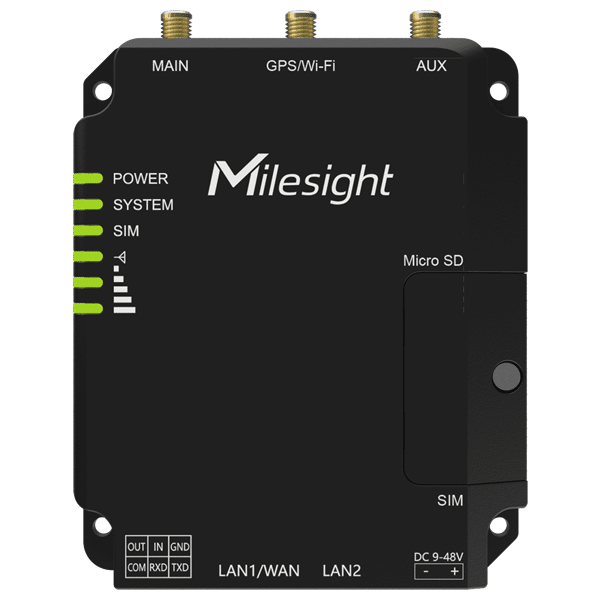
Milesight UR32 Pro Series 4G Router with Serial (RS232/RS485), 2 x Ethernet, DIO (UR32-L0GEU-485)
The Milesight UR32-L0GEU-485 is the entry point to the UR32 Pro Series: a compact industrial 4G LTE Cat 4 router with dual SIM failover, a software-selectable RS232/RS485 serial port, two Ethernet ports and galvanically isolated digital I/O. It carries no Wi-Fi radio, no GPS and no PoE PSE output, which makes it the right specification for panel-mounted telemetry where the only requirements are cellular backhaul and serial equipment integration.
Key Features:
4G LTE Cat 4 – 150 Mbps down / 50 Mbps up, with 3G and 2G fallback
Dual Mini SIM (2FF), 1.8 V / 3 V, with automatic carrier failover
1 x RS232/RS485 serial port, software selectable in the web UI
Modbus RTU to Modbus TCP gateway, plus transparent TCP, UDP, MQTT and DLMS client modes
2 x RJ45 10/100 Mbps Ethernet, 1 x WAN + 1 x LAN or 2 x LAN, 1.5 kV isolation
1 x digital input and 1 x digital output, galvanic isolation, 3.5 mm terminal block
MicroSD slot for local logging and extended storage
VPN: OpenVPN, IPsec, WireGuard, ZeroTier, GRE, L2TP, PPTP, DMVPN spoke
Python SDK for edge logic on the router itself
Ships with a 12 V UK mains PSU, runs from any 9 to 48 V DC rail, typical 1.9 W
-40 to +70 degrees C, IP30 metal housing, DIN rail or wall mount
3-year manufacturer warranty
£121.00 Excl VAT
Milesight UR32-L0GEU-485 4G Router with RS232/RS485 Serial and Digital I/O
The Milesight UR32-L0GEU-485 is the entry-level model in the UR32 Pro Series. It pairs a 4G LTE Cat 4 modem and dual Mini SIM failover with a software-selectable RS232/RS485 serial port, two 10/100 Mbps Ethernet ports and one galvanically isolated digital input and output. There is no Wi-Fi radio, no GPS module and no PoE PSE output. The serial port is the differentiator. It runs a Modbus RTU to Modbus TCP gateway, so meters, PLCs and inverters reach a SCADA or cloud platform over 4G without a separate protocol converter.
Key features
- 4G LTE Cat 4: 150 Mbps download and 50 Mbps upload, with automatic 3G and 2G fallback.
- Dual SIM failover: two Mini SIM (2FF) slots at 1.8 V / 3 V, switching automatically between carrier networks once configured.
- Software-selectable serial: one RS232/RS485 port on a 3.5 mm terminal block, 300 bps to 230,400 bps.
- Modbus gateway: Modbus RTU server and client, Modbus RTU to TCP bridging, plus transparent TCP, UDP, MQTT client and DLMS client modes.
- Two Ethernet ports: 2 x RJ45 10/100 Mbps with 1.5 kV isolation, configurable as 1 x WAN + 1 x LAN or 2 x LAN.
- Digital I/O: one dry-contact input and one wet-contact output rated 0.3 A at 30 V DC, both galvanically isolated.
- Local storage: MicroSD slot for logging and buffering data when the cellular link drops.
- Full VPN stack: OpenVPN, IPsec, WireGuard, ZeroTier, GRE, L2TP, PPTP and DMVPN spoke mode.
- Python SDK: custom edge applications run on the router, cutting cloud round trips for threshold alarms and data pre-processing.
- Flexible power: 9 to 48 V DC on a 2-pin 5.08 mm terminal block, typical draw 1.9 W, with surge and reverse polarity protection.
- Industrial build: metal IP30 housing, -40 to +70 degrees C, DIN rail, wall or desktop mounting.
- Warranty: 3-year manufacturer warranty and UK-based technical support.
What is the UR32-L0GEU-485 used for?
Smart metering and DLMS/COSEM data collection
Electricity meters on an RS485 bus speak DLMS/COSEM. The UR32 includes a native DLMS client, so it polls meter registers directly and forwards readings over 4G to a head-end system. No intermediate data concentrator is required at the cabinet. Because the router has no Wi-Fi radio, it also passes the radio-emission questions that come up during metering asset approvals more easily than a Wi-Fi variant.
Water and wastewater telemetry
Pumping stations and reservoir kiosks combine serial instruments with alarm contacts. The RS485 port reads flow meters, level transmitters and pump controllers over Modbus RTU. Meanwhile the digital input monitors a float switch, door contact or high-level alarm and raises an SMS or MQTT notification on state change. The digital output drives a pilot relay, not the pump itself, since it is rated 0.3 A at 30 V DC.
Solar PV and battery energy storage monitoring
Inverter and BMS manufacturers publish Modbus RTU register maps almost universally. The UR32 sits on the RS485 daisy chain, bridges those registers to Modbus TCP, and delivers them to a monitoring platform over cellular. The 9 to 48 V DC input range means it runs directly from a 12 V or 24 V auxiliary rail in the combiner box. Dual SIM keeps reporting alive when a single carrier degrades at a rural site.
Building management and plant room integration
Chillers, AHUs, energy sub-meters and boiler controllers frequently expose Modbus RTU only. Where the BMS supervisor sits off site, or where the landlord network is unavailable, the UR32 provides the cellular route back. It presents the serial devices as Modbus TCP slaves on a private VPN tunnel. Therefore the supervisor polls them as if they were on the local LAN.
EV charge point back-office connectivity
Charge points expose an Ethernet port and talk OCPP to a back office. The UR32 supplies the cellular WAN, and the two Ethernet ports allow one charge point plus an on-site WAN link, or two charge points in 2 x LAN mode. A fixed IP SIM card keeps the site addressable for inbound diagnostics. RS485 remains available for a revenue-grade meter alongside the charger.
Retail kiosks, POS and vending
Unattended terminals need an always-on link and remote access, and many still carry serial peripherals. The UR32 handles coin validators, receipt printers and older card readers on RS232, then switches to RS485 in software if the estate changes. Dual SIM covers a single-carrier outage. The absence of a Wi-Fi radio removes a wireless attack surface that some payment estates will not sign off.
Pro tip
Two things catch installers out on this variant. First, the serial port is one physical 3.5 mm terminal block whose pin functions change with the mode you select under Industrial, Serial Port, Serial Settings. Wire it after you have chosen RS232 or RS485, not before. Second, because there is no PoE PSE hardware here, you do not need a 48 V supply. Any clean 9 to 48 V DC rail already in the panel will run the router at roughly 1.9 W. On long RS485 runs, fit 120 ohm termination at both ends of the bus and use a shielded twisted pair with the shield grounded at one end only.
Building a resilient cellular connection
Dual SIM is only half of a resilient design. Put two SIMs from different mobile network operators in the two slots, then set the link failover priority in the web UI so the router tests and switches automatically. Nothing about this is plug and play, and it must be configured before deployment. Add a small UPS or a battery-backed 24 V rail so the router outlives a short mains dip, and terminate both cellular antennas on the MAIN and AUX SMA ports. AUX is not optional on a 2×2 MIMO modem. Finally, monitor the fleet through the Milesight Development Platform so a failover event is visible before someone rings the helpdesk.
Which UR32 Pro variant should you buy?
Three UR32 Pro variants are stocked. All three share the same modem, dual SIM, CPU, Ethernet, digital I/O, VPN stack and Python SDK. They differ only in the optional modules fitted at the factory.
- UR32-L0GEU-485 (this product): RS232/RS485 serial. No Wi-Fi. No GPS. No PoE PSE.
- UR32-L0GEU-W-485: adds 2.4 GHz 802.11b/g/n Wi-Fi, AP or client mode, up to 15 clients.
- UR32-L0GEU-P-W-485: adds Wi-Fi and 802.3af/at PoE PSE on both LAN ports, 30 W per port and 60 W total.
Each variant ships with the power supply it needs. This model includes a 12 V UK mains PSU, because it has no PoE hardware to feed. The PoE model includes a 48 V UK mains PSU, so nothing extra has to be bought to make its PoE ports work. The price gap between the three is small, and the top model is often the sensible buy. There are two situations where it is not.
Wi-Fi is a liability on some sites rather than a feature. Utility, payment and OT estates routinely prohibit an unused 2.4 GHz radio, or require it to be disabled and evidenced during commissioning. A unit with no radio fitted removes that conversation entirely. The same applies to change control on an approved asset list, where a variant with fewer fitted modules is faster to sign off.
The second is powering. PoE PSE output only activates when the router itself is fed 48 V DC. Many panels run a 12 V or 24 V rail from an existing DIN-rail PSU, a solar controller or a battery bank, and the bundled 48 V mains adapter never gets used. In that case the PoE ports are inert whichever model you buy. Paying for a PoE stage you cannot supply, and a radio you must disable, is how a small price difference stops being good value.
Also note that Wi-Fi and GPS occupy the same module position on the UR32 board. Neither this variant nor the two Wi-Fi variants carry GPS. If you need GPS with RS485, ask us about the UR32-L0GEU-G-485. If you need GPS and Wi-Fi together, the UR35 or UR75 are the correct platforms.
Buy the top model when a camera, access reader or access point genuinely needs powering from the router, and when you can feed it 48 V. Buy this one when the panel already has a switch, an injector, a low-voltage rail, or nothing to power at all.
Frequently asked questions
What is the difference between the UR32-L0GEU-485 and the UR32-L0GEU-W-485?
Wi-Fi. The UR32-L0GEU-W-485 fits a 2.4 GHz 802.11b/g/n radio supporting AP and client modes and up to 15 simultaneous clients. The UR32-L0GEU-485 has no Wi-Fi module and no RP-SMA antenna port. Cellular, dual SIM, serial, Ethernet, digital I/O, VPN, Python SDK, power range and operating temperature are identical across both.
Does the -485 suffix mean the port is RS485 only?
No. The suffix means the hardware supports both modes and you select between RS232 and RS485 in the web UI under Industrial, Serial Port, Serial Settings. Base UR32 variants without the -485 suffix are RS232 only. Choose the mode before wiring the terminal block, because the pin functions differ.
Can the UR32-L0GEU-485 power an IP camera over Ethernet?
No. This variant has no PoE PSE hardware, and no supply voltage will enable it. It ships with a 12 V UK mains PSU. For router-powered 802.3af/at devices, order the UR32-L0GEU-P-W-485, which includes the 48 V PSU its PoE ports require. Alternatively, keep this router and use an existing PoE switch or a standalone injector on the LAN.
What SIM card do I need for the UR32?
Both slots take a Mini SIM in 2FF format. Standard SIM cards sit behind carrier-grade NAT, which blocks inbound connections. Therefore any deployment that needs inbound VPN access, direct Modbus TCP polling or remote diagnostics should use a fixed IP SIM card. See our IoT SIM cards range for roaming and dynamic IP options.
Does the UR32 support Modbus over RS485?
Yes. The serial port runs Modbus RTU as a server or a client, and includes a Modbus RTU to Modbus TCP gateway. Register data from serial instruments is bridged to a SCADA system, cloud historian or BMS without extra hardware. Transparent TCP client and server, UDP server, MQTT client and DLMS client modes are also supported.
How do I manage a fleet of UR32 routers remotely?
Through the Milesight Development Platform, which handles mass configuration, firmware updates, cellular diagnostics and event alerting across deployed units alongside other Milesight IoT hardware. DeviceHub remains supported, and SNMP v1/v2c/v3, TR-069 and an HTTP(S) API are available for integration with a third-party NMS.
What VPN protocols does it support?
OpenVPN as client and server, IPsec as client and server, WireGuard, ZeroTier, GRE, L2TP, PPTP and DMVPN spoke mode. WireGuard and IPsec are the usual choices for site-to-site tunnels over cellular. Our guide to VPN on cellular routers compares the protocols and covers configuration.
Related products and further reading
Browse the full Milesight 4G router range for the other UR32 configurations. For Wi-Fi, see the UR32-L0GEU-W-485; for Wi-Fi and PoE PSE output, see the UR32-L0GEU-P-W-485. Where serial ports and digital I/O are not needed, the single-SIM UR32L Lite covers cellular WAN alone. Pair any of them with a fixed IP SIM card and a suitable antenna for Milesight routers. UK-based technical support is available on 0300 124 6181.
| Cellular Connectivity | |
|---|---|
| Cellular standard | 4G LTE Cat 4 / WCDMA (3G) / GSM (2G) |
| Max download speed | 150 Mbps |
| Max upload speed | 50 Mbps |
| LTE bands (EU variant) | B1, B3, B5, B7, B8, B20, B38, B40, B41 |
| 3G bands | B1, B5, B8 |
| 2G bands | B3, B8 |
| Tx power | LTE Class 3, 23 dBm +/- 2 dB |
| SIM slots | 2 x Mini SIM (2FF), 1.8 V / 3 V |
| SIM failover | Automatic dual SIM carrier failover, configured in the web UI |
| Cellular antenna connectors | 2 x SMA female, 50 ohm (MAIN and AUX) |
| SIM hot swap | Not supported. Power down before changing a SIM |
| Wi-Fi and GNSS | |
|---|---|
| Wi-Fi | Not fitted on this variant. See the UR32-L0GEU-W-485 |
| GNSS / GPS | Not fitted on this variant. Wi-Fi and GPS are mutually exclusive hardware options on the UR32 platform |
| Ethernet | |
|---|---|
| Ethernet ports | 2 x RJ45 10/100 Mbps |
| Port configuration | 1 x WAN + 1 x LAN, or 2 x LAN |
| Duplex | Full or half duplex, auto-sensing |
| Ethernet isolation | 1.5 kV RMS |
| PoE PSE output | Not fitted on this variant. See the UR32-L0GEU-P-W-485 |
| Serial Interface | |
|---|---|
| Serial port | 1 x RS232 / RS485, software selectable in the web UI |
| Connector | 3.5 mm terminal block |
| Baud rate | 300 bps to 230,400 bps |
| Serial modes | Transparent (TCP client/server, UDP server, MQTT client), Modbus RTU server and client, Modbus gateway (RTU to TCP), DLMS client |
| Digital I/O | |
|---|---|
| Digital input | 1 x DI, dry contact, galvanic isolation |
| Digital output | 1 x DO, wet contact, max 0.3 A at 30 V DC, galvanic isolation |
| Connector | 3.5 mm terminal block |
| DI read methods | SMS, email, CLI, Modbus TCP/RTU server, MQTT |
| DO trigger methods | DI event, SMS, CLI, Modbus TCP/RTU server, MQTT |
| Processor and Memory | |
|---|---|
| CPU | ARM Cortex-A7, 528 MHz (NXP) |
| RAM | 128 MB DDR3 |
| Flash | 128 MB |
| Extendable storage | 1 x MicroSD slot |
| Watchdog | Built-in hardware watchdog and timer |
| Software and Management | |
|---|---|
| Network protocols | IPv4, PPP, PPPoE, DHCP, DNS, DDNS, HTTP, HTTPS, SNMP v1/v2c/v3, TCP, UDP, MQTT, MQTTS, TR-069, RIP v1/v2, OSPF, VRRP, QoS, VLAN, SSH, Telnet, SNTP, ARP |
| Routing | Static, priority-based, RIP, OSPF |
| DDNS | 16+ service providers, manual configuration supported |
| Reliability | VRRP, WAN failover, dual SIM backup |
| IP passthrough | Supported. Assigns the cellular IP address to a connected device |
| VPN | OpenVPN (client and server), IPsec (client and server), WireGuard, ZeroTier, GRE, L2TP (client), PPTP (client), DMVPN (spoke) |
| Firewall | Access control, DMZ, port mapping, MAC binding, SPI, DoS and DDoS protection, IP and domain filtering |
| AAA | RADIUS, TACACS+, LDAP, local authentication, 802.1x, multiple user authority levels |
| VLAN | Port and tag-based |
| Configuration | Web GUI, CLI (SSH / Telnet), SMS, on-demand dial-up, SNMP, TR-069, HTTP(S) API |
| Remote management | Milesight Development Platform, DeviceHub, MilesightVPN |
| Firmware update | Web UI, DeviceHub, Milesight Development Platform |
| SMS management | Send and receive SMS, SMS control, SMS configuration |
| Application development | Python SDK |
| Diagnostics | Ping, traceroute, TCPDUMP, QXDM, log server, cellular AT command debugger, iptables debugger |
| Event alarms | System restart and reboot, network up and down, link switch |
| IP version | IPv4 only on L0GEU hardware |
| Power | |
|---|---|
| Power connector | 1 x 2-pin 5.08 mm terminal block |
| Input voltage | 9 to 48 V DC |
| Protection | Surge protection and reverse polarity protection |
| Power consumption | Typical 1.9 W, max 2.4 W |
| Supplied PSU | 12 V UK mains PSU. No 48 V supply is required, as this variant has no PoE PSE output |
| Physical | |
|---|---|
| Dimensions (W x H x D) | 108 x 90 x 26 mm |
| Weight | 271 g |
| Housing | Metal, black |
| Ingress protection | IP30 |
| Mounting | DIN rail, wall mount or desktop |
| Status LEDs | 1 x Power, 1 x System, 1 x SIM, 3 x Signal strength |
| Reset button | 1 x Reset |
| Environmental | |
|---|---|
| Operating temperature | -40 to +70 degrees C. Reduced cellular performance above 60 degrees C |
| Storage temperature | -40 to +85 degrees C |
| Relative humidity | 0% to 95% non-condensing at 25 degrees C |
| Certifications | |
|---|---|
| Regulatory | CE, FCC, RCM, NBTC, JATE, TELEC |
| Environmental | RoHS |
| EMC | EN 55032, EN 55035 |
| EMS | IEC 61000-4-2 Level 3, IEC 61000-4-3 Level 2, IEC 61000-4-4 Level 2, IEC 61000-4-5 Level 2, IEC 61000-4-6 Level 3, IEC 61000-4-8 Level 1, IEC 61000-4-11 Level 3 |
| Radio | EN 301 489-1/17/19/52, EN 301 511, EN 301 908-1/2/13, EN 303 413, EN 300 328 |
| Safety | EN 62368-1 |
| In the Box | |
|---|---|
| Included | 1 x UR32-L0GEU-485 router, 2 x cellular antennas, 1 x 12 V UK mains PSU, 1 x pluggable terminal block, 1 x DIN rail clip kit, 4 x wall mounting kits |
| Optional accessories | Stubby cellular antennas, DIN mounting bracket kit |
| Warranty and Support | |
|---|---|
| Warranty | 3-year manufacturer warranty |
| Support | UK-based technical support, 0300 124 6181 |
Based on 0 reviews
Be the first to review “Milesight UR32 Pro Series 4G Router with Serial (RS232/RS485), 2 x Ethernet, DIO (UR32-L0GEU-485)”
Related products
- 4G Routers, CAT6 4G Router, Teltonika, Teltonika 4G Routers
Teltonika RUTX12 Dual LTE Cat 6 Industrial Cellular Router
 4G Routers, CAT6 4G Router, Teltonika, Teltonika 4G Routers
Teltonika RUTX12 Dual LTE Cat 6 Industrial Cellular Router
The Teltonika RUTX12 is a powerful dual LTE Cat 6 industrial router designed for mission-critical applications. It offers uninterrupted connectivity with dual LTE modems, providing speeds up to 600 Mbps with load balancing. The robust router features advanced security, remote management, and a durable aluminum housing suitable for harsh environments.Top 6 Key Features:
- Dual LTE Cat 6 Modems for simultaneous high-speed internet up to 600 Mbps
- enables load balancing, hot swap failover or bonded 4G using Bondix service.
- 5 Gigabit Ethernet ports for wired connections up to 1000 Mbps
- Wave-2 802.11ac Dual Band WiFi with speeds up to 867 Mbps
- Advanced security features like VPN, IPsec, PPTP, L2TP, and GNSS tracking
- Remote Management System (RMS) for seamless monitoring and configuration
- Robust aluminium housing with IP30 rating for harsh industrial environments
 SKU: TELTONIKA-RUTX12-N
 - Dual LTE Cat 6 Modems for simultaneous high-speed internet up to 600 Mbps
- 4G Routers, Teltonika, Teltonika 4G Routers
Teltonika RUT200 4G LTE Industrial Cellular Router
The Teltonika RUT200 (RUT200013000) is a compact 4G LTE Cat 4 industrial cellular router with a single Mini SIM, 802.11b/g/n Wi-Fi, and two 10/100 Mbps Ethernet ports in a 125 g aluminium housing. It runs RutOS on a Mediatek 580 MHz processor with a full VPN stack, industrial protocol support, digital I/O, and Teltonika RMS compatibility, operating from -40 to +75 °C.
Key Features:
• 4G LTE Cat 4 – 150 Mbps down / 50 Mbps up; automatic fallback to 3G and 2G
• Single Mini SIM (2FF) with auto APN, band lock, and operator block/allow list
• Wi-Fi 4 (802.11b/g/n) – access point and station modes, up to 50 simultaneous clients
• 1 x WAN + 1 x LAN (10/100 Mbps); WAN port configurable as second LAN via RutOS
• 1 x digital input and 1 x digital output on 4-pin power connector
• Passive PoE input via LAN1 – Mode B, 9-30 V DC (not compatible with 802.3af/at/bt)
• VPN: OpenVPN, IPsec, WireGuard, ZeroTier, GRE, L2TP, DMVPN, SSTP, Tinc
• Modbus TCP, OPC UA, DNP3, MQTT broker/publisher, Azure IoT Hub, AWS IoT Core
• Teltonika RMS compatible – remote management, FOTA, alerts, and VPN tunnels
• CE, UKCA, E-mark certified; IP30; 83 x 25 x 74 mm; 125 gSKU: TELTONIKA-RUT200013000-N - 4G CCTV, 4G Routers, Manufacturers, Proroute, Proroute 4G Routers, Proroute Routers
Proroute H820 WRT 4G Router with 4 x LAN, 1 x WAN and WiFi – Industrial Grade M2M LTE 4G Router
4G CCTV, 4G Routers, Manufacturers, Proroute, Proroute 4G Routers, Proroute RoutersProroute H820 WRT 4G Router with 4 x LAN, 1 x WAN and WiFi – Industrial Grade M2M LTE 4G Router
The Proroute H820 embedded industrial 4G LTE router includes keep alive features such as Ping Reboot to ensure that the router will provide a reliable 4G LTE connection.
Ref : H820 4G Router
SKU: PRORT-H820-4G-CAT4-N - 4G Routers, CAT6 4G Router, Proroute, Proroute 4G Routers
Proroute H900 Dual SIM CAT6 4G Router with Gigabit Ethernet and AX WiFi (WiFi 6)
4G Routers, CAT6 4G Router, Proroute, Proroute 4G RoutersProroute H900 Dual SIM CAT6 4G Router with Gigabit Ethernet and AX WiFi (WiFi 6)
Proroute H900 CAT6 4G router is the high speed version of the dual SIM 4G router with embedded CAT6 LTE modem. LAN connection via 4 x Ethernet ports (2 x Gigabit Ethernet and 2 x Fast Etherent) and Dual band (2.4Ghz / 5.0 Ghz) WiFi6 (802.11AX) and RS232 and Digital IO – DIN Rail mounted.
SKU: PRORT-H900-4G-CAT6-AX-N


There are no reviews yet.