
No products in the basket.

Teltonika RUTX50 Use Cases Leave a comment
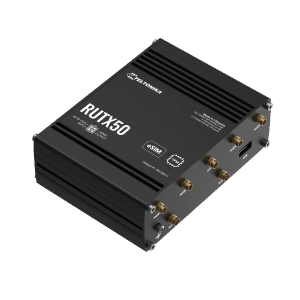
The Teltonika RUTX50 (RUTX50320100) is Teltonika’s industrial 5G flagship in the RUTX series. With 5G NR Sub-6GHz delivering up to 3.3 Gbps download, integrated eSIM with bootstrap provisioning, dual physical Mini-SIM slots, GNSS, digital I/O, and the full RutOS software stack, it spans a wider range of deployment scenarios than most installers initially consider.
This post works through twenty real-world use cases drawn from Teltonika’s own application library and reframes them for the professional installers and technical buyers who deploy this hardware in the UK. We also cover the three technical concepts that come up in almost every RUTX50 conversation: 5G SA vs NSA, eSIM bootstrap, and LTE Cat 20 fallback.



Three things to understand before specifying the RUTX50
5G SA vs 5G NSA — what the difference means on site
The RUTX50 supports both 5G NR Non-Standalone (NSA) and Standalone (SA) architectures. NSA 5G uses the existing 4G LTE core network as a signalling anchor, with 5G NR providing the radio layer. Most current UK 5G coverage is NSA. SA 5G runs on a fully independent 5G core, enabling lower latency, network slicing, and more consistent performance under load — relevant for time-sensitive industrial protocols and high-density deployments.
In practice, the RUTX50 connects to whichever architecture the network presents and handles the transition automatically. On SA-capable networks you get lower latency. On NSA-only coverage you still get 5G NR throughput. The distinction matters most when specifying for applications where latency is a hard requirement — interactive SCADA, real-time teleoperation, or financial transaction systems.
eSIM bootstrap — what it means for deployment
The RUTX50’s integrated eSIM supports bootstrap provisioning. The router ships with a bootstrap profile already loaded on the eSIM chip. On first power-up at site, that profile provides just enough connectivity to reach an eSIM provisioning server, where a full operator data plan is downloaded and activated over the air.
The practical benefit: you can deploy a RUTX50 to a sealed enclosure or remote location without pre-staging a physical SIM. The bootstrap profile facilitates initial provisioning only — it does not carry application data. Once an operator plan is provisioned onto the eSIM, the router connects normally. For large rollouts, this removes one of the most time-consuming pre-deployment steps. Combined with the two physical Mini-SIM slots, you have three independent connectivity pathways for resilience and network diversity.
LTE Cat 20 fallback — why it matters for long-term deployments
Not every site has 5G coverage today, and coverage changes over multi-year deployment lifetimes. The RUTX50’s LTE Cat 20 modem delivers up to 2.0 Gbps download on 4G — faster than most dedicated 4G routers on the market. Where 5G is unavailable, the router falls back gracefully. This matters for infrastructure projects with five- to ten-year lifecycles where the network environment at installation will not be the same as the network environment in year three.
Twenty RUTX50 use cases — where 5G speed and reliability matter
1. 5G gateway for remote construction work
Construction sites in remote or greenfield locations need connectivity for site offices, access control, CCTV, machine telematics, and increasingly for BIM platform access. Fixed broadband is rarely available at the start of a project. The RUTX50 provides 5G or LTE Cat 20 backhaul from a DIN rail installation in the site distribution board. Modbus TCP supports connected generators reporting hours and fault codes. The GNSS receiver feeds position data to plant telematics systems. The wide 9–50 V DC input suits direct connection to site power without a separate PSU.
2. 5G router for egg farm automation
Modern poultry operations use automated feeding, ventilation control, environmental monitoring, and production tracking — all of which require reliable WAN connectivity to reach cloud management platforms. Rural locations often make fixed broadband unviable. The RUTX50 provides 5G or LTE Cat 20 backhaul, with Modbus TCP connecting ventilation controllers and environmental sensors to a SCADA platform. MQTT publisher support forwards production data to cloud dashboards. The -40 °C lower operating limit covers unheated agricultural buildings in winter.
3. Bonding mobile routers for EV motorsports connectivity
EV motorsport generates large volumes of real-time telemetry — battery state, motor temperature, traction data, and driver biometrics — that teams need to receive and analyse at pitside with minimal latency. The RUTX50 supports channel bonding via Bondix S.A.NE or MWAN3 load balancing in RutOS, combining multiple WAN connections for aggregated throughput. 5G SA’s low latency keeps telemetry streams consistent even in high-density RF environments at race circuits. E-mark certification confirms compliance for vehicle and trackside installations.
4. Dual 5G router for flawless live streaming
Broadcast-quality live streaming from outdoor or temporary venues requires sustained uplink throughput that 4G cannot reliably guarantee in congested environments. A single 4K stream at broadcast quality needs 15–25 Mbps sustained upload. The RUTX50’s 5G NSA uplink of up to 600 Mbps provides substantial headroom. For even higher reliability, dual SIM failover — configured in RutOS — keeps the stream online if one network degrades. The Wi-Fi AP connects cameras and production equipment on a separate network from the public-facing hotspot.
5. Dual 5G router: a connectivity lifeline for first responders
Police, fire, and ambulance services operating at major incidents need reliable, high-bandwidth connectivity for video feeds, command and control systems, and real-time database access. The RUTX50’s dual SIM and eSIM configuration provides multi-network resilience — if one emergency services network is congested, the router fails over to a commercial network. RutOS VLAN segmentation keeps sensitive operational traffic isolated. The GNSS receiver supports incident mapping and vehicle tracking. IPsec or WireGuard tunnels protect all traffic end-to-end.
6. 5G router for port connectivity channel bonding
Port operations generate continuous data flows across cranes, automated guided vehicles, access control systems, and cargo tracking platforms. Fixed infrastructure in port environments is expensive to install and maintain across large areas. The RUTX50 provides 5G WAN connectivity with channel bonding across multiple connections for higher aggregate throughput and resilience. DNP3 and Modbus TCP support legacy terminal automation protocols. The grounding screw and IP30 metal enclosure suit the electrically noisy environment of a working port.
7. Data transmission from electric aircraft with a 5G router
Electric and hybrid aircraft generate large volumes of flight, battery, and systems data that manufacturers and operators need to capture and transmit during ground operations and near-airport flight. The RUTX50’s 5G throughput handles high-bandwidth data dumps from the aircraft data bus on landing. GNSS positioning tracks aircraft movement on the apron. The router’s VPN suite encrypts proprietary performance data in transit. LTE Cat 20 fallback maintains connectivity at smaller airfields without 5G coverage.
8. 5G gateway for network slicing in smart grid infrastructure
5G SA network slicing allows a mobile operator to provide a dedicated logical network with defined latency and bandwidth guarantees for a specific application — highly relevant for grid operators who need deterministic communication for protection relaying and SCADA. The RUTX50 is one of the few routers at this price point that supports 5G SA, making it capable of connecting to a sliced network when the operator provides one. DNP3, Modbus TCP, and IEC 61850 MMS all run over the 5G WAN connection. Dual SIM provides fallback if the primary network slice is unavailable.
9. Multi-user MIMO 5G router for pop-up auto shows
Classic car shows, manufacturer launch events, and automotive exhibitions need fast, reliable Wi-Fi for exhibitors, payment systems, and media. The RUTX50’s Wi-Fi 5 with MU-MIMO supports up to 150 simultaneous clients per access point. The eSIM bootstrap means the router can be provisioned on-site at a new venue without pre-staging. Multiple VLANs separate exhibitor, payment, and public networks on a single device. RMS provides remote monitoring of all deployed units from a central dashboard without a site visit.
10. 5G router for fleet management of autonomous robots
Autonomous mobile robots in warehouses, logistics centres, and manufacturing facilities require low-latency connectivity to their fleet management system for path planning, task assignment, and collision avoidance. 5G SA’s sub-10 ms latency on well-configured networks is measurably better than 4G for real-time control loops. The RUTX50’s Modbus TCP client can poll robot controllers directly. Azure IoT Hub and AWS IoT Core integration allows robot telemetry to feed directly into cloud fleet management platforms without a separate gateway device.
11. 5G router and GPS tracker for public events safety
Large public events — marathons, concerts, protests — require temporary command and control infrastructure with real-time positioning of safety personnel and vehicles. The RUTX50 combines a 5G WAN connection with integrated GNSS, providing both connectivity and positioning from a single device. Geofencing zones can be configured in RutOS to trigger alerts when a vehicle or asset moves outside a defined area. The hotspot feature provides Wi-Fi for safety team devices without exposing them to the public internet.
12. 5G router for bus hotspot and remote management
Bus operators providing passenger Wi-Fi need a router that handles the RF environment inside a vehicle, operates across a wide temperature range, and can be managed remotely across a fleet without rolling engineering visits. The RUTX50 meets all three requirements. E-mark certification covers in-vehicle installation. The Wi-Fi AP provides passenger hotspot with captive portal and usage limits configurable in RutOS. Teltonika RMS allows the entire fleet to be monitored centrally, with FOTA firmware updates pushed to all vehicles simultaneously.
13. 5G gateway for entertainment and industrial teleoperation
Remote teleoperation of industrial machinery — excavators, cranes, mining equipment — requires video feeds from the machine combined with low-latency control signals back to the operator. 5G SA’s combination of high throughput and low latency supports both simultaneously. The RUTX50’s digital I/O can interface with the machine’s control system directly. For entertainment applications such as remote-controlled racing or robotics events, the same capability applies: high-quality video out, low-latency control signals in.
14. Pushing the boundaries of transportation with Hyperloop connectivity
Next-generation transportation infrastructure like Hyperloop requires data communication between pods and trackside control systems at high relative speeds. 5G NR’s beamforming and handover performance suits high-mobility applications better than 4G. The RUTX50 provides the 5G connectivity layer with GNSS positioning for pod tracking. DNP3 and Modbus TCP support trackside control systems. This use case also applies to high-speed rail, where lineside monitoring and passenger Wi-Fi both benefit from 5G backhaul.
15. Securing networks with VLAN tagging across managed infrastructure
Enterprise and industrial sites often need to segment traffic between operational technology, IT, guest, and management networks without separate physical infrastructure for each. The RUTX50 supports port-based and tag-based VLAN in RutOS, combined with per-VLAN firewall rules and 802.1x port-based access control. A single RUTX50 can provide a 5G WAN connection, four segmented LAN networks, and a separate Wi-Fi SSID per VLAN — replacing several devices in a compact DIN rail installation.
16. Ensuring crop health with 5G-enhanced drone operations
Precision agriculture drones generate high-resolution imagery that needs to be transferred quickly after each flight for analysis. A single survey drone flight over a 50-hectare field produces several gigabytes of data. 5G throughput allows this to be uploaded to a cloud analysis platform at the field edge rather than waiting for the drone to return to a fixed facility. The RUTX50’s GNSS supports drone positioning and geofencing. Modbus TCP connects irrigation and soil sensor networks to the same WAN link.
17. 5G router for RV, campervan, and mobile office internet
Mobile workers, remote production crews, and premium leisure vehicles need reliable, fast connectivity wherever they travel. The RUTX50’s LTE Cat 20 fallback means consistent performance even where 5G coverage is patchy. The Wi-Fi AP provides connectivity for multiple devices in the vehicle. Band lock in RutOS allows the router to be configured to prioritise specific LTE bands known to perform well in a given region, improving consistency compared to automatic network selection. E-mark certification covers the vehicle installation requirement.
18. Live streaming children’s sports and community events
Grassroots sports clubs and community organisations increasingly want to stream matches and events for remote supporters. Fixed broadband is often unavailable at sports grounds. The RUTX50 provides the 5G uplink, with the Wi-Fi AP connecting a camera encoder or laptop running streaming software. A single SIM from a network with good local coverage is sufficient for most grassroots streaming at 1080p. For critical productions, dual SIM failover keeps the stream live if one network has a short outage.
19. 5G router for warehouse automation and synergy
Modern warehouses combine automated conveyor systems, robotic picking, WMS platforms, and real-time inventory tracking. Each system generates continuous data that needs to reach a central platform with minimal latency. The RUTX50 provides 5G WAN backhaul with Modbus TCP and OPC UA support for automation controllers, MQTT forwarding to cloud WMS platforms, and VLAN segmentation between operational and IT networks. The USB port supports a serial adapter for legacy warehouse equipment that predates Ethernet connectivity.
20. Fixed broadband failover for business-critical sites
Any site that depends on fixed broadband for payment systems, VoIP, or cloud-hosted business applications needs a fast, reliable cellular failover. The RUTX50’s LTE Cat 20 provides up to 2.0 Gbps on 4G — sufficient to sustain most business-critical workloads during a fixed line outage. VRRP support allows hot-standby failover without reconfiguring the default gateway on connected devices. Ping reboot and ICMP link monitoring in RutOS detect uplink failure and switch automatically once configured. For sites with occasional 5G coverage, the primary connection can be 5G with fixed broadband as the wired backup.
Choosing the right SIM configuration for your RUTX50 deployment
The RUTX50 has three SIM pathways — integrated eSIM plus two physical Mini-SIM (2FF) slots — but the right configuration depends on the deployment.
For fixed infrastructure requiring inbound access or VPN termination, a fixed IP SIM card on the primary connection is strongly recommended. Standard SIM cards on UK networks sit behind carrier-grade NAT, which prevents inbound connections. A fixed IP SIM gives the router a static, routable address. We supply fixed IP SIMs on EE, O2, Vodafone, and multi-network roaming.
For deployments requiring network resilience, use physical SIMs from two different mobile operators. SIM failover in RutOS switches automatically when the primary network fails, once configured in the WebUI.
For large rollouts or sealed enclosures, the eSIM bootstrap provisioning allows devices to be deployed and provisioned without pre-loading a physical SIM. We supply IoT eSIM plans compatible with this workflow. Call us on 0300 124 6181 to discuss the right SIM configuration for your project.
Antenna selection for the RUTX50
All four SMA mobile antenna ports must be connected for 4×4 MIMO to operate at full throughput. The standard package includes four stub antennas, which are adequate for open-air deployments. For installations inside metal enclosures, run low-loss SMA cable to external antennas mounted on the cabinet exterior. A quality 4×4 MIMO 5G antenna on a short cable run consistently outperforms stubs inside a steel cabinet, particularly on 5G NR n77 and n78 where free-space loss is highest.
Managing a RUTX50 fleet with Teltonika RMS
For any deployment of more than a handful of units, Teltonika RMS is the right management layer. It provides remote configuration, FOTA firmware updates, RMS Connect for SSH and RDP access to devices behind the router without a public IP, and fleet-level monitoring with configurable alerts for signal degradation, data limit thresholds, and reboot events. We stock Teltonika RMS credits for all licence tiers.
Buy the Teltonika RUTX50
The RUTX50320100 is in UK stock with next-working-day delivery on orders placed by 3:00 PM. It includes a UK PSU, four 5G mobile stub antennas, two Wi-Fi antennas, a GNSS antenna, a 1.5 m Ethernet cable, and a SIM adapter kit. DIN rail and wall mounting kits are available separately.
Buy the Teltonika RUTX50 eSIM 5G Router or call us on 0300 124 6181. We are a Teltonika Diamond Partner with UK-based technical support.
