
-
×


Subtotal: £157.50
Available on back-order
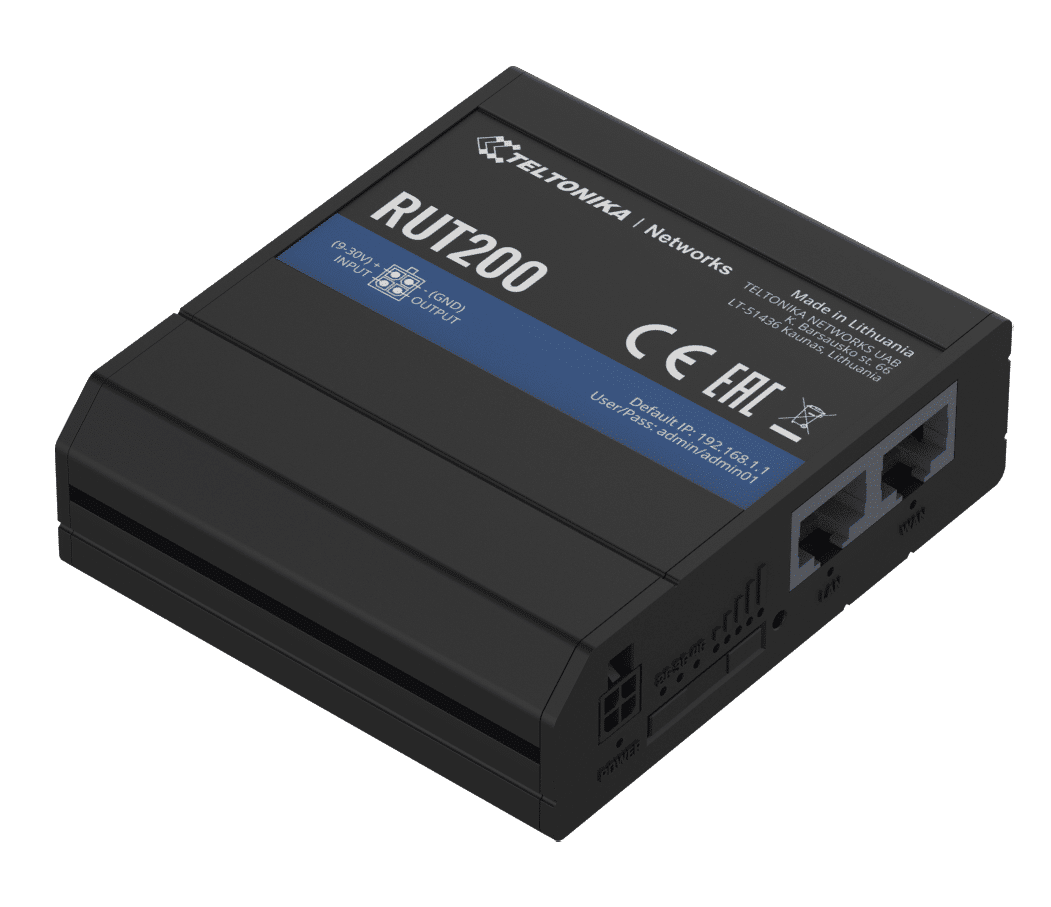
Teltonika RUT200 (RUT200343000 is the ) is a compact industrial 4G Cat 4 Router with integrated eSIM, supplied with a UK PSU and modem designed for UK and European mobile network connectivity. The built-in eSIM runs alongside a physical Mini SIM (2FF) slot, with configurable switching between them on signal loss, data limit, roaming or network failure – no site visit required to change network.
Key Features:
• 4G LTE Cat 4 – 150 Mbps download / 50 Mbps upload
• Integrated eSIM with up to 7 stored profiles plus 1 x Mini SIM (2FF) physical slot
• Automatic SIM/eSIM failover – triggers on weak signal, data limit, roaming, no network or connection failure
• LTE FDD bands B1, B3, B5, B7, B8, B20, B28 – covers all major UK 4G frequencies
• 802.11b/g/n Wi-Fi access point and station modes, up to 50 simultaneous clients
• 1 x WAN and 1 x LAN, 10/100 Mbps Ethernet (WAN configurable as LAN in RutOS)
• Digital input and digital output on 4-pin industrial power connector
• Passive PoE input on LAN1, 9-30 V DC, Mode B – not compatible with 802.3af/at injectors or switches
• -40 to +75 °C operating temperature, IP30, aluminium enclosure, 125 g
• RutOS with OpenVPN, WireGuard, IPsec, Modbus TCP, MQTT, DNP3 and Teltonika RMS

£90.00 Excl VAT
Available on back-order
The Teltonika RUT200 (order code RUT200343000) is a compact industrial 4G LTE Cat 4 router with integrated eSIM, covering European networks and supplied with a UK PSU. It delivers up to 150 Mbps download over LTE on bands B1, B3, B5, B7, B8, B20 and B28, including B20 and B28 which are the primary rural 4G bands used by all major UK operators.
The defining feature of this variant is the combination of a built-in eSIM and a physical Mini SIM (2FF) slot on a single modem. RutOS manages which connection is active and can be configured to switch between them based on defined triggers – weak signal, data limit reached, SMS limit, roaming, no network, network denied, or data connection failure. Each trigger threshold is set in the WebUI. Once configured, switching to a different mobile network requires no site visit. New eSIM profiles are downloaded over the air, and the router stores up to 7 profiles. This makes the RUT200343000 the right choice for installations where physical SIM access is difficult or where network flexibility is operationally important.
Substations, pump stations, weather stations and environmental monitoring sites often have no permanent on-site staff. If the primary SIM loses coverage or a better-value contract becomes available, the RUT200343000 allows a network switch over the air. There is no need to send an engineer to swap a physical SIM card.
CCTV routers are frequently installed in roof-mounted enclosures, traffic cabinets and vehicle compounds. Physical SIM access is time-consuming and sometimes requires specialist access equipment. An eSIM profile switch is handled remotely via RMS. For inbound VPN access to camera streams, a fixed IP SIM loaded as an eSIM profile removes the carrier-grade NAT problem without any additional hardware.
A network installer managing multiple UK retail or hospitality sites faces varying coverage by location. The RUT200343000 allows different eSIM profiles to be loaded and activated per site remotely, without physically touching the router. RutOS hotspot functionality supports captive portal and Radius authentication for guest Wi-Fi alongside the primary cellular connection.
OCPP-compliant EV charge points require a reliable upstream connection to the charge point management system. The RUT200343000 provides 4G primary connectivity with SIM/eSIM switching configurable in RutOS, along with WAN failover to the Ethernet port if a wired backup is available. The digital output on the power connector supports alerting or load control integrations. For more on EV charging connectivity options, see our EV charging connectivity guide.
Construction site offices, temporary monitoring stations and event infrastructure benefit from a router that can change networks between deployments without a SIM swap. Load a profile for the best network at the current site location, then switch to a different profile at the next site. The compact 83 x 25 x 74 mm form factor fits in small enclosures.
The 4-pin power connector carries a digital input (0-6 V logic low, 8-30 V logic high) and an open-collector digital output (max 30 V, 300 mA). These support door sensors, alarm inputs, relay outputs and equipment status signals in SCADA and building management applications. I/O events can trigger email, SMS or RMS alerts.
eSIM profiles do not include data plans. The RUT200343000 ships with eSIM hardware capability but no pre-loaded data plan. You must obtain an eSIM data plan from a compatible UK carrier or IoT SIM provider separately. Contact us to discuss IoT SIM options on 0300 124 6181.
Antenna connections. Both mobile SMA ports on the rear panel must have antennas connected. The RUT200 is a 2×2 MIMO router and requires both the MAIN and AUX SMA antennas to operate correctly – connecting only the MAIN antenna will degrade throughput and signal performance. Running the modem with no antenna on the MAIN port risks modem damage. The Wi-Fi RP-SMA port is separate from the two mobile SMA ports and takes the included RP-SMA stub antenna.
SIM card format. The physical SIM slot takes a Mini SIM (2FF). This is larger than the Micro SIM (3FF) or Nano SIM (4FF) cards used in most current phones and modems. Check your SIM format before installation. The SIM holder is on the front panel and accessible without tools.
Passive PoE input. The LAN1 port accepts passive PoE, Mode B, 9-30 V DC. Do not connect an 802.3af or 802.3at PoE switch or injector. These output 48 V and will damage the router. Use a matched 12 V or 24 V passive PoE injector only. The WAN port does not accept PoE.
Power connector pinout. The 4-pin industrial connector carries: Power (red), Ground (black), Digital Input (green), Digital Output (white). This order code includes a UK PSU, so the 4-pin connector is available for I/O wiring rather than power delivery if the PSU is used.
Fixed IP SIMs and remote access. Standard SIM cards sit behind carrier-grade NAT. Inbound VPN connections and direct remote access require a fixed IP SIM, either in the physical slot or loaded as an eSIM profile. See the fixed IP SIM explainer for details.
Mounting. DIN rail and wall mount kits are not included. They are sold separately. The router can also be placed on a flat surface. All three mounting options require the appropriate kit.
The standard RUT200 (order code RUT200013000) has one physical Mini SIM slot and no eSIM. The RUT200343000 adds an integrated eSIM alongside the physical SIM slot. RutOS determines which is active and can be configured to switch between them on defined triggers. The LTE band set is the same. The 3G configuration differs slightly: the standard variant supports 3G on B1, B5 and B8; the 34**** variant supports B1 and B8 only. For UK 3G fallback this makes no practical difference as B8 covers EE, O2, Vodafone and Three.
The RUT200343000 stores up to 7 eSIM profiles simultaneously. Profiles are downloaded and removed over the air. The router does not ship with any pre-loaded data plans. You must obtain eSIM connectivity from a compatible carrier or IoT SIM provider. For guidance on IoT SIM options, call us on 0300 124 6181 or visit the SIM connectivity section.
Yes, and it does need configuring. SIM switching does not activate itself out of the box. The APN for each connection, the active SIM priority, and each switching trigger must be set up in the RutOS WebUI. Available triggers are: weak signal, data limit reached, SMS limit reached, roaming detected, no network, network denied, and data connection failure. WAN failover – which can additionally use the Ethernet WAN port or Wi-Fi WAN as backup paths – is configured separately. Read more about eSIM routers and how eSIM switching works in practice.
The physical SIM slot takes a Mini SIM (2FF), which measures 25 x 15 mm. This is the older, larger format. Most current UK carrier SIM cards are supplied as a triple-cut card that can be used as Mini, Micro or Nano. Break out the 2FF size for this router. The slot is on the front panel and accessible without opening the enclosure.
Yes. The RUT200 is fully compatible with Teltonika RMS. RMS provides remote monitoring, configuration, firmware updates, VPN access and alerting across your device fleet. RMS operates on a credit-based system. RMS credits are available from routerstore.com.
The RUT200 supports OpenVPN (client and server, 27 encryption methods), WireGuard (client and server), IPsec (IKEv1 and IKEv2, XFRM), GRE, L2TP, PPTP, DMVPN Phase 2 and 3, ZeroTier, SSTP, Stunnel and Tinc. For remote access deployments, a fixed IP SIM is strongly recommended alongside VPN to avoid carrier-grade NAT. For a full breakdown of VPN options on cellular routers, see the VPN on cellular routers explainer.
The RUT200343000 is part of the Teltonika 4G router range stocked at routerstore.com. For dual physical SIM hardware failover, the RUT901 is the natural step up within the RUT series. For serial port connectivity (RS232/RS485) or integrated GNSS, the RUT956 covers both requirements. For edge computing with Docker container support and Wi-Fi 6, the RUTC40 is the appropriate choice. Pair the RUT200 with a 4G antenna for enclosure installations where the supplied stub antennas cannot be mounted externally. For SIM connectivity, browse IoT SIM cards including fixed IP and roaming options.
| Cellular Connectivity | |
| Cellular standard | 4G LTE Cat 4 / 3G / 2G |
| Max download speed | 150 Mbps (4G LTE Cat 4) |
| Max upload speed | 50 Mbps (4G LTE Cat 4) |
| 3G max download | 21 Mbps |
| 3G max upload | 5.76 Mbps |
| 2G max speed | 236.8 kbps DL / 236.8 kbps UL |
| 3GPP release | Release 9 |
| LTE FDD bands | B1, B3, B5, B7, B8, B20, B28 |
| LTE TDD bands | B38, B40, B41 |
| 3G bands | B1, B8 |
| 2G bands | B3, B8 |
| SIM slots | 1 x Mini SIM (2FF) physical slot + 1 x consumer eSIM |
| SIM format (physical) | Mini SIM (2FF), 1.8 V / 3 V, external holder on front panel |
| eSIM | Integrated eSIM; profile download and removal over the air; up to 7 eSIM profiles stored; data plans not included |
| SIM / eSIM switching | Automatic switching between physical SIM and eSIM on: weak signal, data limit, SMS limit, roaming, no network, network denied, data connection failure |
| Mobile antenna ports | 2 x SMA female (MAIN and AUX) on rear panel |
| Mobile features | Auto APN, band lock, operator block/allow list, multiple PDN, SIM PIN management, bridge, passthrough, USSD |
| Signal status | RSSI, SINR, RSRP, RSRQ, EC/IO, RSCP, connected band, cell ID, ARFCN, EARFCN, MCC, MNC, IMSI, ICCID, LAC, TAC |
| SMS | SMS status, configuration, EMAIL to SMS, SMS to EMAIL, SMS to HTTP, SMS to SMS, scheduled SMS, SMS autoreply, SMPP |
| Wi-Fi | |
| Wi-Fi standard | IEEE 802.11b/g/n (Wi-Fi 4) |
| Wi-Fi modes | Access Point (AP), Station (STA) |
| Wi-Fi security | WPA3-SAE, WPA3-EAP, WPA2-PSK, WPA2-Enterprise (PEAP), WPA-EAP, WPA-PSK, OWE; AES-CCMP, TKIP, Auto-cipher; EAP-TLS with PKCS#12 certificates; 802.11w Protected Management Frames |
| Max simultaneous clients | 50 |
| Wi-Fi features | Wireless mesh (802.11s), fast roaming (802.11r), BSS transition management (802.11v), radio resource measurement (802.11k), Relayd, SSID stealth, MAC filter, QR code generator, TravelMate |
| Hotspot | Captive portal, internal/external Radius server, Radius MAC authentication, SMS authorisation, SSO, walled garden, user groups, 9 default customisable themes |
| Wi-Fi antenna port | 1 x RP-SMA female on rear panel |
| Ethernet | |
| WAN port | 1 x RJ45, 10/100 Mbps, IEEE 802.3 / 802.3u / 802.3az, auto MDI/MDIX; configurable as LAN in RutOS |
| LAN port | 1 x RJ45, 10/100 Mbps, IEEE 802.3 / 802.3u, auto MDI/MDIX |
| Total Ethernet ports | 2 |
| Processor and Memory | |
| CPU | Mediatek, 580 MHz, MIPS 24KEc |
| RAM | 128 MB DDR2 |
| Flash storage | 16 MB SPI Flash |
| Software and Operating System | |
| Operating system | RutOS (OpenWrt-based Linux) |
| Routing | Static, BGP, OSPF v2, RIP v1/v2, EIGRP, NHRP, policy-based routing |
| Network protocols | TCP, UDP, IPv4, IPv6, ICMP, NTP, DNS, HTTP, HTTPS, SFTP, FTP, SMTP, SSL/TLS, ARP, VRRP, PPP, PPPoE, UPNP, SSH, DHCP, Telnet, SMPP, SNMP, MQTT, Wake On LAN, VXLAN |
| Network backup / failover | Wi-Fi WAN, mobile, VRRP, wired; each configurable as automatic failover |
| Load balancing | Yes - balance traffic over multiple WAN connections |
| VLAN | Port and tag-based VLAN separation |
| QoS / SQM | Traffic priority queuing by source/destination, service, protocol or port; WMM, 802.11e |
| Firewall | Preconfigured rules via WebUI, unlimited via CLI, DMZ, NAT, NAT-T, NAT64; port forward, traffic rules, TTL customisation |
| Attack prevention | DDoS prevention (SYN flood, SSH, HTTP/HTTPS), port scan prevention (SYN-FIN, SYN-RST, X-mas, NULL flags, FIN scan) |
| DDNS | 77 providers supported; manual configuration available |
| DNS over HTTPS | Yes |
| Connection monitoring | Ping reboot, Wget reboot, periodic reboot, LCP and ICMP for link inspection |
| VPN | OpenVPN (client and server, 27 encryption methods), WireGuard (client and server), IPsec (XFRM, IKEv1, IKEv2, 14 encryption methods), GRE, PPTP, L2TP (v3, over IPsec), Stunnel, DMVPN (Phase 2 and 3), SSTP, ZeroTier, Tinc |
| Industrial protocols | Modbus TCP (client and server, custom registers), OPC UA (client and server, TCP), DNP3 (station and outstation, TCP), DLMS/COSEM (client, TCP), MQTT (broker and publisher), Data to Server (HTTP/S, MQTT, Azure MQTT) |
| Security | Pre-shared key, X.509 certificates, TACACS+, RADIUS (internal and external), IP and login attempt blocking, time-based login blocking; 802.1x port-based access control; mobile quota control; web filter; Certificate Manager (CA, server, client, Let's Encrypt, SCEP) |
| Management | WebUI (HTTP/HTTPS), CLI, SSH (v1, v2), SNMP (v1, v2, v3 with trap and brute force protection), TR-069, JSON-RPC over HTTP/HTTPS, RMS, FOTA, SMS management, call actions |
| IoT platforms | Azure IoT Hub (with Device Provisioning Service, zero-touch provisioning), AWS IoT Core (Jobs support), ThingWorx, Cumulocity / Cloud of Things |
| SDK / customisation | RutOS SDK with build environment; Busybox shell, Lua, C, C++; GPL customisation; Package Manager for additional software |
| Interfaces | |
| Digital input | 1 x, on 4-pin power connector; 0-6 V = logic low, 8-30 V = logic high |
| Digital output | 1 x, open collector, max 30 V / 300 mA, on 4-pin power connector |
| I/O events | Email, RMS alert, SMS |
| Serial interfaces | None |
| GNSS / GPS | None |
| USB | None |
| Status LEDs | 3 x connection type, 5 x signal strength, 2 x LAN status, 1 x power |
| Reset button | Reboot / user default reset / factory reset |
| Power | |
| Power connector | 4-pin industrial DC power socket |
| Power connector pinout | Pin 1: Power (red), Pin 2: Ground (black), Pin 3: Digital Input (green), Pin 4: Digital Output (white) |
| Input voltage | 9-30 V DC; reverse polarity protection; surge protection 31 V DC, 10 µs max |
| Passive PoE input | Mode B over spare pairs via LAN1 port; 9-30 V DC; NOT compatible with IEEE 802.3af, 802.3at or 802.3bt |
| Active PoE (802.3af/at) | Not supported - do not connect 48 V PoE injectors or switches |
| Power consumption | < 6.5 W maximum |
| Included PSU | 9 W UK PSU (included with RUT200343000) |
| Physical | |
| Dimensions (W x H x D) | 83 x 25 x 74 mm (housing only, excluding antenna connectors) |
| Weight | 125 g |
| Housing | Aluminium housing, plastic panels |
| Antenna connectors | 2 x SMA female (mobile MAIN and AUX, rear panel), 1 x RP-SMA female (Wi-Fi, rear panel) |
| Mounting | DIN rail, wall mount, flat surface - all require additional mounting kit (not included) |
| Environmental | |
| Operating temperature | -40 °C to +75 °C |
| Operating humidity | 10% to 90% non-condensing |
| IP rating | IP30 |
| Certifications and Compliance | |
| Certifications | CE, UKCA, RCM, EAC, Anatel, ANRT, Kenya, ICASA, NCC, ETA-WPC, SIRIM, IMDA, NTC, NBTC, MTC NOM, E-mark, CB, RoHS, REACH, R118 |
| EMC emissions | EN 55032:2015 + A1:2020, EN 55035:2017 + A11:2020, EN IEC 61000-3-2:2019, EN 61000-3-3:2013 + A1:2019 |
| Radio standards | EN 300 328 V2.2.2, EN 301 511 V12.5.1, EN 301 908-1 V15.1.1, EN 301 908-2 V13.1.1, EN 301 908-13 V13.1.1 |
| Safety standards | EN IEC 62368-1:2020 + A11:2020 (CE), EN IEC 62311:2020, EN 50665:2017, AS/NZS 62368.1:2022 (RCM), IEC 62368-1:2018 (CB) |
| HS code | 851762 / HTS 8517.62.00 |
| In the Box | |
| Order code | RUT200343000 - Standard package with UK PSU |
| Included items | RUT200 router, 9 W UK PSU, 2 x mobile SMA stub antennas, 1 x Wi-Fi RP-SMA stub antenna, quick start guide |
| Not included | Mounting kit (DIN rail / wall mount sold separately), eSIM data plan |
| Warranty and Support | |
| Warranty | 2-year Teltonika manufacturer warranty |
| Technical support | UK-based technical support - 0300 124 6181 |
| Remote management | Teltonika RMS compatible - RMS credits available |
| Firmware updates | FOTA (firmware over the air), WebUI update, RMS mass update |
The Teltonika RUT956 is a rugged industrial 4G LTE router with dual-SIM failover, GPS/GNSS, RS232 and RS485 serial ports, digital I/O, WiFi, and advanced RutOS security. Ideal for CCTV, SCADA/telemetry, EV chargers, kiosks, solar sites, and remote monitoring. Securely deploy with multi-network IoT SIMs, RMS remote management, and external antenna options.
Key Features
TELTONIKA RMS | IoT SIM‘s | Datasheet

The Teltonika RUTX11 is a robust 4G LTE router designed for industrial and enterprise applications. Offering high-speed cellular connectivity, dual-SIM functionality, and versatile networking options, it’s ideal for IoT, M2M, and remote monitoring solutions. Its rugged design ensures reliable performance in challenging environments.
Key Features:
The Teltonika RUT200 (RUT200013000) is a compact 4G LTE Cat 4 industrial cellular router with a single Mini SIM, 802.11b/g/n Wi-Fi, and two 10/100 Mbps Ethernet ports in a 125 g aluminium housing. It runs RutOS on a Mediatek 580 MHz processor with a full VPN stack, industrial protocol support, digital I/O, and Teltonika RMS compatibility, operating from -40 to +75 °C.
Key Features:
• 4G LTE Cat 4 – 150 Mbps down / 50 Mbps up; automatic fallback to 3G and 2G
• Single Mini SIM (2FF) with auto APN, band lock, and operator block/allow list
• Wi-Fi 4 (802.11b/g/n) – access point and station modes, up to 50 simultaneous clients
• 1 x WAN + 1 x LAN (10/100 Mbps); WAN port configurable as second LAN via RutOS
• 1 x digital input and 1 x digital output on 4-pin power connector
• Passive PoE input via LAN1 – Mode B, 9-30 V DC (not compatible with 802.3af/at/bt)
• VPN: OpenVPN, IPsec, WireGuard, ZeroTier, GRE, L2TP, DMVPN, SSTP, Tinc
• Modbus TCP, OPC UA, DNP3, MQTT broker/publisher, Azure IoT Hub, AWS IoT Core
• Teltonika RMS compatible – remote management, FOTA, alerts, and VPN tunnels
• CE, UKCA, E-mark certified; IP30; 83 x 25 x 74 mm; 125 g


There are no reviews yet.