
No products in the basket.



5G Routers, eSIM 5G Routers, Teltonika, Teltonika 5G Routers
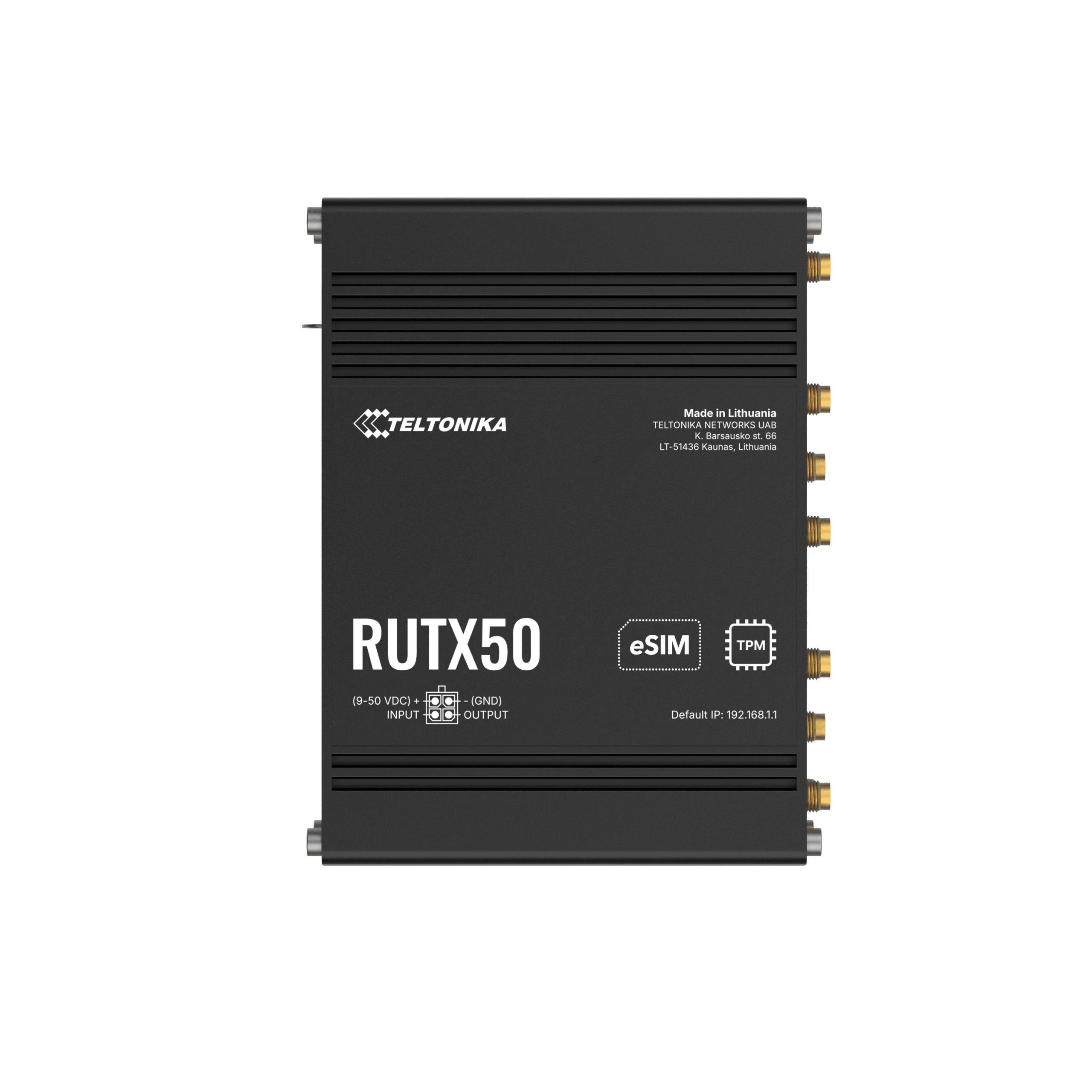
Teltonika RUTX50 eSIM 5G Router
The Teltonika RUTX50 (RUTX50320100) is an industrial 5G router with integrated eSIM, dual Mini-SIM slots, and 5G NR Sub-6GHz connectivity delivering up to 3.3 Gbps download. Built for demanding IoT, infrastructure and industrial deployments, it combines a full Gigabit Ethernet switch, dual-band Wi-Fi 5, GNSS, digital I/O, and the complete RutOS feature set in a ruggedised aluminium enclosure.
Key Features:
• 5G NR Sub-6GHz SA/NSA — up to 3.3 Gbps DL / 900 Mbps UL (4×4 MIMO)
• LTE Cat 20 fallback — up to 2.0 Gbps DL / 200 Mbps UL
• Integrated eSIM (eUICC) with up to 7 profiles plus 2 x Mini-SIM slots
• 1 x Gigabit WAN + 4 x Gigabit LAN ports
• Dual-band Wi-Fi 5 (802.11ac Wave 2) — up to 867 Mbps, up to 150 clients
• GNSS: GPS, GLONASS, BeiDou, Galileo, QZSS
• Digital input and digital output on 4-pin industrial power connector
• 9–50 V DC wide-range input, passive PoE via LAN1 (Mode B)
• Full VPN suite: OpenVPN, IPsec, WireGuard, ZeroTier, DMVPN, Tailscale
• RutOS with Modbus TCP, OPC UA, DNP3, DLMS/COSEM, MQTT
• Teltonika RMS compatible — remote management, FOTA, RMS Connect
• Operating temperature: -40 to +75 °C, IP30, DIN rail / wall mount
• UK plug PSU included, CE/UKCA/E-mark certified

£375.00 Excl VAT
Teltonika RUTX50 — industrial 5G router with integrated eSIM
The Teltonika RUTX50 (RUTX50320100) is a 5G Sub-6GHz industrial router with integrated eSIM, dual physical Mini-SIM slots, and LTE Cat 20 fallback. It delivers up to 3.3 Gbps download via 4×4 MIMO and supports both 5G NR SA and NSA architectures. Five Gigabit Ethernet ports, dual-band Wi-Fi 5, GNSS, digital I/O, and the full RutOS software platform make it suitable for high-demand fixed and semi-permanent deployments across energy, infrastructure, security, and industrial automation.
The integrated eSIM allows operator profiles to be loaded and switched remotely via the RutOS WebUI or Teltonika RMS, without physical SIM access. Combined with two physical SIM slots, the RUTX50 provides three independent connectivity pathways. SIM failover, band locking, operator allow/block lists, and per-SIM data limits are all configurable once set up in the RutOS WebUI.
Key features
- 5G NR Sub-6GHz SA/NSA: up to 3.3 Gbps download and 900 Mbps upload with 4×4 MIMO.
- LTE Cat 20 fallback: up to 2.0 Gbps download and 200 Mbps upload for mixed-coverage sites.
- Integrated eSIM (eUICC): up to 7 operator profiles, remote provisioning via RutOS WebUI — an active data plan must be obtained separately before the eSIM carries traffic.
- Dual physical Mini-SIM slots: 2 x 2FF with auto-failover, SIM idle protection, and load balancing, configurable in RutOS.
- Five Gigabit Ethernet ports: 1 x WAN (configurable as LAN) and 4 x LAN, all 10/100/1000 Mbps.
- Dual-band Wi-Fi 5: 802.11b/g/n/ac Wave 2 with MU-MIMO, up to 867 Mbps, up to 150 simultaneous clients.
- GNSS: GPS, GLONASS, BeiDou, Galileo, and QZSS with NMEA 0183 output, NTRIP support, and configurable geofencing.
- Digital I/O: 1 x digital input and 1 x digital output on the 4-pin power connector, with RMS, SMS, and email event triggers.
- Wide-range power input: 9–50 V DC with reverse polarity and surge protection; passive PoE via LAN1 (Mode B, 9–50 V DC).
- Full VPN suite: OpenVPN, IPsec (IKEv1/v2), WireGuard, ZeroTier, Tailscale, GRE, DMVPN, L2TP, SSTP, Stunnel, Tinc.
- Industrial protocols: Modbus TCP client and server, OPC UA client and server, DNP3 station and outstation, DLMS/COSEM client, MQTT broker and publisher.
- Teltonika RMS: full remote management, configuration, FOTA, RMS Connect (SSH, RDP, VNC), and fleet monitoring.
What is the RUTX50 used for?
Energy and utility infrastructure
Remote substations, BESS installations, and solar or wind generation sites need reliable WAN connectivity for SCADA telemetry, IEC 61850 data transfer, and OT remote access. The RUTX50 provides 5G or LTE Cat 20 backhaul with IPsec or WireGuard VPN tunnels to control networks. GNSS positioning and digital I/O event triggers support alarm and status reporting without additional hardware.
EV charge point management
EV charge point operators use the RUTX50 to provide OCPP-over-IP connectivity between chargers and their cloud management platforms. The eSIM allows network operator changes without site visits, which is valuable when MNO coverage at a charging location changes after installation. Dual SIM failover, once configured in RutOS, keeps chargers online if a primary network fails.
CCTV and ANPR
High-uplink 5G throughput supports multi-camera video streams from construction sites, temporary CCTV towers, and traffic enforcement deployments. The RUTX50 tolerates the wide temperature range and vibration present in roadside cabinet installations. A fixed-IP SIM paired with an IPsec or OpenVPN tunnel allows inbound management access without a public IP on a standard SIM.
Smart city and public infrastructure
Traffic management systems, environmental monitoring nodes, and digital information panels in urban deployments rely on consistent connectivity over long deployment lifetimes. The eSIM removes the need to revisit sealed cabinets to swap SIM cards when networks are renegotiated. RMS provides fleet-level firmware updates and alert management across large numbers of deployed units.
Industrial automation and SCADA
The RUTX50 supports Modbus TCP, OPC UA, and DNP3 alongside standard IP routing, allowing PLCs and RTUs to send data to SCADA platforms over 5G. VPN tunnels protect OT traffic on public networks, and VLAN segmentation keeps operational and management traffic separate. The -40 to +75 °C operating range covers plant rooms, outdoor cabinets, and process environments.
Temporary and event connectivity
Construction sites, outdoor events, and rapid-deployment networks benefit from the RUTX50’s combination of 5G throughput, self-contained power supply, and flexible mounting. The eSIM supports fast deployment when local MNO selection is unknown in advance. DIN rail or wall mounting allows quick installation in temporary switchgear enclosures.
Pro tip
The RUTX50 ships with four stub mobile SMA antennas. All four SMA mobile ports must be connected for 4×4 MIMO to function at full throughput. For installations inside metal enclosures or where the stub antennas cannot be positioned externally, run low-loss SMA cable to external antennas mounted on the cabinet exterior. A quality 4×4 MIMO 5G antenna on a short cable run will consistently outperform four stub antennas inside a steel cabinet, particularly on 5G NR n77 and n78 where free-space loss is highest.
Building a resilient cellular connection
The RUTX50 supports three independent SIM pathways — integrated eSIM plus two physical Mini-SIM slots — which can be configured in RutOS for automatic failover between networks from different mobile operators. Use SIMs from two separate MNOs where uptime is critical, so a single network outage does not take the connection down. Pairing the router with a DIN rail UPS in the same enclosure protects against short mains interruptions. Teltonika RMS provides fleet-level monitoring with configurable alerts for signal degradation, data limit thresholds, or device reboot events, allowing issues to be identified before they cause service outages.
Frequently asked questions
Does the RUTX50 support bootstrap eSIM provisioning?
Yes. The RUTX50 eSIM supports bootstrap provisioning, allowing an eSIM data plan to be downloaded and activated remotely over the air without a pre-loaded physical SIM. The bootstrap profile enables initial connectivity so the router can reach the provisioning server on first power-up. An active eSIM data plan must still be obtained separately — the bootstrap profile itself is not a data plan and does not carry traffic until a plan is provisioned onto the eSIM.
What is the difference between the eSIM and the physical SIM slots on the RUTX50?
The integrated eSIM is soldered to the PCB and cannot be removed. It supports up to 7 operator profiles which can be downloaded, activated, and switched remotely without physical access to the router. The two physical Mini-SIM (2FF) slots accept standard SIM cards and function independently. All three pathways can be used simultaneously for failover, configured in the RutOS WebUI.
What SIM card do I need for the RUTX50?
The physical SIM slots take a Mini SIM (2FF) — not Micro or Nano. For fixed installations requiring inbound access or VPN termination, a fixed IP SIM card is strongly recommended. Standard SIM cards sit behind carrier-grade NAT, which prevents inbound connections. We supply fixed IP SIMs on EE, O2, Vodafone, and multi-network roaming. Our team can advise on the right option for your deployment.
Does the RUTX50 support Teltonika RMS?
Yes. The RUTX50 is fully compatible with Teltonika RMS. RMS provides remote configuration, FOTA firmware updates, RMS Connect for SSH and RDP access to devices behind the router, and fleet-level monitoring with alerts. RMS operates on a credit-based licence — we stock Teltonika RMS credits.
Does the RUTX50 have GPS?
Yes. The RUTX50 includes a GNSS receiver supporting GPS, GLONASS, BeiDou, Galileo, and QZSS. A dedicated GNSS SMA antenna connector is on the rear panel, and a GNSS adhesive antenna is included in the box. NMEA 0183 output, configurable geofencing zones, and TAVL server support are all available through RutOS.
What is the operating temperature of the RUTX50?
The RUTX50 operates from -40 °C to +75 °C with 10% to 90% non-condensing humidity. The aluminium housing provides passive cooling with no moving parts. It is rated IP30, suitable for indoor cabinet and DIN rail installations. For outdoor deployments, the router should be housed in an IP-rated enclosure.
Can I use the WAN port as a second LAN port?
Yes. The WAN port is configurable as a LAN port through the RutOS WebUI, giving five LAN ports in mobile-only or Wi-Fi WAN deployments.
Related products and further reading
Browse our full range of Teltonika 5G routers or view all 5G routers we stock. For installations requiring an external antenna, see our 5G antennas, including 4×4 MIMO options suited to the RUTX50’s four mobile SMA ports. If you need SIM connectivity, we supply fixed IP SIM cards and IoT SIM cards with same-day activation. For eSIM connectivity options, see our eSIM router guide. For remote management, see our Teltonika RMS explainer.
| Cellular Connectivity | |
|---|---|
| Mobile standard | 5G NR Sub-6GHz SA/NSA; 4G LTE Cat 20; 3G HSPA+ |
| Max download | 5G: 3.3 Gbps (4x4 MIMO); 4G: 2.0 Gbps; 3G: 42 Mbps |
| Max upload | 5G: 900 Mbps (2x2 MIMO); 4G: 200 Mbps; 3G: 5.76 Mbps |
| 3GPP release | Release 15/16 (hardware version dependent) |
| 5G NR NSA bands (EMEA) | n1, n3, n5, n7, n8, n20, n28, n38, n40, n41, n77, n78 |
| 5G NR SA bands (EMEA) | n1, n3, n5, n7, n8, n20, n28, n38, n40, n41, n77, n78 |
| 4G LTE FDD bands | B1, B3, B5, B7, B8, B20, B28, B32 |
| 4G LTE TDD bands | B38, B40, B41, B42, B43 |
| 3G bands | B1, B5, B8 |
| eSIM | Integrated eSIM (eUICC), consumer type, up to 7 profiles; remote profile download and removal via RutOS WebUI. Supports bootstrap eSIM provisioning. Active data plan must be obtained separately before the eSIM carries traffic. |
| Physical SIM slots | 2 x Mini SIM (2FF), 1.8 V / 3 V |
| SIM auto-switch | Configurable in RutOS: weak signal, data limit, SMS limit, roaming, no network, network denied, connection fail, SIM idle protection |
| SIM features | Auto APN, band lock, operator allow/block list, multiple PDN, SIM PIN management, SIM idle protection |
| Mobile antenna ports | 4 x SMA female (rear panel) |
| Wi-Fi | |
|---|---|
| Wi-Fi standard | 802.11b/g/n/ac Wave 2 (Wi-Fi 5), dual band, MU-MIMO |
| Max Wi-Fi speed | Up to 867 Mbps |
| Wi-Fi modes | Access Point (AP), Station (STA), Mesh (802.11s) |
| Max simultaneous clients | 150 |
| Wi-Fi security | WPA3-SAE, WPA3-EAP, WPA2-PSK, WPA2-Enterprise (PEAP, EAP-TLS with PKCS#12), OWE, AES-CCMP, TKIP, 802.11w PMF |
| Wireless features | 802.11r fast roaming, 802.11v BSS transition, 802.11k radio resource measurement, SSID stealth, MAC allow/block list, QR code connect, TravelMate hotspot relay |
| Wi-Fi antenna ports | 2 x RP-SMA female (rear panel) |
| Ethernet | |
|---|---|
| WAN port | 1 x RJ45, 10/100/1000 Mbps, IEEE 802.3 / 802.3u / 802.3az, auto MDI/MDIX (configurable as LAN) |
| LAN ports | 4 x RJ45, 10/100/1000 Mbps, IEEE 802.3 / 802.3u / 802.3az, auto MDI/MDIX |
| Processor and Memory | |
|---|---|
| CPU | Quad-core ARM Cortex A7, 717 MHz |
| RAM | 256 MB |
| Flash storage | 256 MB |
| Software and OS | |
|---|---|
| Operating system | RutOS (OpenWrt-based Linux) |
| Routing protocols | Static, BGP, OSPF v2, RIP v1/v2, EIGRP, NHRP, policy-based routing |
| VPN | OpenVPN (27 encryption methods), IPsec (IKEv1/v2, 14 encryption methods), WireGuard, ZeroTier, Tailscale, GRE (over IPsec), PPTP, L2TP (v3, over IPsec), SSTP, DMVPN (Phase 2/3, Dual Hub), Stunnel, Tinc |
| Industrial protocols | Modbus TCP client and server (custom registers), OPC UA client and server (TCP), DNP3 station and outstation (TCP), DLMS/COSEM client (TCP), MQTT broker and publisher |
| Network features | VLAN (port and tag-based), QoS/SQM, DDNS (77 providers), DNS over HTTPS, load balancing, VRRP, hotspot/captive portal, DHCP, VRF, SSHFS, VoIP passthrough (H.323, SIP-ALG), VXLAN, Wake-on-LAN |
| Connection monitoring | Ping Reboot, Wget Reboot, Periodic Reboot, LCP, ICMP — must be configured in RutOS WebUI |
| Security | 802.1x port-based access control, pre-shared key / X.509 / RADIUS / TACACS+ authentication, stateful firewall (DMZ, NAT, NAT-T, NAT64), DDoS prevention (SYN flood, SSH, HTTP/HTTPS), port scan prevention, VLAN isolation, mobile quota control, web filter, Certificate Manager (CA, server, client, Let's Encrypt, SCEP) |
| Management | WebUI (HTTP/HTTPS), CLI, SSH (v1/v2), SNMP (v1/v2/v3, trap, brute force protection), TR-069, JSON-RPC over HTTP/HTTPS, SMS management, call-triggered actions, Teltonika RMS, FOTA, MQTT broker |
| IoT platforms | Azure IoT Hub (with Device Provisioning Service, zero-touch), AWS IoT Core (Jobs support), ThingWorx, Cumulocity / Cloud of Things |
| Development | SDK with build environment, BusyBox shell, Lua, C, C++, Python, Java (via Package Manager), GPL firmware customisation |
| Interfaces | |
|---|---|
| SIM slots | 2 x Mini SIM (2FF), front panel push-pull holders |
| USB | 1 x USB 2.0 Type-A — Samba share, USB-to-serial, external HDD/flash/modem/printer; FAT, FAT32, exFAT, NTFS (read-only), ext2/3/4 |
| Digital input | 1 x, on 4-pin power connector, 0–6 V = logic low, 8–30 V = logic high |
| Digital output | 1 x, open collector, max 30 V / 300 mA, on 4-pin power connector |
| I/O events | Email, RMS, SMS (configurable in RutOS WebUI) |
| GNSS | GPS, GLONASS, BeiDou, Galileo, QZSS; NMEA 0183; NTRIP; geofencing; TAVL; 1 x SMA female antenna port (rear panel) |
| Status LEDs | 4 x WAN type, 3 x mobile connection type, 3 x mobile signal strength, 10 x Ethernet port status, 2 x Wi-Fi band (2.4G/5G), 1 x power |
| Reset button | Reboot / user default reset / factory reset |
| Grounding | 1 x grounding screw |
| Power | |
|---|---|
| Power connector | 4-pin industrial DC power socket |
| Input voltage | 9–50 V DC, reverse polarity protection, surge protection 51 V DC 10 µs max |
| Passive PoE input | Via LAN1 port, Mode B (spare pairs), 9–50 V DC — not compatible with IEEE 802.3af, 802.3at, or 802.3bt |
| Power consumption | Idle: < 4 W; max: < 16.5 W |
| Power socket pinout | Power (red), Ground (black), Input (green), Output (white) |
| Physical | |
|---|---|
| Housing material | Aluminium |
| Dimensions (W x H x D) | 132 x 44.2 x 95.1 mm (excluding antenna connectors and screws) |
| Weight | 533 g |
| Mounting | DIN rail, wall mount, flat surface — all require additional mounting kit (not included) |
| Antenna connectors | 4 x SMA female (mobile), 2 x RP-SMA female (Wi-Fi), 1 x SMA female (GNSS) — all on rear panel |
| Environmental | |
|---|---|
| Operating temperature | -40 °C to +75 °C |
| Operating humidity | 10% to 90% non-condensing |
| Ingress protection | IP30 |
| Certifications | |
|---|---|
| Regulatory | CE/RED, UKCA, RCM, CB, E-mark, IMDA, SIRIM, ETSI EN 303 645, SDPPI, ETAWPC, MTCTE |
| Operator | NOS (Portugal) |
| EMC standards | EN 55032, EN 55035, EN IEC 61000-3-2, EN 61000-3-3, EN 301 489-1/3/17/19/52 |
| Safety | EN IEC 62368-1:2020 + A11:2020, EN 62311:2020, AS/NZS 62368.1:2022, IEC 62368-1:2018 |
| RF standards | EN 300 328, EN 300 440, EN 301 893, EN 301 908-1/2/13/25, EN 303 413 |
| In the Box | |
|---|---|
| Contents | RUTX50 router, 18 W UK PSU, 4 x 5G mobile SMA antennas (swivel, SMA male), 2 x Wi-Fi dual-band magnetic SMA antennas (1.5 m cable, RP-SMA male), 1 x GNSS adhesive SMA antenna (3 m cable, SMA male), Ethernet cable 1.5 m, SIM adapter kit, Quick Start Guide |
| Note | DIN rail and wall mounting kits are sold separately and are not included in the standard package. |
| Warranty and Support | |
|---|---|
| Warranty | 2-year manufacturer warranty |
| Support | UK-based technical support — 0300 124 6181 |
| Remote management | Teltonika RMS compatible |
| Classification | HS Code: 851762 / HTS: 8517.62.00 |
Based on 0 reviews
Be the first to review “Teltonika RUTX50 eSIM 5G Router”
You may also like…
- Network Switches, Teltonika, Teltonika Switches
Teltonika TSW304 Unmanaged Switch With Built-in Din Rail Mount
 Network Switches, Teltonika, Teltonika Switches
Teltonika TSW304 Unmanaged Switch With Built-in Din Rail Mount
Teltonika TSW304 is a tiny, 4 port Gigabit Ethernet Switch from Teltonika that includes a built-in DIN Rail mount and all the ports, power and grounding on the same face to provide easy, convenient installation.
SKU: TELTONIKA-TSW304-N - Network Switches, Networking, Teltonika, Teltonika Switches
Teltonika TSW210 Industrial Switch
Teltonika TSW210 is an industrial grade switch from with eight Gigabit Ethernet and two SFP ports.
- The TSW210 is an industrial unmanaged switch for centralizing your resources.
- Equipped with 2 SFP ports for long-range fibreoptic communication and 8 Gigabit Ethernet ports with of up to 1000 Mbps download/upload speed.
- Durable, rugged aluminium housing with DIN rail and surface mounting options make the TSW210 perfect for industrial settings.
- 2-pin industrial DC power socket with an input voltage range of 7-57 VDC.
SKU: TELTONIKA-TSW210-N - Networking, POE Switches, Teltonika, Teltonika Switches
Teltonika TSW200 Unmanaged POE+ Switch
The Teltonika TSW200 8-Port Unmanaged Rackmountable Gigabit PoE+ Switch is industrial unmanaged switch from Teltonika Networks. It is equipped with two (2) SFP ports for long-range Fibre-optic communication and eight (8) Gigabit Ethernet ports which support IEEE802.3af and IEE802.3at Power-over-Ethernet standards.
Classified as power source equipment (PSE), it enables centralisation of the power supply, providing up to 30 watts per port and reducing the effort for installing power. It has 10/100/1000 Mbps Ethernet ports to provide an economical high-bandwidth solution for your industrial Ethernet network. This rugged unmanaged industrial switch is ideal for professional high bandwidth applications where it is necessary to provide both a reliable data connection and power supply.
Key Features
- Eight (8) Gigabit Ethernet with speeds up to 1000 Mbps.
- Two (2) SFP ports for long-range Fibre-optic communication.
- Eight (8) PoE ports with 802.3af and 802.3at support.
- Total power budget at PSE up to 240 W.
- Rugged aluminium housing.
- DIN rail and surface mountable (kits sold separately).
- DOES NOT INCLUDE POWER SUPPLY
- Teltonika 62W Power Supply – PR317UKA
- Teltonika 250W Power Supply – PR320UKA
SKU: TELTONIKA-TSW200-N


Related products
- 5G Routers, Teltonika, Teltonika 5G Routers
Teltonika RUTM31
The Teltonika RUTM31 is a compact, industrial-grade 5G router delivering high-speed, secure connectivity for IoT, enterprise, and industrial applications. Featuring dual-SIM failover, dual-band Wi-Fi, robust VPN and security options, and full remote management, it is ideal for mission-critical deployments where reliability and flexibility are paramount.
Key Features:
- 5G Sub-6 GHz with LTE Cat 12 and 3G fallback
- Dual-SIM with intelligent failover
- Dual-band Wi-Fi 5 with MU-MIMO and mesh support
- Two Gigabit Ethernet ports (1× WAN, 1× LAN)
- Advanced VPN, firewall, and security features
- Full remote management via Teltonika RMS
Unavailable due to part shortages – Contact us for alternatives
SKU: TELTONIKA-RUTM31-N - 5G Routers, Proroute, Proroute 5G Routers, Proroute Routers
Proroute H685fc-w Compact IoT Industrial 5G Router
5G Routers, Proroute, Proroute 5G Routers, Proroute RoutersProroute H685fc-w Compact IoT Industrial 5G Router
PROROUTE H685fc-W IoT 5G Router
This is the version of the popular H685f-W designed for large scale deployment.
The functionality remains the same, but with the main difference being the modem inside which is the Quectel RM500U-EA which is a 5G Sub-6 GHz module specifically optimized for IoT/ eMBB/ URLLC applications.
- Reliable 5G connectivity for data-intensive IoT applications
- 4×4 MiMo 5G antenna support for optimal signal reception
- 2 x Gigabit Ethernet Ports for flexible network setups
- 802.11a/b/g/n WiFi for local wireless access
SKU: PRORT-H685-5G-FC-W-N - 5G Routers, Office 5G Router, Teltonika, Teltonika 5G Routers
Teltonika RUTM51 Industrial M2M / IoT 5G Router
5G Routers, Office 5G Router, Teltonika, Teltonika 5G RoutersTeltonika RUTM51 Industrial M2M / IoT 5G Router
The Teltonika RUTM51 5G Router delivers unparalleled connectivity with lightning-fast 5G speeds, versatile network support, and robust security features. Ideal for businesses and tech enthusiasts, this industrial-grade router ensures reliable performance in demanding environments. Experience seamless internet access for remote work, IoT applications, and more with the advanced RutOS operating system.
Key Features
- Blazing Fast 5G Speeds: Up to 3.4 Gbps download speeds.
- Multi-Network Support: Compatible with 3G, 4G, and 5G networks.
- Dual-Band WiFi: Strong connections on both 2.4 GHz and 5 GHz.
- Industrial-Grade Design: Robust performance in extreme conditions.
- Advanced Security: Comprehensive VPN and firewall features.
- User-Friendly Interface: Easy setup and management through a web-based GUI.
NB : The RUTM51 supports CAT12 LTE 4G and does not include GPS/GNSS – If you need faster 4G (CAT20) or GPS/GNSS Then please select Teltonika RUTX50
NOT CURRENTLY AVAILABLE DUE TO PART SHORTAGES – See RUTX50 or RUTM30
SKU: Teltonika-RUTM51-N - 5G Routers, Teltonika, Teltonika 5G Routers
Teltonika RUTM54 5G Router With Telit Modem
The RUTM54 is a high-performance, dual-SIM and eSIM 5G router, ideal for data-intensive applications that demand reliable, high-speed connectivity. With a European Telit 5G modem, the RUTM54 delivers exceptional global connectivity and consistent performance. Its 5 Gigabit Ethernet ports and dual-band Wi-Fi provide robust redundancy, while auto-failover ensures uninterrupted service. With backward compatibility to 4G and multiple interface options, the RUTM54 is designed for seamless expandability and future upgrades.
SKU: TELTONIKA-RUTM54-N


There are no reviews yet.