
No products in the basket.
Milesight, Milesight 4G Routers
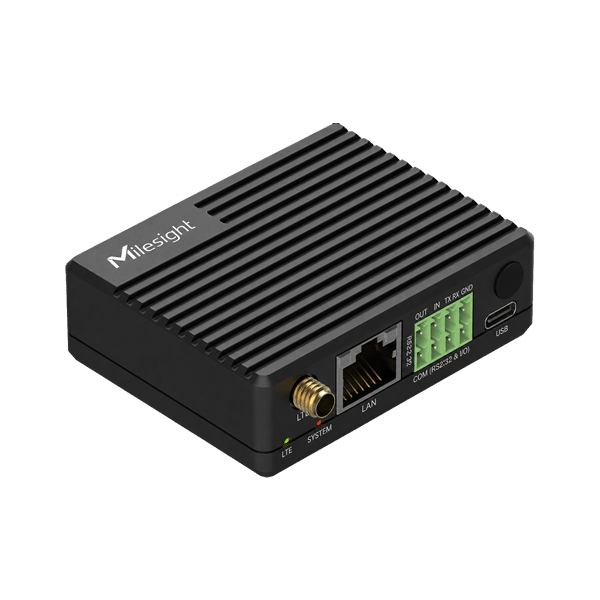
Milesight UR41L 4G Cat 1 Mini Industrial Router
The Milesight UR41L (UR41L-L0CEU) is a compact 4G LTE Cat 1 industrial router built for cost-sensitive M2M and IoT deployments where low power consumption and serial device connectivity matter more than peak throughput. At 70 x 55 x 22 mm and 103 g, it combines RS232/RS485, galvanically isolated digital I/O, and a hardware watchdog in a metal IP30 enclosure rated to -40 to +60 °C.
Key Features:
• 4G LTE Cat 1 connectivity for low-throughput M2M and IoT applications
• RS232 or RS485 (software switchable) – Modbus RTU/TCP, transparent serial, DLMS client
• 1 x digital input + 1 x digital output, galvanically isolated, 3.5 mm terminal block
• Dual power input: 5-24 V DC terminal block or 5 V USB Type-C
• Ultra-low standby power: 6.3 mA at 12 V – suitable for battery and solar-powered installs
• Hardware watchdog for automatic recovery from cellular or system failures
• VPN support: IPsec, OpenVPN, WireGuard, GRE, L2TP, PPTP, DMVPN, ZeroTier
• Remote management via Milesight DeviceHub and MilesightVPN
• Scheduled wake, SMS wake, and DI wake for power-managed deployments
• Desk, wall, and DIN rail mounting – 70 x 55 x 22 mm, 103 g
£89.00 Excl VAT
Milesight UR41L (UR41L-L0CEU) – 4G Cat 1 mini industrial router with serial I/O
The Milesight UR41L (UR41L-L0CEU) is a 4G LTE Cat 1 industrial router in the same palm-sized metal enclosure as the UR41, measuring 70 x 55 x 22 mm and weighing 103 g. Where the UR41 targets deployments that need Cat 4 throughput or GPS positioning, the UR41L is built for fixed M2M and IoT applications where the priority is low unit cost, low power draw, and reliable serial device connectivity. It carries the same RS232/RS485 serial port, galvanically isolated digital I/O, dual power input, hardware watchdog, and full VPN suite as the Cat 4 model – with a Cat 1 modem that keeps idle and active power consumption lower.
At 226 mA at 12 V under data link conditions, the UR41L draws less active power than the UR41’s 157 mA figure. Standby is identical at 6.3 mA. Remote management runs through Milesight DeviceHub for bulk configuration and firmware updates across fleets of devices, and MilesightVPN for direct secure tunnel access to equipment in the field. Modbus RTU, Modbus TCP, and DLMS/COSEM run natively over the serial port without additional software.
Key features
- 4G LTE Cat 1: Sufficient for Modbus polling, MQTT telemetry, DLMS meter reads, and VPN-tunnelled SCADA traffic. No GPS and no 3G/2G fallback on this variant – CE certified for European networks.
- Software-switchable serial port: One port configures as RS232 or RS485 via the web interface. Supports Modbus RTU/TCP client, Modbus gateway, transparent TCP/UDP, and DLMS client for smart meter communication.
- Galvanically isolated digital I/O: One DI (dry contact) and one DO (wet contact, max 0.3 A at 30 V DC) on a 3.5 mm terminal block. Triggerable via DI state, SMS, CLI, Modbus, or MQTT.
- Low standby power: 6.3 mA at 12 V in standby. Supports scheduled wake, SMS wake, and DI-triggered wake for deployments on battery or solar supply.
- Dual power input: 5-24 V DC on a 2-pin 3.5 mm terminal block with surge and reverse polarity protection, plus 5 V/1 A via USB Type-C for bench testing or USB-powered installations.
- Hardware watchdog: Built-in watchdog automatically recovers from software lockup, cellular failure, and network outage without remote intervention.
- Full VPN suite: IPsec (multiple clients and server), OpenVPN (multiple clients and server), WireGuard, GRE, L2TP, PPTP, DMVPN spoke, and ZeroTier.
- Milesight DeviceHub management: Centralised dashboard for status monitoring, bulk configuration, and remote firmware update across multiple UR41L units.
- AWS and Azure IoT native: Built-in support for AWS IoT Core with Jobs support and Azure IoT Hub. Serial device data routes directly to cloud platforms via MQTT or MQTTS.
- Compact industrial enclosure: Metal housing, IP30, -40 to +60 °C operating range. DIN rail, wall mount, and desktop mounting supported.
What is the Milesight UR41L used for?
Fixed M2M telemetry on managed IoT SIMs
Cat 1 delivers consistent low-latency connectivity for applications that send small, regular data payloads – meter reads, sensor polls, alarm events, status updates. The UR41L suits any fixed site where a managed IoT SIM with a fixed IP provides the WAN, inbound VPN access is required, and throughput above 10 Mbps is never needed. Monthly data consumption on a Modbus polling or DLMS metering application is typically well under 1 GB.
Smart metering and DLMS/COSEM integration
The UR41L supports DLMS/COSEM client mode over the serial port for direct communication with IEC 62056-compliant electricity and gas meters via RS232 or RS485. Meter data forwards upstream via MQTT or HTTPS to Azure IoT Hub, AWS IoT Core, or a head-end SCADA system. Cat 1 throughput is more than sufficient for scheduled meter reads and alarm-driven uploads.
Building automation and BMS connectivity
Building management systems using Modbus RTU over RS485 connect directly to the UR41L serial port. The router bridges Modbus RTU to Modbus TCP for integration with cloud-based BMS platforms, or forwards data to AWS IoT Core and Azure IoT Hub. The small enclosure fits inside standard DIN rail panels and electrical cabinets without occupying significant space.
Vending machines and unattended retail
The UR41L suits vending machine connectivity where RS232 to the vend controller, remote reboot via SMS or DI, low standby power, and a small form factor are the key requirements. Cat 1 handles transaction data, stock alerts, and remote configuration comfortably. The USB Type-C power input suits machines where only a USB supply is available inside the enclosure.
Industrial equipment monitoring
PLCs and controllers communicating over RS485 Modbus RTU connect directly to the UR41L serial port. The router bridges Modbus RTU to Modbus TCP for SCADA integration, or routes telemetry data to cloud IoT platforms including ThingWorx and AWS IoT Core. The galvanic isolation on the DI/DO protects against ground loop faults common in motor-heavy environments.
Solar and battery-powered remote sites
Standby power draw of 6.3 mA at 12 V makes the UR41L viable on small solar-charged battery systems. Scheduled wake and DI-triggered wake mean the router sleeps between reporting intervals and wakes on an alarm input, keeping average current well below the standby figure across a full day.
Pro tip: use IP passthrough for single-device installations
If the UR41L connects a single downstream device – a PLC, RTU, or meter head-end server – enable IP passthrough in the network settings. The router assigns the cellular IP address directly to the downstream device, removing a NAT layer and simplifying inbound connections from your SCADA or management platform. Combined with a fixed IP SIM, this gives the field device a stable, routable address with no dynamic DNS dependency. Configure IP passthrough under Network > Internet Access > Cellular in the UR41L web interface.
UR41L vs UR41: which variant to choose?
The UR41L (UR41L-L0CEU) and the UR41 (UR41-L08EU) share the same enclosure, processor, memory, serial port, DI/DO, USB port, and management platform. The differences are in the cellular module and positioning capability.

| Feature | UR41L (UR41L-L0CEU) | UR41 (UR41-L08EU) |
|---|---|---|
| Cellular standard | 4G LTE Cat 1 only | 4G LTE Cat 4 / 3G WCDMA / 2G GSM |
| Max download | 10 Mbps (Cat 1 typical) | 150 Mbps (LTE Cat 4) |
| Max upload | 5 Mbps (Cat 1 typical) | 50 Mbps (LTE Cat 4) |
| 3G/2G fallback | No | Yes – WCDMA and GSM |
| GPS / GNSS | No | Yes – GPS, GLONASS, BeiDou, Galileo, QZSS |
| Certifications | CE, RoHS | CE, FCC, RoHS |
| Idle power at 12 V | 78 mA | 70 mA |
| Data link power at 12 V | 226 mA | 157 mA |
| Typical use case | Fixed M2M, cost-sensitive IoT, low-throughput telemetry | Remote monitoring, vehicle IoT, metering with positioning |
Choose the UR41L where throughput above 10 Mbps is never needed, GPS is not required, and unit cost is the primary driver. Choose the UR41 where 3G/2G fallback adds resilience, GPS positioning is operationally useful, or higher throughput headroom is preferred.
Frequently asked questions
What is the difference between the Milesight UR41L and the UR41?
The UR41L uses a Cat 1 modem with a maximum of around 10 Mbps download and no GPS. The UR41 uses a Cat 4 modem capable of 150 Mbps download and includes GPS/GNSS with support for GPS, GLONASS, BeiDou, Galileo, and QZSS. Both share the same enclosure, serial port, DI/DO, power inputs, VPN suite, and management platform. For fixed, low-throughput M2M applications with no positioning requirement, the UR41L is the more cost-effective choice.
Does the Milesight UR41L have Wi-Fi?
No. Neither the UR41L nor the UR41 has Wi-Fi. The router provides 4G cellular as its WAN and one 10/100 Mbps Ethernet LAN port for wired device connection. If Wi-Fi is a requirement, the Milesight UR32S is the relevant alternative in the Milesight range.
Does the UR41L have 3G or 2G fallback?
No. The UR41L is a Cat 1 LTE-only device with no 3G WCDMA or 2G GSM fallback. If fallback to 3G or 2G is important for coverage resilience in your deployment area, the UR41 (UR41-L08EU) is the appropriate variant.
What SIM card does the Milesight UR41L take?
The UR41L uses a single Nano SIM (4FF) slot. The SIM tray requires the ejector tool supplied in the box. The router does not support hot-swapping – power it down before inserting or removing the SIM. For fixed installations requiring inbound VPN connections or a static address, a fixed IP SIM card removes the carrier-grade NAT barrier that standard SIMs sit behind.
How is the Milesight UR41L powered?
The UR41L accepts 5-24 V DC on a 2-pin 3.5 mm terminal block with built-in surge protection and reverse polarity protection. It also accepts 5 V at 1 A via the USB Type-C port for bench testing or installations where only USB power is available. The DC terminal block covers 12 V and 24 V DC supplies directly without a converter and is the recommended route for permanent installations.
What is Milesight DeviceHub and does the UR41L support it?
Milesight DeviceHub is a cloud-based device management platform for Milesight routers. It provides centralised status monitoring, remote configuration, bulk firmware updates, and alert management across multiple devices from a single dashboard. The UR41L supports DeviceHub alongside MilesightVPN, which gives engineers direct secure tunnel access to devices and equipment connected behind routers in the field. Both are included with no additional hardware required.
Related products and further reading
The UR41L-L0CEU sits within our Milesight router range alongside the UR41-L08EU for deployments where Cat 4 throughput or GPS is needed. For the SIM card, a fixed IP SIM is strongly recommended for any installation requiring inbound VPN access or a stable routable address. Our range of 4G antennas includes external options for installations where the supplied stub antenna is insufficient, particularly in metal cabinets or sub-panel installs.
Based on 0 reviews
Be the first to review “Milesight UR41L 4G Cat 1 Mini Industrial Router”
Related products
- 4G Routers, CAT6 4G Router, Teltonika, Teltonika 4G Routers
Teltonika RUT360 CAT6 4G LTE Industrial Router
 4G Routers, CAT6 4G Router, Teltonika, Teltonika 4G Routers
Teltonika RUT360 CAT6 4G LTE Industrial Router
RUT360 is a compact, cost-effective and powerful industrial LTE 4G LTE CAT6 router for professional applications. This router delivers high performance for mission-critical cellular communication. The Teltonika RUT360 router is equipped with an external SIM holder and signal strength status LEDs, providing easy network management.
THE RUT360 HAS BEEN REPLACED WITH THE RUT361 – CLICK HERE
 SKU: TELTONIKA-RUT360-N
 - 4G Routers, Teltonika, Teltonika 4G Routers
Teltonika RUT200 4G LTE Industrial Cellular Router
The Teltonika RUT200 (RUT200013000) is a compact 4G LTE Cat 4 industrial cellular router with a single Mini SIM, 802.11b/g/n Wi-Fi, and two 10/100 Mbps Ethernet ports in a 125 g aluminium housing. It runs RutOS on a Mediatek 580 MHz processor with a full VPN stack, industrial protocol support, digital I/O, and Teltonika RMS compatibility, operating from -40 to +75 °C.
Key Features:
• 4G LTE Cat 4 – 150 Mbps down / 50 Mbps up; automatic fallback to 3G and 2G
• Single Mini SIM (2FF) with auto APN, band lock, and operator block/allow list
• Wi-Fi 4 (802.11b/g/n) – access point and station modes, up to 50 simultaneous clients
• 1 x WAN + 1 x LAN (10/100 Mbps); WAN port configurable as second LAN via RutOS
• 1 x digital input and 1 x digital output on 4-pin power connector
• Passive PoE input via LAN1 – Mode B, 9-30 V DC (not compatible with 802.3af/at/bt)
• VPN: OpenVPN, IPsec, WireGuard, ZeroTier, GRE, L2TP, DMVPN, SSTP, Tinc
• Modbus TCP, OPC UA, DNP3, MQTT broker/publisher, Azure IoT Hub, AWS IoT Core
• Teltonika RMS compatible – remote management, FOTA, alerts, and VPN tunnels
• CE, UKCA, E-mark certified; IP30; 83 x 25 x 74 mm; 125 gSKU: TELTONIKA-RUT200013000-N - 4G Routers, CAT6 4G Router, Teltonika, Teltonika 4G Routers
Teltonika RUTX12 Dual LTE Cat 6 Industrial Cellular Router
4G Routers, CAT6 4G Router, Teltonika, Teltonika 4G RoutersTeltonika RUTX12 Dual LTE Cat 6 Industrial Cellular Router
The Teltonika RUTX12 is a powerful dual LTE Cat 6 industrial router designed for mission-critical applications. It offers uninterrupted connectivity with dual LTE modems, providing speeds up to 600 Mbps with load balancing. The robust router features advanced security, remote management, and a durable aluminum housing suitable for harsh environments.Top 6 Key Features:
- Dual LTE Cat 6 Modems for simultaneous high-speed internet up to 600 Mbps
- enables load balancing, hot swap failover or bonded 4G using Bondix service.
- 5 Gigabit Ethernet ports for wired connections up to 1000 Mbps
- Wave-2 802.11ac Dual Band WiFi with speeds up to 867 Mbps
- Advanced security features like VPN, IPsec, PPTP, L2TP, and GNSS tracking
- Remote Management System (RMS) for seamless monitoring and configuration
- Robust aluminium housing with IP30 rating for harsh industrial environments
 SKU: TELTONIKA-RUTX12-N
 - Dual LTE Cat 6 Modems for simultaneous high-speed internet up to 600 Mbps
- 4G Router For Office, 4G Routers, CAT6 4G Router, Manufacturers, Proroute, Proroute 4G Routers, Proroute Routers
Proroute H820 CAT6 LTE-A 4G Router – Industrial M2M IOT 4G CAT6 Router with RJ45 Ethernet and WiFi
4G Router For Office, 4G Routers, CAT6 4G Router, Manufacturers, Proroute, Proroute 4G Routers, Proroute RoutersProroute H820 CAT6 LTE-A 4G Router – Industrial M2M IOT 4G CAT6 Router with RJ45 Ethernet and WiFi
The Proroute H820 CAT6 4G LTE Router is a reliable, industrial grade 4G LTE-A router with embedded high speed LTE CAT6 4G module for high speed mobile broadband data transfer speeds.
SKU: PRORT-H820-4G-CAT6-N


There are no reviews yet.