
No products in the basket.
Teltonika, Teltonika IoT Gateways
Teltonika TRB236 Industrial LTE CAT4 / LTE 450 IoT Gateway
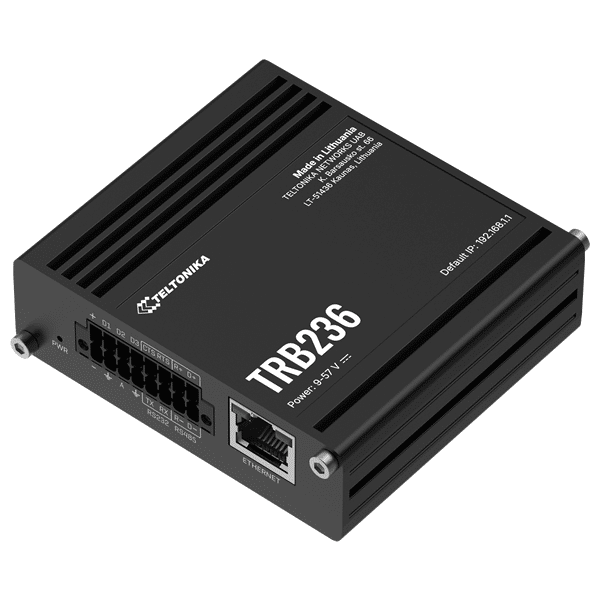
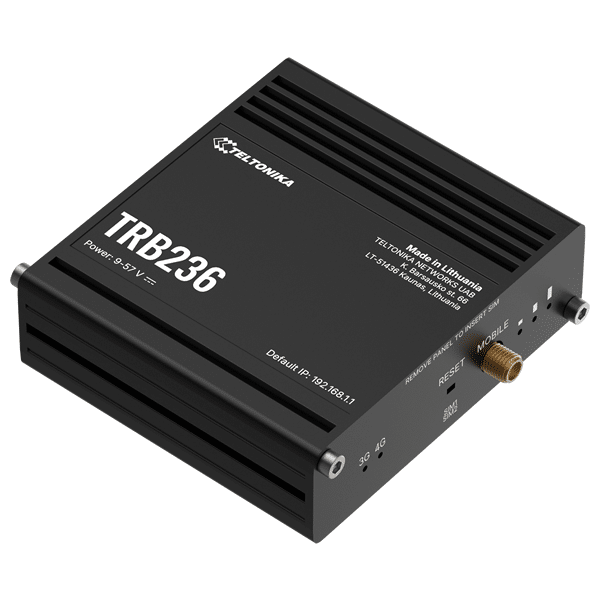
The Teltonika TRB236 is an industrial LTE 450 IoT gateway that delivers Cat 1 or Cat 4 connectivity over the 450 MHz band, giving utility and infrastructure operators reliable cellular coverage in hard-to-reach locations. It connects legacy field equipment to IP networks via RS232, RS485, Ethernet, and configurable I/O, with dual SIM and eSIM support for continuous connection continuity.
TRB236 Key Features:
• LTE 450 MHz connectivity – LTE Band 31 (452.5-457.5 MHz), Band 72 (451-456 MHz), and Band 87 (410-415 MHz)
• Choice of LTE Cat 1 or LTE Cat 4 modem variant to match network requirements
• Standard LTE fallback: FDD Bands 1, 3, 7, 8, 20, 28 and TDD Bands 38, 40
• 3G WCDMA fallback on Bands 1, 8
• RS232 and RS485 serial interfaces for legacy equipment integration
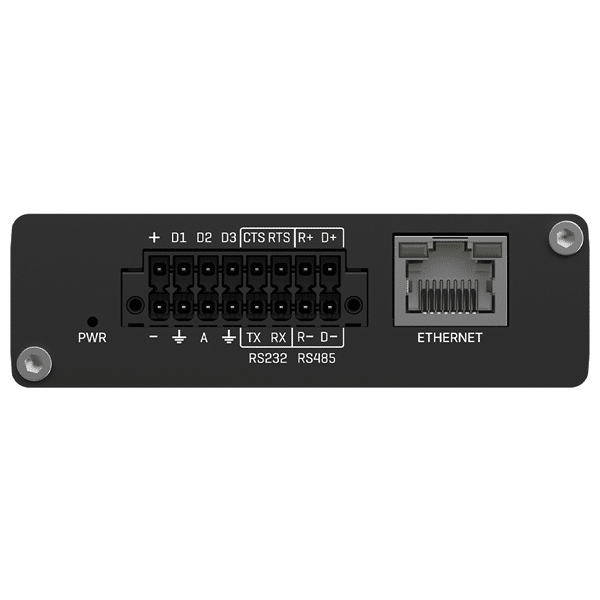
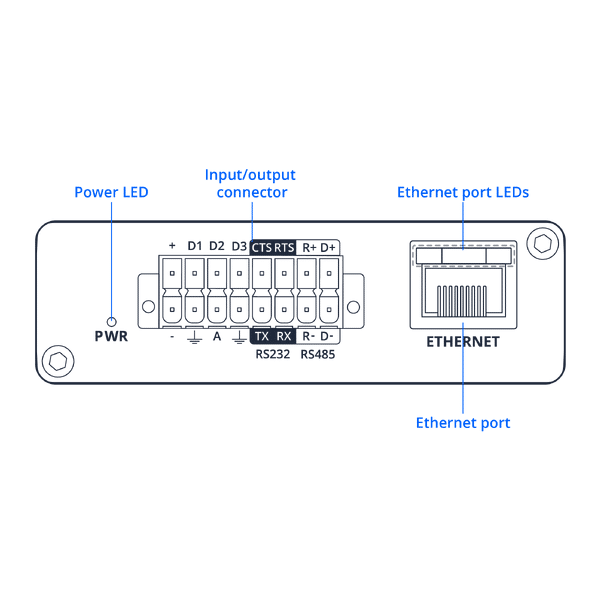
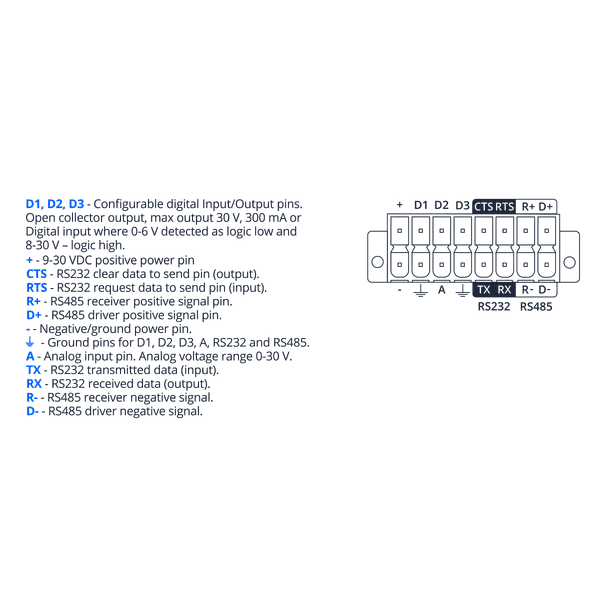
• Configurable digital inputs and outputs via 16-pin industrial terminal block
• Dual Nano SIM + eSIM with automatic failover
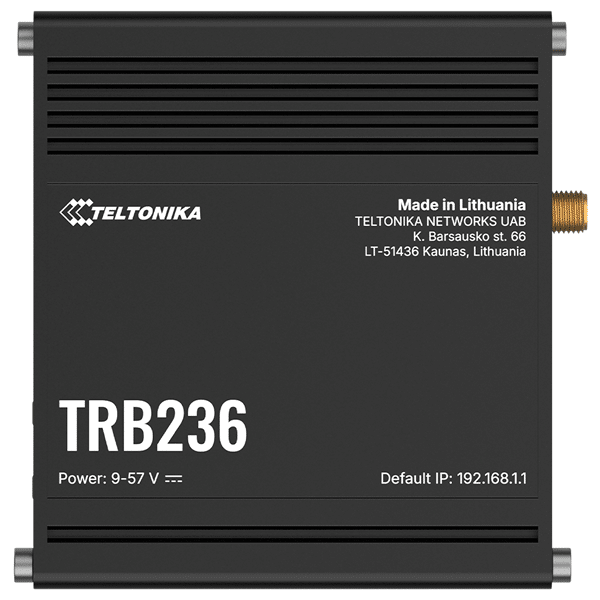
• 9-57 VDC wide-range power input
• -40 to +40°C operating temperature
• RutOS with Modbus, MQTT, VPN, and full RMS remote management support
TRB236 Flyer (pdf)
Price range: £145.00 through £150.00 Excl VAT
Teltonika TRB236: Industrial LTE CAT4 / LTE 450 IoT Gateway
The Teltonika TRB236 is an industrial IoT gateway with option for LTE 450 private networks or standard CAT4 LTE. It delivers LTE Cat 1 or Cat 4 connectivity over the 450 MHz band – a low-frequency licensed spectrum used by utilities, energy operators, and critical infrastructure providers across Europe. The 450 MHz band offers superior signal propagation and building penetration compared to standard LTE frequencies, making the TRB236 the right choice for remote substations, meter cabinets, underground infrastructure, and sites where higher-band LTE is unavailable or unreliable.
Equipped with RS232, RS485, Ethernet, and configurable digital I/O via a 16-pin industrial terminal block, the TRB236 connects legacy field equipment directly to IP networks. Dual SIM and eSIM support keep the connection active through automatic failover. RutOS delivers a full software stack including VPN, Modbus, MQTT, and Teltonika RMS remote management – all in a compact DIN rail-mountable enclosure rated for -40 to +40°C.
Key Features
- LTE 450 MHz connectivity – Band 31 (452.5-457.5 MHz), Band 72 (451-456 MHz), and Band 87 (410-415 MHz) for private utility network access. See our LTE 450 explainer for a full overview of this technology.
- Cat 1 or Cat 4 modem variant – choose the variant that matches your network operator’s deployment
- Standard LTE fallback – FDD bands 1, 3, 7, 8, 20, 28 and TDD bands 38, 40 for hybrid public/private deployments
- 3G WCDMA fallback – bands 1 and 8 for maximum backward compatibility
- RS232 and RS485 serial interfaces for Modbus RTU, DNP3, and legacy field protocol integration
- Configurable digital I/O via 16-pin industrial terminal block for remote switching and monitoring
- Dual SIM + eSIM with automatic failover – supports auto-switch on weak signal, data limit, roaming, and network denial
- Wide-range 9-57 VDC power input via 16-pin terminal block – suitable for DC supply rails in grid infrastructure
- RutOS with VPN, MQTT, Modbus TCP, and industrial protocol support
- Teltonika RMS compatible for centralised remote monitoring, configuration, and firmware updates
- CE and UKCA certified
What the TRB236 is Used For
Smart Meter Gateways on Private LTE 450 Networks
Energy distribution operators deploying private LTE 450 networks use the TRB236 to connect smart meters, meter data concentrators, and data management systems. The 450 MHz band provides the reach to connect meters in basements, utility rooms, and rural locations that standard LTE bands cannot reliably serve. RS485 and Modbus RTU support integration with IEC 62056 DLMS/COSEM metering protocols.
Substation Automation and Grid Telemetry
Distribution system operators use the TRB236 to backhaul SCADA data from remote substations over private LTE 450 infrastructure. RS232 and RS485 interfaces allow direct connection to RTUs, IEDs, and legacy telecontrol equipment. The wide-range 9-57 VDC input is compatible with standard substation DC supplies, and the -40 to +40°C operating range covers most indoor cabinet environments.
Water and Gas Utility Telemetry
Water and gas distribution operators use the TRB236 to collect remote telemetry data from pumping stations, pressure monitoring points, and flow meters across wide geographic areas. The 450 MHz signal reaches rural sites and isolated infrastructure where higher-band LTE coverage is not available. Configurable digital I/O pins enable direct monitoring of valve states, pressure alarms, and pump status.
Remote Infrastructure Monitoring in Coverage Gaps
Transmission and distribution network operators use the TRB236 to connect remote sites where no public LTE coverage exists and a private 450 MHz network is the only viable connectivity option. The TRB236 supports hybrid operation – connecting to a private 450 MHz network where available and falling back to public LTE on standard bands where the private network has not yet been deployed.
Critical IoT in Urban Basement and Underground Environments
The deep building penetration of the 450 MHz band makes the TRB236 suitable for connecting meters, sensors, and control equipment installed in basements, below-ground cabinets, and dense urban environments where higher-band LTE signals are significantly attenuated. 450 MHz signals propagate through reinforced concrete and masonry that would block a standard LTE connection.
Public Safety and Emergency Communications Backhaul
National and regional agencies with licensed 410-450 MHz spectrum use the TRB236 to provide data connectivity at emergency sites, remote command posts, and temporary infrastructure. The Band 87 support (410-415 MHz) extends coverage to critical safety networks operating in this range.
Frequently Asked Questions
What is LTE 450 and why does it matter for utilities?
LTE 450 is 4G LTE connectivity delivered over the 450 MHz frequency band rather than the 700 MHz to 2.6 GHz bands used by mainstream public mobile networks. The 450 MHz band travels further from each cell tower and penetrates buildings and underground structures more effectively than higher frequencies. Several European countries have licensed this spectrum specifically to energy operators and utilities for private network deployments. This means a utility can operate its own dedicated LTE network for smart metering, grid automation, and field telemetry, without relying on public mobile infrastructure. Our LTE 450 explainer covers this in detail.
What is the difference between the TRB236 Cat 1 and Cat 4 variants?
The TRB236 is available in two modem variants. The Cat 1 variant uses LTE Category 1, which provides lower peak data rates (typically 10 Mbps down / 5 Mbps up) but draws less power – well-suited to SCADA telemetry, meter data collection, and low-bandwidth IoT applications. The Cat 4 variant uses LTE Category 4, which supports up to 150 Mbps down / 50 Mbps up – more appropriate where video surveillance, large firmware updates, or higher-volume data transfers are required. Both variants support the same 450 MHz band set and have the same interface configuration. Check with your account manager or contact us for current variant availability.
Does the TRB236 support standard public LTE networks as well as 450 MHz?
Yes. The TRB236 supports LTE FDD bands 1, 3, 7, 8, 20, and 28 alongside the 450 MHz bands (31, 72, 87), plus 3G WCDMA on bands 1 and 8. This means the TRB236 can operate on a private 450 MHz network where available and fall back to a public LTE network in areas where the private network has not yet been deployed or where coverage is temporarily unavailable. An IoT SIM card with multi-network roaming is typically the best choice for this hybrid deployment model.
Does the TRB236 support Teltonika RMS?
Yes. The TRB236 runs RutOS and is fully compatible with Teltonika RMS, the cloud-based remote management system. RMS allows centralised monitoring, configuration, and firmware updates across large gateway fleets – which is particularly relevant for utility operators managing thousands of remote sites. RMS connections work over the 450 MHz link as well as standard LTE.
What industrial protocols does the TRB236 support?
The TRB236 runs RutOS, which supports Modbus TCP and Modbus RTU, MQTT, DLMS/COSEM (for metering), DNP3, and OPC UA. The RS485 interface enables direct connection to Modbus RTU field devices. Specific protocol availability depends on firmware version – verify the current feature set at wiki.teltonika-networks.com.
What SIM card does the TRB236 need?
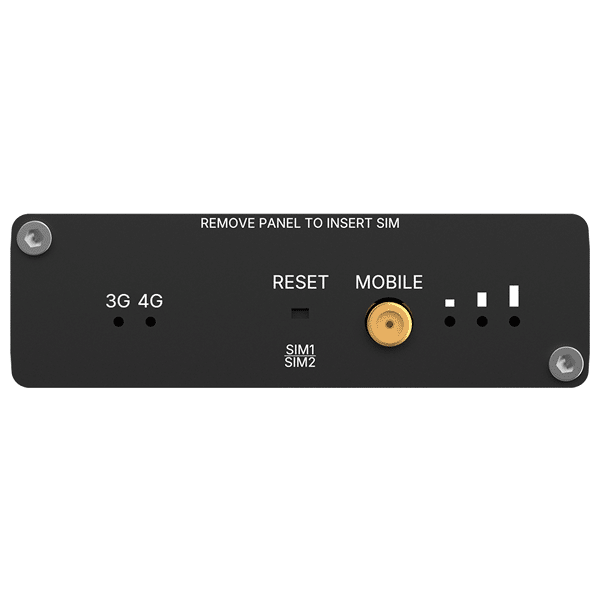
For public LTE connectivity, the TRB236 takes a standard Mini SIM (2FF) in either of its two SIM slots. For private LTE 450 networks, the SIM will be provisioned by the private network operator. For hybrid deployments or fallback to public networks, a multi-network IoT SIM card with coverage on the required LTE bands is the recommended approach. Contact our team to discuss the right SIM for your deployment.
Related Products and Further Reading
The TRB236 is designed forVersion LTE 450 private network deployments – a specialist application well covered in our What is LTE 450? explainer. For sites where standard 4G connectivity is sufficient, the Teltonika IoT gateway range includes options such as the TRB246 (LTE Cat 4 with RS232, RS485, and I/O). For deployments requiring secure remote access over cellular, see our guide to VPN on cellular routers. For IoT SIM cards compatible with this gateway, visit our SIM connectivity page.
| Version | CAT1, CAT4 |
|---|
| Cellular Connectivity | |
| Mobile module | LTE Cat 1 / 3G (Cat 1 variant) or LTE Cat 4 / 3G (Cat 4 variant) |
| 450 MHz LTE bands | FDD Band 31 (452.5-457.5 / 462.5-467.5 MHz), Band 72 (451-456 / 461-466 MHz), Band 87 (410-415 / 420-425 MHz)* |
| Standard LTE FDD bands | Band 1 (2100 MHz), Band 3 (1800 MHz), Band 7 (2600 MHz), Band 8 (900 MHz), Band 20 (800 MHz), Band 28 (700 MHz), Band 51 (850 MHz)* |
| LTE TDD bands | Band 38 (2600 MHz), Band 40 (2300 MHz), Band 41 (2500 MHz)* |
| 3G / WCDMA bands | Band 1 (2100 MHz), Band 8 (900 MHz), Band 51 (850 MHz)* |
| Max TX power | 25 dBm (WCDMA); 25.5 dBm (LTE 450 MHz bands) |
| SIM | 2x Mini SIM (2FF) slots, 1.8 V / 3 V, dual stacked SIM tray + eSIM |
| SIM failover | Automatic switch on: weak signal, data limit, SMS limit, roaming, no network, network denied |
| GNSS | 1x SMA connector for GNSS antenna |
| Ethernet | |
| Ethernet port | See datasheet |
| Processor and Memory | |
| CPU | See datasheet |
| RAM | See datasheet |
| Flash storage | See datasheet |
| Software and Operating System | |
| Operating system | RutOS (OpenWrt-based Linux) |
| Remote management | Teltonika RMS, WebUI (HTTP/HTTPS), SSH, CLI |
| Routing protocols | Static, BGP, OSPF v2, RIP v1/v2, EIGRP, NHRP, policy-based routing |
| Network protocols | TCP, UDP, IPv4, IPv6, ICMP, NTP, DNS, HTTP, HTTPS, SFTP, FTP, SMTP, SSL/TLS, ARP, VRRP, PPP, PPPoE, UPNP, SSH, DHCP, MQTT, SNMP |
| VPN | IPsec (IKEv1/v2), OpenVPN, GRE, L2TP, PPTP, DMVPN, ZeroTier, WireGuard, Stunnel, Tinc |
| Industrial protocols | Modbus TCP, Modbus RTU, MQTT Broker/Publisher, DNP3, DLMS/COSEM, OPC UA - see wiki for current firmware feature list |
| Firewall | Port forwarding, traffic rules, custom rules, DMZ, NAT, DDoS prevention, port scan prevention |
| IoT platforms | ThingWorx, Cumulocity, Azure IoT Hub, AWS, and others |
| Firmware updates | FOTA (firmware over the air), WebUI, RMS |
| Interfaces | |
| Serial interfaces | RS232, RS485 (via 16-pin industrial terminal block) |
| Digital I/O | Configurable digital inputs and outputs (see datasheet for exact count and specifications) |
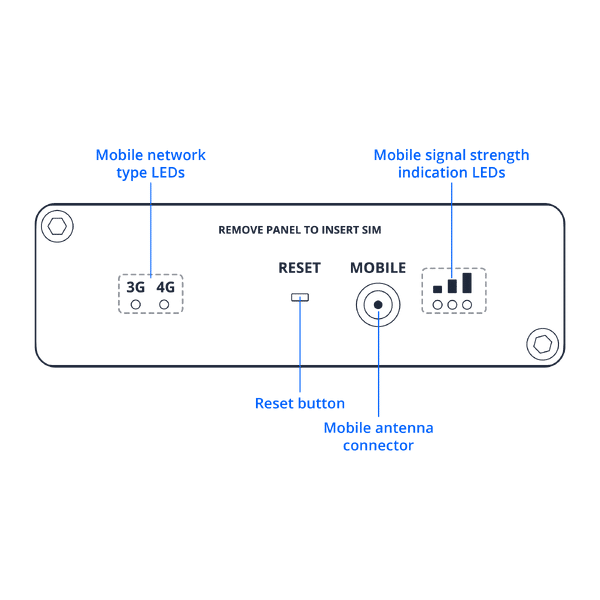
| Antenna connectors | 1x SMA (LTE), 1x SMA (GNSS) |
| Connector type | 16-pin industrial terminal block (power + serial + I/O) |
| Power | |
| Input voltage | 9-57 VDC |
| Power connector | 16-pin industrial terminal block (pins 1 and 2) |
| Power consumption | See TRB236 Power Consumption |
| Physical | |
| Dimensions (housing) | 83 x 25 x 82.6 mm (W x H x D) |
| Dimensions (packaging) | 107 x 30.6 x 100 mm |
| Weight (device) | 175 g |
| Housing material | See datasheet |
| Mounting | DIN rail mountable |
| Environmental | |
| Operating temperature | -40°C to +40°C |
| Storage temperature | See datasheet |
| Humidity | 10% to 90% (non-condensing) |
| IP rating | See datasheet |
| Certifications and Compliance | |
| CE | Directive 2014/53/EU (Radio Equipment Directive) |
| RoHS | 2011/65/EU |
| UKCA | Radio Equipment Regulations 2017 |
| In the Box | |
| Included accessories | 16-pin industrial terminal strip - see Teltonika ordering information for full accessories |
| Warranty and Support | |
| Warranty | See datasheet - confirm with Teltonika account manager |
| Support | UK-based technical support from routerstore.com. Teltonika Diamond Partner. |
* Band 51 not supported in European region. Band 41 not supported in European or Oceanian regions. Band 87 frequency shown is for the 410 MHz range. Verify band support for your region and private network operator before ordering.
Based on 0 reviews
Be the first to review “Teltonika TRB236 Industrial LTE CAT4 / LTE 450 IoT Gateway”
Related products
- Network Switches, Teltonika, Teltonika Switches
Teltonika TSW304 Unmanaged Switch With Built-in Din Rail Mount
 Network Switches, Teltonika, Teltonika Switches
Teltonika TSW304 Unmanaged Switch With Built-in Din Rail Mount
Teltonika TSW304 is a tiny, 4 port Gigabit Ethernet Switch from Teltonika that includes a built-in DIN Rail mount and all the ports, power and grounding on the same face to provide easy, convenient installation.
SKU: TELTONIKA-TSW304-N - Accessories, Teltonika, Teltonika Accessories
Teltonika PR5MEC00 DIN Rail Kit for RUT9xx & RUT2xx Series Routers
Accessories, Teltonika, Teltonika AccessoriesTeltonika PR5MEC00 DIN Rail Kit for RUT9xx & RUT2xx Series Routers
The Teltonika PR5MEC00 is the official metal DIN rail mounting kit for the RUT2xx and RUT9xx series routers.
Made from low carbon steel with a standard 35mm DIN rail mount, it lets you install your Teltonika router securely inside control cabinets, distribution boards, and industrial enclosures. Supplied with all fixings.
Compatible with RUT200, RUT202, RUT204, RUT206, RUT241, RUT281, RUT901, RUT906, RUT951, RUT956, RUT981, RUT986, RUTX50, RUTM30, RUTC40, and more.
SKU: TELTONIKA-METAL-DIN-PR5MEC00-N


There are no reviews yet.