
No products in the basket.


4G Routers, Edge Computing, Teltonika, Teltonika 4G Routers, Teltonika eSIM Routers
Teltonika RUTC16 Global 4G CAT6 Edge Router
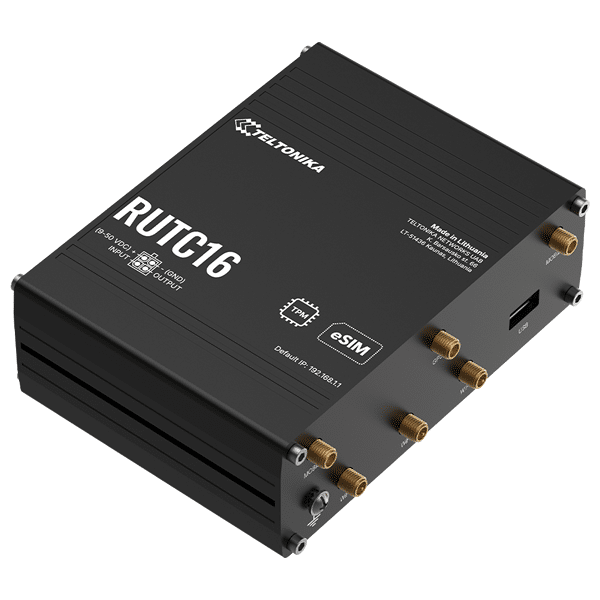
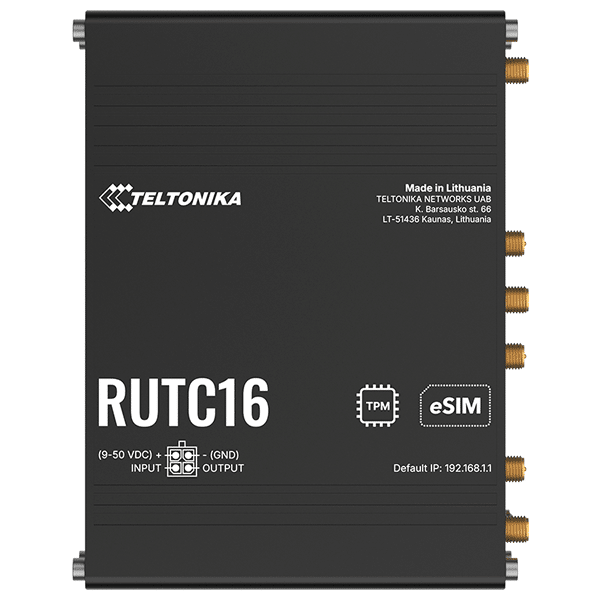
The Teltonika RUTC16 is a global 4G LTE Cat 6 edge router built for industrial and IoT deployments that need local compute at the network edge. It combines a worldwide Telit Cat 6 modem, dual SIM plus eSIM, Wi-Fi 6 and Docker container support with 1 GB of RAM and 8 GB of eMMC storage in a rugged aluminium enclosure.
Key features:
• Global 4G LTE Cat 6 via Telit modem: 300 Mbps down, 50 Mbps up
• Dual SIM plus consumer eSIM (up to 7 profiles) with configurable auto-failover
• Docker container support for edge applications on RutOS
• Dual-band Wi-Fi 6 (802.11ax) with MU-MIMO, up to 512 clients
• Dual-core 1.3 GHz ARM Cortex-A53 CPU, 1 GB DDR4 RAM, 8 GB eMMC flash
• 5x Gigabit Ethernet (1 WAN configurable as LAN, 4 LAN)
• Built-in GNSS: GPS, GLONASS, BeiDou, Galileo, QZSS
• USB 2.0 host port plus digital input and digital output
• 9-50 V DC input with passive PoE (Mode B), DIN rail mount, -40 to +75 degrees C
• RutOS with OpenVPN, WireGuard, IPsec, Modbus TCP, DNP3, MQTT and RMS support

Teltonika RUTC16
The Teltonika RUTC16 is a global 4G LTE Cat 6 edge router for industrial and IoT sites that need local processing alongside reliable cellular connectivity. A worldwide Telit Cat 6 modem delivers up to 300 Mbps download and 50 Mbps upload across a broad global band set, while dual SIM and eSIM handle carrier redundancy. What sets the RUTC16 apart in the RUTC range is its edge compute stack: a dual-core 1.3 GHz CPU, 1 GB of RAM and 8 GB of eMMC storage running Docker containers directly on RutOS.
Key features
- Global Cat 6 modem: Telit LTE Cat 6 with carrier aggregation, up to 300 Mbps download and 50 Mbps upload, covering a worldwide 4G band set.
- Dual SIM plus eSIM: two Mini SIM (2FF) slots and a consumer eSIM holding up to 7 profiles, with configurable auto-switching on weak signal, data limit, roaming or connection loss.
- Docker at the edge: run containerised applications and microservices on the router, isolated from the RutOS system.
- Wi-Fi 6: dual-band 802.11ax with MU-MIMO, up to 2402 Mbps on 5 GHz and 576 Mbps on 2.4 GHz, and up to 512 clients.
- Edge compute hardware: dual-core 1.3 GHz ARM Cortex-A53, 1 GB DDR4 RAM, 8 GB eMMC and 16 MB NOR flash.
- Five Gigabit ports: four LAN and one WAN at 10/100/1000 Mbps, with the WAN port reconfigurable as a fifth LAN.
- Built-in GNSS: GPS, GLONASS, BeiDou, Galileo and QZSS, with geofencing and NMEA 0183 output.
- USB and digital I/O: one USB 2.0 host port, plus one digital input and one digital output on the power connector.
- Industrial power and build: 9-50 V DC input with passive PoE, anodised aluminium housing, DIN rail mounting and -40 to +75 degrees C operation.
- RutOS software: OpenVPN, WireGuard, IPsec, Modbus TCP, DNP3, OPC UA, MQTT and Teltonika RMS support.
What is the RUTC16 used for?
Edge data processing in industrial automation
Run Docker containers on the RUTC16 to filter, buffer and pre-process PLC and sensor data before it leaves the site. RutOS polls equipment over Modbus TCP or OPC UA, and a container normalises that data or runs a local rules engine, which cuts backhaul volume and latency. This suits automation cells and remote plant where a separate edge gateway would be overkill.
Energy and utility telemetry
The RUTC16 speaks DNP3, DLMS/COSEM and Modbus, so it fits battery energy storage systems (BESS), remote substations and smart metering concentrators. Dual SIM failover keeps SCADA links up when a single carrier drops, and the -40 to +75 degrees C rating handles unheated cabinets and roadside kiosks.
Retail and branch connectivity
Wi-Fi 6 with MU-MIMO and up to 512 clients covers busy shop floors and pop-up sites, while four Gigabit LAN ports feed tills, cameras and payment terminals. Once configured, the router fails over from wired WAN to cellular automatically, so a branch stays online through a fixed-line outage.
Connected and mobile asset monitoring
Built-in GNSS reports position over NMEA and RMS, and geofencing can trigger an SMS or a digital output when an asset leaves a defined zone. Combined with the digital input, the RUTC16 monitors plant and vehicles that move between sites or need location-aware alerts.
Smart city and CCTV backhaul
Gigabit Ethernet and a Cat 6 uplink give ANPR cameras, traffic sensors and public Wi-Fi nodes enough headroom for video and telemetry. GNSS timestamps events, and RMS manages firmware and configuration across a dispersed estate from one dashboard.
Pro tip
The RUTC16 accepts passive PoE on LAN1 across its full 9 to 50 V DC range, so a single cable can carry power and data to a router mounted inside a cabinet or on a mast. This is passive PoE using Mode B spare pairs, not the 802.3af, 802.3at or 802.3bt standards. Do not connect a standard 48 V PoE switch or injector to LAN1. Use a matched passive injector set within the input range, for example 12 V or 24 V, sized for the 22.5 W maximum draw plus cable loss.
Building a resilient cellular connection
For sites that cannot afford downtime, load two SIMs from different mobile networks and configure automatic failover in the RutOS WebUI, so the RUTC16 switches carrier when a network drops or hits a data limit. Add a DC UPS on the 9 to 50 V DC input to ride through mains interruptions, and keep the wired WAN or Wi-Fi WAN as an extra backup path. Monitor the whole estate through Teltonika RMS, which reports signal strength, failover events and firmware status across every deployed router. For inbound VPN access to a remote RUTC16, pair it with a fixed IP SIM to avoid carrier-grade NAT.
Frequently asked questions
Does the RUTC16 support Docker containers?
Yes. The RUTC16 is part of Teltonika’s RUTC edge series and runs Docker on RutOS, so you can deploy containerised applications and microservices on the router itself. Its 1 GB of RAM and 8 GB of eMMC storage give containers real headroom for local data processing. Our guide to Docker on Teltonika routers covers setup.
What SIM cards does the RUTC16 use, and does it have eSIM?
The RUTC16 takes two Mini SIM (2FF) cards in external front-panel holders, plus a consumer eSIM that can store up to seven profiles. The eSIM does not include a data plan; you provision profiles yourself or bootstrap them through RMS. Switching between the two SIMs and the eSIM is configurable in the RutOS WebUI. For inbound remote access we recommend a fixed IP SIM.
Can I power the RUTC16 over PoE?
Yes, using passive PoE on LAN1 across the 9 to 50 V DC range. This is Mode B passive PoE, not the 802.3af, 802.3at or 802.3bt standards, so do not connect a standard 48 V PoE switch or injector. Use a matched passive injector within the input voltage range.
Does the RUTC16 have GPS?
Yes. The RUTC16 has built-in GNSS for GPS, GLONASS, BeiDou, Galileo and QZSS through a dedicated SMA antenna port. It outputs NMEA 0183 and supports geofencing, so you can track position and trigger events on connected or mobile assets.
How is the RUTC16 different from the RUTC40?
Both are global, Docker-capable edge routers. The RUTC16 uses a Cat 6 modem for up to 300 Mbps download, against the RUTC40‘s Cat 4 at 150 Mbps, and it adds built-in GNSS and a USB host port. Choose the RUTC16 when you need higher cellular throughput or on-board positioning.
Does the RUTC16 support VPN?
Yes. RutOS includes OpenVPN, IPsec, WireGuard, GRE, L2TP, ZeroTier, Tailscale and more, as client or server depending on the protocol. See our guide to VPN on cellular routers.
Related products and further reading
For lower-throughput sites, the Cat 4 Teltonika RUTC40 shares the same Docker edge platform, while the RUTC50 steps up to 5G. Browse the full range of Teltonika 4G routers, pair the RUTC16 with a fixed IP SIM for remote access, and read what Teltonika RMS is before you deploy at scale.
| Cellular connectivity | |
|---|---|
| Cellular standard | 4G LTE Cat 6 (Telit modem), with carrier aggregation |
| Max download | 300 Mbps |
| Max upload | 50 Mbps |
| 3G fallback | Up to 42 Mbps down / 5.76 Mbps up |
| 4G LTE bands (Global) | B1, B2, B3, B4, B5, B7, B8, B12, B13, B14, B17, B18, B19, B20, B25, B26, B28, B29, B30, B38, B39, B40, B41, B42, B43, B48, B66, B71 |
| 3G bands | B1, B2, B4, B5, B6, B8, B9, B19 |
| 3GPP release | Release 12 |
| SIM | 2 x Mini SIM (2FF), external holders, 1.8 V / 3 V, plus consumer eSIM (up to 7 profiles, no data plan) |
| SIM switching | Configurable auto-switch: weak signal, data limit, SMS limit, roaming, no network, connection fail, SIM idle protection |
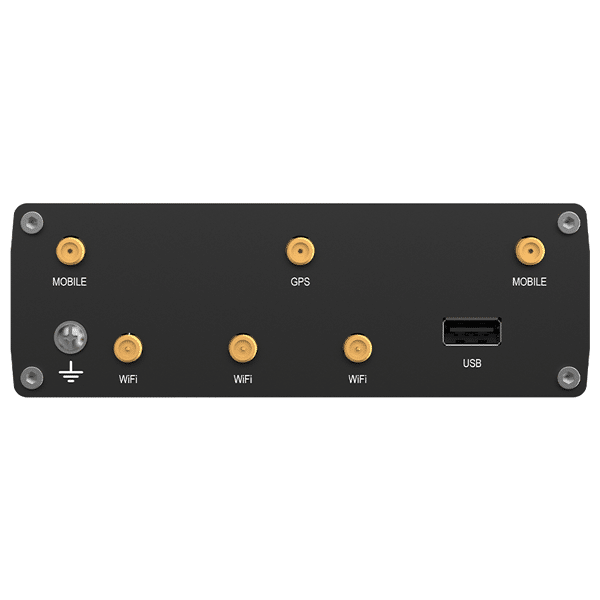
| Mobile antenna ports | 2 x SMA (2x2 MIMO) |
| Wi-Fi | |
| Standard | 802.11b/g/n/ac/ax (Wi-Fi 6), dual band, MU-MIMO |
| Max throughput | 2402 Mbps on 5 GHz, 576 Mbps on 2.4 GHz |
| Modes | Access Point (AP), Station (STA) |
| Security | WPA3-SAE, WPA3-EAP, WPA2-PSK, WPA2-Enterprise, OWE, 802.11w PMF |
| Max clients | Up to 512 |
| Wi-Fi antenna ports | 3 x RP-SMA |
| Ethernet | |
| Ports | 5 x RJ45, 10/100/1000 Mbps |
| WAN | 1 x Gigabit (configurable as LAN) |
| LAN | 4 x Gigabit |
| Processor and memory | |
| CPU | Mediatek dual-core, 1.3 GHz, ARM Cortex-A53 |
| RAM | 1 GB DDR4 |
| Flash | 8 GB eMMC plus 16 MB serial NOR |
| Software and operating system | |
| Operating system | RutOS (OpenWrt based Linux) |
| Containers | Docker |
| VPN | OpenVPN, IPsec, WireGuard, GRE, PPTP, L2TP, ZeroTier, Tailscale, Netbird, OpenConnect, Stunnel, DMVPN, SSTP, Tinc, EoIP |
| Industrial protocols | Modbus TCP, OPC UA, DNP3, DLMS/COSEM, BACnet, MQTT, Data to Server |
| Management | WebUI, CLI, SSH, SNMP v1/v2/v3, TR-069, JSON-RPC, FOTA, Teltonika RMS |
| Cloud platforms | Azure IoT Hub, AWS IoT Core, ThingWorx, Cumulocity (Cloud of Things) |
| Interfaces | |
| USB | 1 x USB 2.0 host (Type A) |
| Digital input | 1 x (0-6 V logic low, 8-50 V logic high), on power connector |
| Digital output | 1 x open collector, max 50 V / 300 mA, on power connector |
| GNSS | GPS, GLONASS, BeiDou, Galileo, QZSS; NMEA 0183; geofencing |
| GNSS antenna port | 1 x SMA |
| Status LEDs | WAN type, mobile connection type, mobile signal strength, LAN status, power, Wi-Fi band |
| Power | |
| Connector | 4-pin industrial DC socket |
| Input voltage | 9-50 V DC, reverse polarity protection, surge protection >51 V DC 10us max |
| Passive PoE | LAN1, Mode B, 9-50 V DC. Not compatible with IEEE 802.3af, 802.3at or 802.3bt |
| Power consumption | Idle < 5.5 W, max < 22.5 W |
| Physical | |
| Dimensions (W x H x D) | 132 x 44.2 x 104 mm |
| Weight | 490 g |
| Housing | Anodised aluminium housing and panels |
| Mounting | DIN rail, wall mount, flat surface (all require an additional kit, sold separately) |
| Environmental | |
| Operating temperature | -40 to +75 degrees C |
| Operating humidity | 10% to 90% non-condensing |
| Ingress protection | IP30 |
| Certifications | |
| Compliance | Check current compliance on Teltonika WiKi |
| In the box (order code RUTC16000200, UK PSU) | |
| Package contents | RUTC16 router, 18 W UK PSU, 2 x mobile SMA antennas, 3 x Wi-Fi RP-SMA antennas, 1 x GNSS adhesive antenna (SMA, 3 m cable), Ethernet cable (1.5 m), SIM adapter kit, quick start guide |
| Warranty and support | |
| Warranty | 24 months return to manufacturer |
| Support | UK-based technical support |
Based on 0 reviews
Be the first to review “Teltonika RUTC16 Global 4G CAT6 Edge Router”
Related products
- 4G Router For Office, 4G Routers, DrayTek, Office 4G Router
Draytek Vigor 2620Ln VDSL LTE 4G Router Dual SIM
 4G Router For Office, 4G Routers, DrayTek, Office 4G Router
Draytek Vigor 2620Ln VDSL LTE 4G Router Dual SIM
The DrayTek Vigor 2620Ln is a low cost router/firewall with an integrated LTE/4G modem. Supporting speeds of up to 150Mbps downstream and 50Mbps Upstream, the DrayTek Vigor 2620Ln provides high speed mobile broadband with versatile connectivity.
With Dual-SIM cellular (3G/4G/LTE) modem, VDSL2 / ADSL2+ modem (Phone Line Broadband) and Ethernet (RJ45) the Vigor 2620Ln offers users a highly adaptable router with non-stop connectivity. Ideal for mobile internet connectivity with the built-in 4G, the Vigor 2620Ln offers users the benefits of DrayTek firewall, with optional web content filtering, shared by multiple users on wireless or wired connections to the unit.
No Longer Stocked
SKU: DRAYTEK-V2620LN-N - 4G CCTV, 4G Routers, Teltonika, Teltonika 4G Routers
Teltonika RUT956 Industrial 4G Router with RS232, RS485 and GNSS
4G CCTV, 4G Routers, Teltonika, Teltonika 4G RoutersTeltonika RUT956 Industrial 4G Router with RS232, RS485 and GNSS
The Teltonika RUT956 is a 4G LTE Cat 4 industrial router with dual SIM, RS232, RS485, GNSS, and a full suite of digital and analogue I/O. It combines cellular failover, serial device integration, and precise location tracking in a compact aluminium enclosure rated for -40 to +75 °C.
Key Features:
• 4G LTE Cat 4 – 150 Mbps down / 50 Mbps up, 3G and 2G fallback
• Dual Mini SIM (2FF) + integrated eSIM with configurable auto-failover
• RS232 (DB9) and RS485 serial interfaces for Modbus RTU, DNP3, DLMS/COSEM, and NTRIP
• GNSS: GPS, GLONASS, BeiDou, Galileo and QZSS with geofencing support
• 4 x digital/analogue I/O: dry input, isolated input, analogue 4-20 mA input, relay output
• 4 x RJ45 Ethernet (1 x WAN, 3 x LAN), 10/100 Mbps
• Wi-Fi 4 (802.11b/g/n) access point and station modes, up to 100 clients
• RutOS with OpenVPN, WireGuard, IPsec, Modbus TCP/RTU, MQTT, OPC UA, BACnet
• Teltonika RMS compatible – remote monitoring, FOTA, configuration management
• DIN rail, wall mount or flat surface mounting (kit required, sold separately)SKU: TELTONIKA-RUT956200100-N - 4G Router For Office, 4G Routers, CAT6 4G Router, Manufacturers, Proroute, Proroute 4G Routers, Proroute Routers
Proroute H820 CAT6 LTE-A 4G Router – Industrial M2M IOT 4G CAT6 Router with RJ45 Ethernet and WiFi
4G Router For Office, 4G Routers, CAT6 4G Router, Manufacturers, Proroute, Proroute 4G Routers, Proroute RoutersProroute H820 CAT6 LTE-A 4G Router – Industrial M2M IOT 4G CAT6 Router with RJ45 Ethernet and WiFi
The Proroute H820 CAT6 4G LTE Router is a reliable, industrial grade 4G LTE-A router with embedded high speed LTE CAT6 4G module for high speed mobile broadband data transfer speeds.
SKU: PRORT-H820-4G-CAT6-N


There are no reviews yet.